Renault Has Put A Folding Canvas Roof On The Electric Renault 4


The original Renault 4 had a fabric roof you could peel back by hand. It was one of the car’s defining features: simple, charming and completely in keeping with a car that was designed for people who wanted to get on with life rather than fuss over machinery. The new Renault 4 E-Tech electric Plein Sud brings that idea back, reimagined as a fully electric folding canvas roof that opens at the touch of a button or by asking the car’s voice assistant to do it for you.
It is the only fully electric car in the small SUV segment that offers an opening roof. No other B-SUV EV has one. And with prices starting from £27,445 after the £3,750 Electric Car Grant, the Plein Sud costs just £1,500 more than the equivalent fixed-roof Renault 4.
R Pass customers can place orders from today, May 8. The wider public can order from May 14. First deliveries are expected from the third quarter of 2026.
What Plein Sud Means
Plein Sud is French for “full south.” It is the direction you drive when you want sunshine, open roads and warm air above your head. The name is a statement of intent, and the car delivers on it.
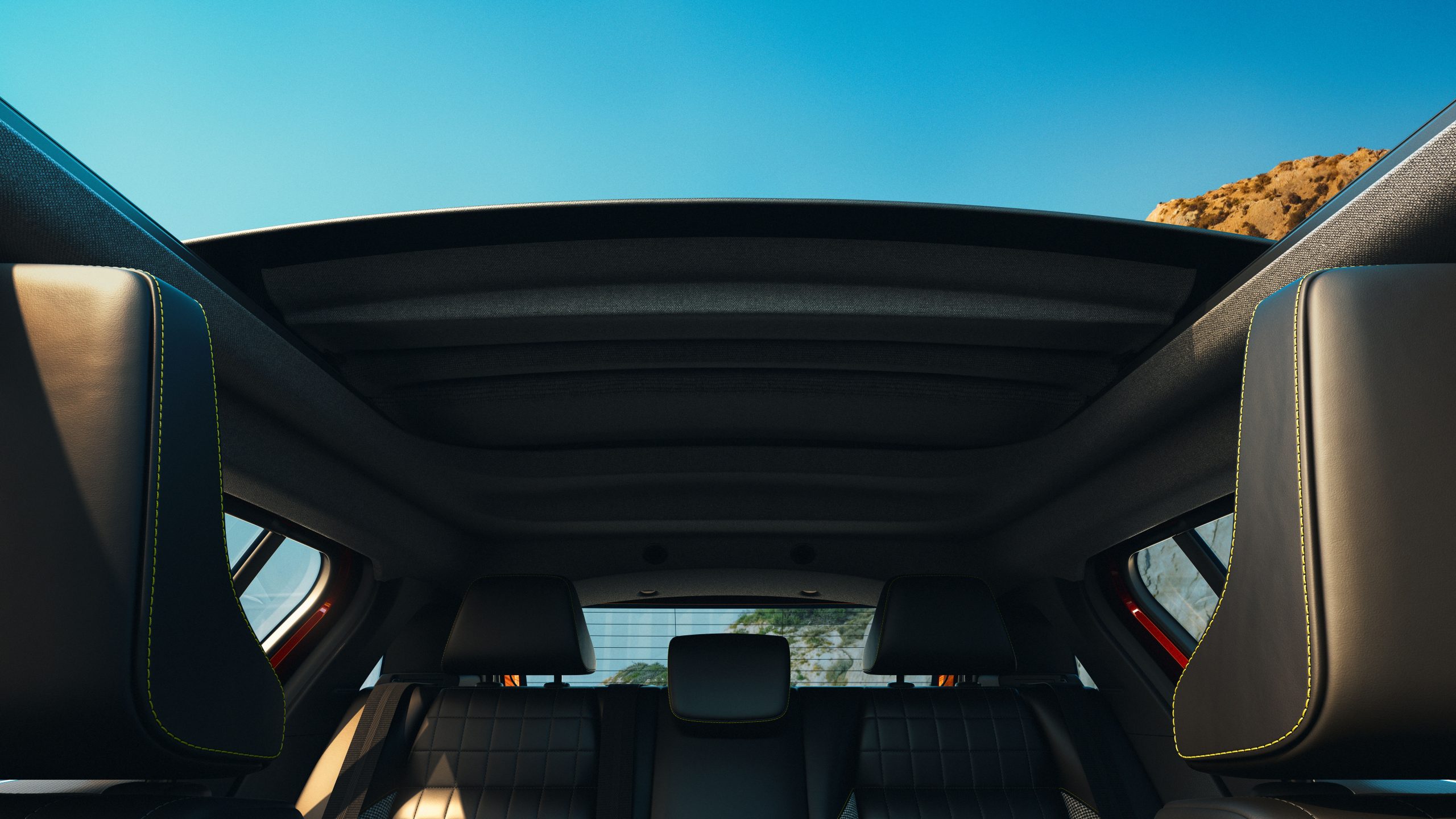
The canvas roof provides an 80 by 92 centimetre opening that stretches across both the front and rear of the cabin, giving all four occupants a panoramic view of the sky. It is operated electrically via a one-touch button above the windscreen or by voice command through Reno, Renault’s digital assistant. The roof gathers into three clean folds when open and can be stopped at several intermediate positions depending on how much sky you want.
When closed, the multi-layer construction provides acoustic insulation and weather sealing that Renault says matches the fixed-roof car, with minimal impact on headroom. In practice, the difference should be invisible to anyone sitting inside.
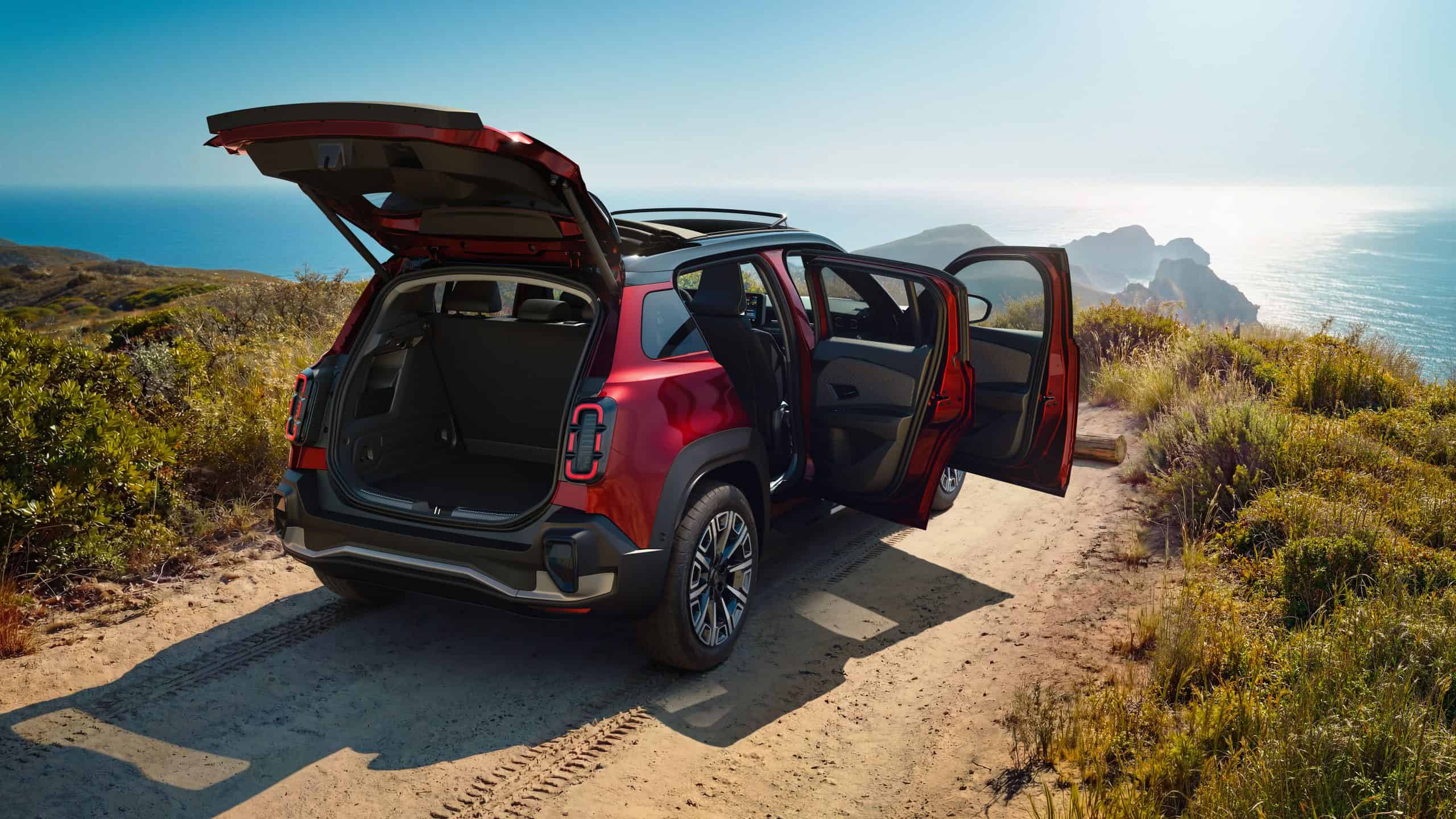
The only features lost compared to the standard Renault 4 are the roof bars and the shark-fin antenna, both removed to allow the full canvas opening. Everything else, including the 1,350-litre maximum boot space with the rear seats folded, is unchanged.
What It Is Based On
The Renault 4 E-Tech electric shares its platform and powertrain with the Renault 5 E-Tech electric, the car that became Britain’s best-selling EV in April. Where the 5 is a city-focused supermini, the 4 is around eight centimetres longer with a taller, more upright body, more ground clearance and a larger boot. It is the practical one, designed for families, dog owners and anyone who needs a bit more space without wanting a bigger car.
The standard Renault 4 won the Parkers Car of the Year award for 2026. Reviews have been consistently positive, praising the ride quality, the interior design and the way the car feels on the road. The Plein Sud adds the canvas roof to a car that was already one of the strongest small EVs on sale.
Range And Charging
Every version of the Plein Sud uses a 52 kWh lithium-ion battery and a 150 hp electric motor driving the front wheels. The WLTP range is 242 miles, which is five miles less than the fixed-roof Renault 4’s maximum of 247 miles. The difference is down to the slight aerodynamic penalty of the canvas roof mechanism and is unlikely to be noticeable in daily driving.
DC rapid charging at up to 100 kW takes the battery from 15% to 80% in around 30 minutes. On a 7.4 kW home wallbox, a full charge from 15% to 100% takes around seven hours and 47 minutes, which is comfortably within an overnight window. An 11 kW three-phase charger reduces that to just under five hours.
Performance is adequate rather than exciting: 0 to 62 mph in 8.2 seconds and a top speed of 93 mph. The Renault 4 is not trying to be fast. It is trying to be comfortable, practical and enjoyable, and the driving experience reflects that. One-pedal driving is standard on both Plein Sud trims, making the car particularly easy to live with in town.
What You Get For The Money
The Plein Sud is available in two trims: techno+ at £27,445 after the grant and iconic+ at £29,445.
The techno+ comes with 18-inch alloy wheels, a 10-inch central touchscreen with Google built-in (including Google Maps with charging stop optimisation), a 10.3-inch digital instrument display, wireless Apple CarPlay and Android Auto, dual-zone climate control, adaptive cruise control with stop and go, a reversing camera, front and rear parking sensors, keyless entry, a wireless phone charger, 48-colour ambient lighting, hands-free parking and V2L bidirectional charging. That is a substantial list for a car at this price.
The iconic+ adds heated front seats, a heated steering wheel, a Harman Kardon audio system, a power-operated tailgate, active driver assist with lane centring, blind spot warning, rear cross traffic alert, and upgraded seat materials with a houndstooth textile trim that nods to the original Renault 4’s cabin character.
Both trims also gain the latest GSR2.3 safety standard, bringing up to 28 advanced driver assistance systems. New additions include a driver monitoring camera on the windscreen pillar that detects fatigue, an emergency stop assist function that brings the car to a halt if the driver becomes unresponsive, and a predictive eco-driving assistant that uses onboard mapping to warn of upcoming bends and roundabouts so you can lift off the accelerator and save energy.
The Company Car Case
At 4% BiK for the 2026/27 tax year, the Plein Sud is one of the cheapest company cars available. On the techno+ at a list price of £31,195 (before the grant, which does not apply to BiK calculations), the annual BiK value is £1,247. A higher-rate taxpayer would pay approximately £499 per year in company car tax. A basic-rate taxpayer would pay around £249.
For anyone running a car through salary sacrifice or a company fleet, those numbers are difficult to beat. The Renault 5 offers similar BiK advantages at a lower list price, but the 4 adds the extra space, the higher driving position and, in Plein Sud form, a canvas roof that no salary sacrifice scheme can put a value on.
The Personalisation Options
Renault has expanded the personalisation choices across the entire Renault 4 range alongside the Plein Sud launch. Six body colours are available: Glacier White, Urban Grey, Diamond Black, Carmin Red, Cumulus Blue and Hauts-de-France Green, the last of which is a tribute to the Ile-de-France Blue offered on the original 1960s car. A contrasting Diamond Black bonnet is optional, alongside wing-mounted graphics and a central stripe.
The intention is clearly to make the Renault 4 a car that owners want to make their own, in the same way that the MINI and the Fiat 500 have built loyal followings around individual expression. The canvas roof is the biggest expression of that philosophy: a feature that exists purely because it makes the car more enjoyable to own.
Why It Works
The Renault 4 Plein Sud does not do anything that the fixed-roof version cannot do. It has the same range, the same boot space, the same practicality and the same equipment. What it adds is the experience of driving with the sky above your head, the sound of the world coming in, and the feeling that a car can be more than a box that moves you from one place to another.
At £1,500 over the fixed-roof equivalent, it is a modest premium for something that no other electric small SUV offers. At £27,445 after the grant, it is one of the more affordable ways into a new EV with genuine character. And at 4% BiK, it might be the most enjoyable company car in the country.
Orders open to the public on May 14.

Leave a Comment
More in News
DfT Proposes Penalty Points and Car Seizure for Driving Without a Valid MOT

Do Cam Belts Really Need Changing Every 5 Years? The Number Nobody Published

How to Spot a Clocked Car (and What to Do If Caught Out)

What Dashcam Footage Actually Counts as Evidence (and the Rules on Sharing It)

Why Connecticut Is Adding Speed Cameras to School Zones Across the State
Trending on Motoring Chronicle

Every UK Driver With the Wrong Number Plate Risks a £1,000 DVLA Fine

Hybrid high performer: the new Audi RS 5

Petrol Hits 158.7p a Litre as Middle East Conflict Drives a Two Year Price High

Why a $1.3 Million Car Theft Ring Used Fake Temporary Plates on Stolen Luxury Cars