


- Ferrari unveiled the road-legal 296 Challenge Stradale on 21 November 2026 at the Finali Mondiali in Spain, powered by a 2,992cc twin-turbo V6 that makes 670hp with no hybrid assistance.
- Ferrari quotes a dry mass of 1,330kg, which is 140kg less than the 296 GTB, and 617kg of downforce at 250km/h (about 155mph), which is 72 percent more than the 296 GTB.
- A track-only exhaust, a cockpit with the chassis left showing and a seven-year servicing plan are on the options list, but no price, UK delivery date or fuel economy figure has been announced.
The Road Ferrari That Leaves Part of the Chassis Showing
Ferrari describes the 296 Challenge Stradale as the car in its current range closest to a race car of any model it sells, and the numbers back the claim. Ferrari quotes 0 to 100km/h (about 62mph) in 2.8 seconds, 0 to 200km/h (about 124mph) in 7.9 seconds and a top speed above 300km/h (about 186mph). Stopping from 200km/h takes 101 metres, and a lap of Ferrari’s Fiorano test track takes 1 minute 18.5 seconds.
The car was shown on 21 November 2026 at the Circuit de Barcelona-Catalunya in Montmelo, Spain, at the Ferrari Finali Mondiali, the season-closing event that brings together the Ferrari Challenge series, Ferrari’s competition-car programmes and its non-competitive activities. The Finali Mondiali closed the next day as its 34th edition. Ferrari shared the stage with a second car, the 296 Challenge EVO, which is a pure race car and covered further down.
Every figure above is Ferrari’s own, and the maker has not yet published a price, a UK delivery date or a production figure. Its WLTP fuel consumption and CO2 figures are listed as pending homologation, so the official economy figures are not yet confirmed.

A V6 With No Hybrid System
The engine is a 2,992cc, 120 degree twin-turbo V6 in the combustion-only layout taken from the Ferrari 296 Speciale, which pairs the same V6 with an electric motor. It produces 670hp at 8,000rpm and 740Nm of torque at 6,250rpm, and it revs to 8,500rpm. An eight-speed dual-clutch gearbox sends the power to the rear wheels.
Dropping the hybrid system is one reason the car is lighter. Ferrari says the 1,330kg dry mass also comes from a dedicated driveline, light components and the racing-style cockpit, and the maker lists a power to mass ratio of 1.98kg per horsepower. Run the sum yourself, 1,330kg divided by 670hp, and the answer is 1.985. The 140kg saving implies a dry mass of about 1,470kg for the 296 GTB. Ferrari attaches a footnote to the 1,330kg figure: it applies to a car with the optional equipment fitted, so a car without those options can differ.
Taking the hybrid out meant engineers had to rebuild parts the electric motor used to handle. The car gets a mechanical compressor for the air conditioning and a Belt Starter Generator that works as both starter motor and alternator, which Ferrari calls an absolute first for one of its road cars. The braking system carries its own extra cooling to make up for the loss of regenerative braking.
The recalibrated V6 delivers more than 32 percent more torque than the 296 GTB in the same manoeuvre, Ferrari says. Ferrari quotes upshifts of about 170 milliseconds under high load and high revs, and about 250 milliseconds in its sports shift at low and medium revs, a logic taken from the SF90 XX Stradale. A “hot tube” system carries pressure waves from the exhaust into the cabin, so the driver hears the V6 up to its 8,500rpm limit.
An exhaust for track use only is available on request. Ferrari says it is built free of type-approval limits, and official Ferrari dealerships fit and remove it. The standard car has a twin-tailpipe exhaust of larger diameter than before.
617kg of Downforce and What It Does in a Corner
At 250km/h the car produces 617kg of downforce, 72 percent more than the 296 GTB. A fixed rear wing on hollow struts makes 270kg of that total. By subtraction, the other 347kg comes from the rest of the package, which Ferrari lists as the splitter, the flick elements on the bumper, the fully enclosed underbody, the diffuser and the vortex generators. Separate aero dampers make the downforce respond more evenly when the car pitches.
Ferrari gives the handling changes against the 296 GTB as percentages: maximum lateral performance up 7 percent, stability up 34 percent and the roll gradient down 68 percent. The suspension uses springs roughly twice as stiff as earlier Ferrari applications, with a second spring fitted in line with the main one, and semi-active dampers with their own calibration.
The car rolls on semi-slick Pirellis developed for it, in the P Zero R and Trofeo RS ranges, sized 245/35 R20 at the front and 305/35 R20 at the rear. Carbon-ceramic discs measure 398 by 38mm at the front and 380 by 34mm at the rear. ABS Evo stays active whatever the grip and whichever Manettino setting the driver picks, and Ferrari calls the track-tuned predictive slip control a first for one of its road cars.
The road car is still meant to be driven on the road. Ferrari says the front underbody sits at a height suited to everyday driving, with a ramp angle that copes with speed bumps. The car also carries driver aids such as adaptive cruise control, automatic emergency braking that detects vehicles, pedestrians and cyclists, lane keeping assist, blind spot detection, traffic sign assistance and a driver drowsiness monitor. The front luggage compartment holds 67 litres.
Inside: No Armrest, No Pocket, Optional Exposed Chassis
The cockpit follows the 296 GTB layout, then strips it back. The door panel is a single piece of carbon fibre with no armrest and no storage pocket. Ferrari calls it a first on a production car: an optional specification deletes the trim under the seats, the lower part of the carpets and the trim beneath the centre console, so part of the chassis is left exposed.
The central tunnel uses carbon fibre for the fork-shaped front section, which holds the gear selector gate, the cupholder and a wireless charging station. Buyers can order carbon-fibre tubular seats first used on the SF90 XX Stradale, which Ferrari says are 25 percent lighter than standard racing seats. A carbon-fibre bonnet trim saves 0.7kg, and forged wheels cut unsprung mass by about 11.9kg. The carbon-fibre wheels first offered on the 296 GTB are still available. Wheels come in three matte finishes: Grigio Corsa, Nero (diamond-cut) and Bianco Fuji, and a livery with roof graphics and a bonnet badge is available on request.
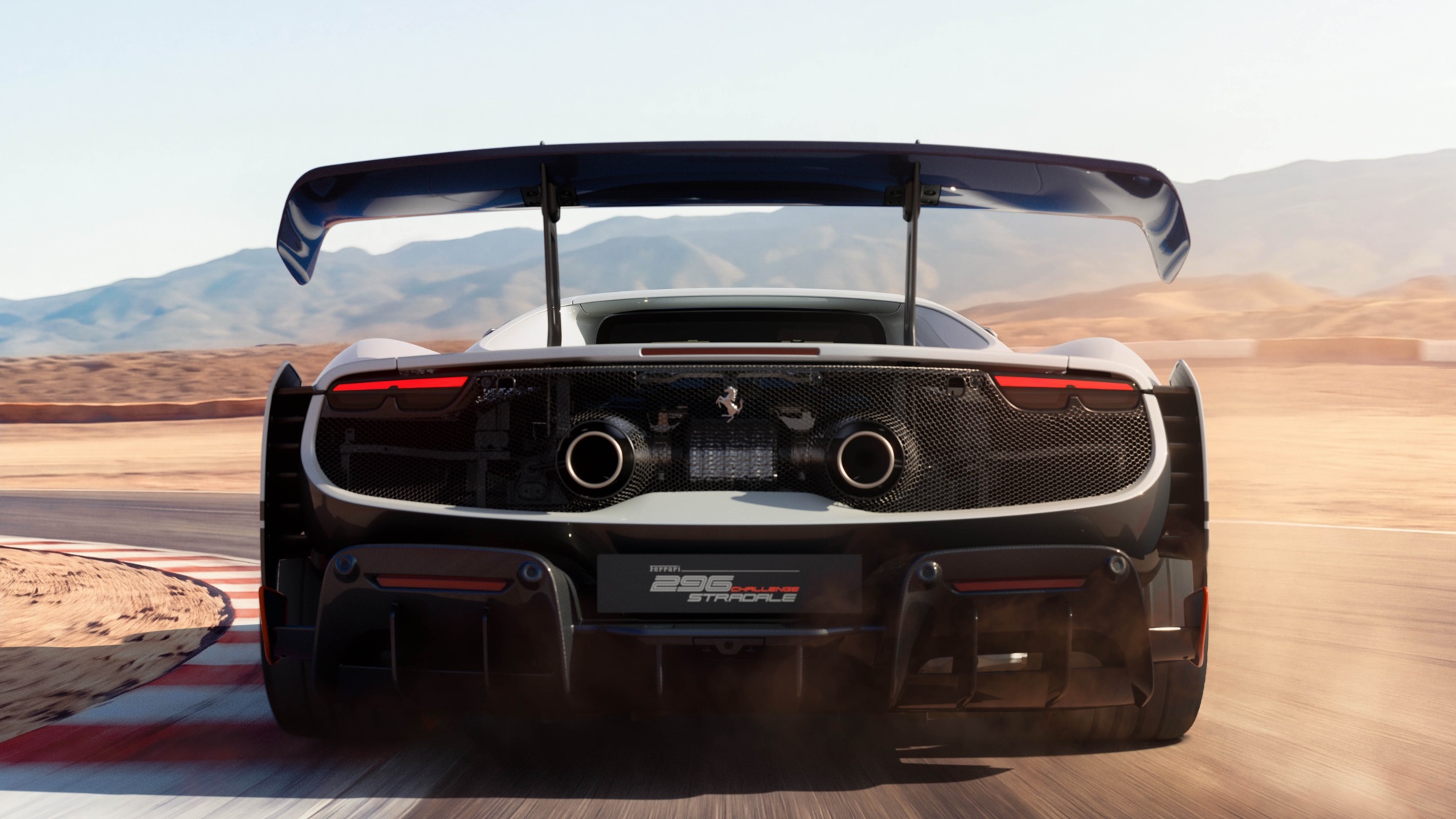
Outside, the Ferrari Design Studio under Flavio Manzoni gave the car a large technical insert on the bonnet, where the radiators breathe out, and a black metal mesh at the rear that leaves the exhaust tailpipes in view. It measures 4,678mm long, 2,039mm wide and 1,301mm high on a 2,600mm wheelbase, with a 64.5 litre fuel tank.
The 296 Challenge EVO Beside It, and What Ownership Includes
The 296 Challenge EVO is the race car unveiled alongside it. Ferrari quotes 700hp at 7,500rpm from the same V6, a seven-speed gearbox, and the same 1,330kg dry mass. It carries 12 percent more downforce than the current 296 Challenge, an extra 100kg at 250km/h, and a Low Drag setting that trims minimum drag by 4 percent. In High Downforce form it laps Mugello 0.8 seconds quicker than the 296 Challenge. It enters the Ferrari Challenge in 2027, the 35th season of the series, which will add 40-minute Endurance races at Mugello, Hockenheim and Valencia which let two drivers share a car and carry a mandatory pit stop.
For the road car, Ferrari offers its Genuine Maintenance programme, a seven-year plan covering scheduled servicing. Servicing falls due every 20,000km, about 12,400 miles, or annually if that comes first, and the plan puts no cap on total mileage. Work uses genuine parts and modern diagnostic equipment, handled by staff schooled at Ferrari’s Maranello training centre.
The 296 Challenge race kit has already reached a road 296 once, in Mat Armstrong’s damaged 296 GTB, where Ferrari refused to clear the software locks on the modified car.
Ferrari’s rivals are changing too, with a Chinese electric supercar aimed at Ferrari and Lamborghini buyers. Ferrari has not announced UK price or delivery details for the Stradale. Until it does, the figures are Ferrari’s own: 670hp, 1,330kg with options, and 617kg of downforce at 250km/h.
Want more car content? Add us as a preferred source on Google to your favourites list for the best automotive news and analysis on the internet.
If you enjoyed this article, be sure to follow us on Microsoft Start.
Reviewed by Preetam Gadekar

Leave a Comment
More in News
What a £160 Parking Fine Trial Could Mean for Every Driver Outside London

What to Do When a Fine Arrives for a Car You Never Drove

What a Windscreen Claim Costs You When Your Policy Quietly Drops the Cover
NSW Red-Light Camera Starts 26 November, Then $562 Fines and 3 Points

Out-of-state man drives to Michigan to buy a used car. Then he makes a strange request: ‘Leave it blank’
Trending on Motoring Chronicle

Ford Recalls 565,691 Broncos Over Wiring That Can Spark Engine Fires
What DVLA Makes Parking Firms Prove Before Handing Over Your Address for £2.50

Why Every New Car Sold in Britain Must Have These 18 Safety Systems From July
Every UK Driver’s Car Insurance Now Depends on an £850 Postcode Gap
