
Is Synthetic Oil Really Worth the Extra Cost Over Conventional?


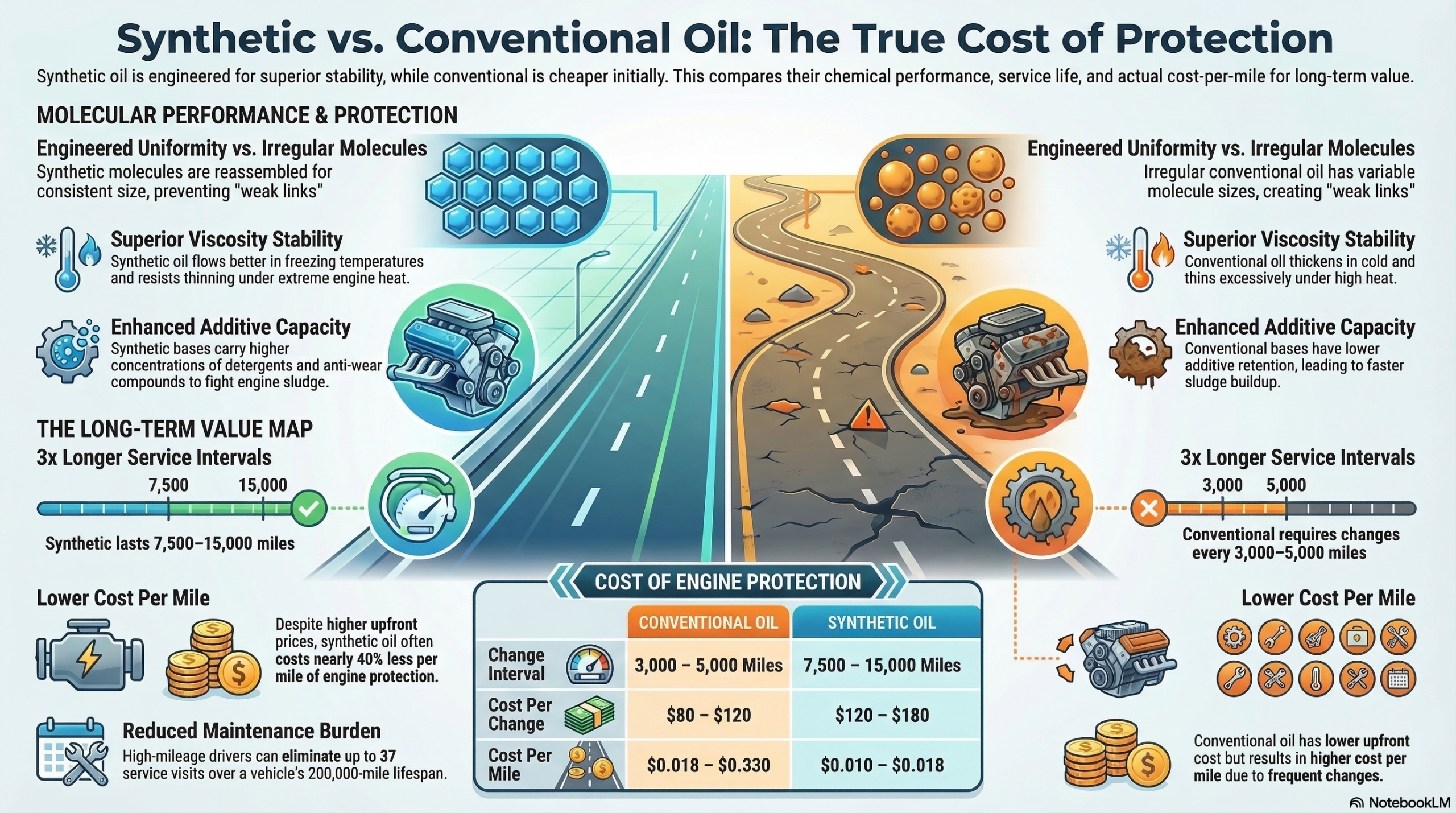
Synthetic oil is worth the extra cost for most drivers. It lasts 7,500 to 15,000 miles between changes compared to 3,000 to 5,000 miles for conventional oil, performs significantly better in cold-weather starts, and provides stronger film protection at high temperatures. When the cost per mile of protection is calculated rather than cost per change, synthetic typically works out cheaper than conventional for vehicles driven more than 8,000 miles per year.
What Makes Synthetic Oil Different From Conventional
How synthetic base stock is manufactured
Conventional motor oil begins as crude petroleum pumped from the ground. Refinery processes separate this crude into different weight grades, but the molecules remain irregular in size and structure. The best conventional oils are heavily refined to remove the worst impurities, but they still contain a variable population of hydrocarbons that behave differently at temperature extremes.
Synthetic oil starts with a chemical building block, typically derived from crude petroleum or natural gas, which is then broken down to individual molecules. These molecules are reassembled in a controlled laboratory process to create uniform compounds with predictable properties. This manufacturing method produces oil with molecules of consistent size and shape, all engineered to resist breakdown under heat and stress. The result is a product where every molecule performs identically, eliminating the weak links in the oil film that conventional oil cannot.
The difference translates to performance at the molecular level. A conventional oil might contain some very long-chain molecules that break apart under high temperature, reducing film strength precisely when protection is most needed. Synthetic oil contains only molecules engineered to stay intact under stress. This uniformity is why synthetic oil performs better in extreme conditions and why it degrades more slowly over time. The manufacturing process costs money, yet the engineered molecular structure justifies the price difference from a purely technical standpoint.
The additive package and what it controls
Neither conventional nor synthetic oil leaves the refinery ready for an engine. Both require chemical additives that make up 10 to 15 percent of the finished product. These additives include detergents to keep combustion deposits suspended and prevent sludge, antioxidants to slow chemical breakdown, anti-wear compounds to protect engine metal, rust inhibitors, and viscosity modifiers that help the oil perform across a wide temperature range.
Synthetic oil tolerates higher additive concentrations in a way that conventional oil cannot. Conventional oil has a limit to how much additive content it can carry before the additives and the oil base interact negatively. This means synthetic oil can deliver more detergent power to fight carbon buildup, more anti-wear protection at the piston ring, and more powerful antioxidant defense against chemical breakdown. The additive advantage compounds over time, as synthetic oil resists the chemical reactions that consume additives in conventional oil.
The detergent additives in synthetic oil are critically important in turbocharged and direct-injection engines, which produce more high-temperature combustion deposits than naturally aspirated engines. A synthetic oil’s superior detergent carrying capacity helps prevent the carbon accumulation that can reduce fuel economy and increase emissions over time. In severe driving conditions, where conventional oil’s additive reserves would be exhausted, synthetic oil maintains its protective properties. For engines operating under high stress, the enhanced additive capacity of synthetic oil is a concrete performance advantage, not marketing.
Viscosity stability across temperature extremes
Motor oil viscosity changes with temperature. Cold oil flows slowly; hot oil flows faster. This is why winter starting can strain an engine with the wrong oil weight. A 10W-40 oil must behave like a 10-weight oil at cold start to flow to the engine in freezing conditions, yet behave like a 40-weight oil at full operating temperature to maintain film thickness at the bearing surfaces.
Conventional oil accomplishes this using viscosity index improvers, which are long polymer molecules that expand when heated and contract when cooled. The problem is that these polymer chains break apart under the shear forces in the engine, especially in tight clearances like valve train wear. As the polymers fragment, the oil becomes thinner and loses its ability to protect at high temperature. This is why conventional oil’s viscosity gradually increases, then suddenly drops, causing the oil to thin dangerously near the end of its service life.
Synthetic oil uses fewer and more stable viscosity modifiers in a way conventional oil does not. The uniform molecular structure of synthetic oil already resists thinning at high temperature and thickening at low temperature more effectively than conventional oil, so less additive intervention is needed. This means synthetic oil maintains its viscosity characteristics far longer, losing viscosity stability much more gradually over the entire drain interval. A synthetic oil at 9,000 miles performs much closer to its performance at 1,000 miles than conventional oil does. This viscosity stability is why synthetic oil can stretch drain intervals to 10,000, 12,000, or even 15,000 miles, something conventional oil cannot reliably do.
The Real Cost Comparison
Cost per change vs. cost per mile of protection
Comparing synthetic and conventional oil by the price per quart or per change is misleading. Synthetic oil costs $8 to $12 per quart while conventional costs $4 to $6, making a synthetic change roughly twice the expense per service visit. Most drivers focus on this upfront cost and conclude that conventional is cheaper. This logic fails to account for what is actually being purchased: miles of engine protection.
Calculate the cost per mile of protection instead. A conventional oil change costs $80 to $120 including labor and filter, and protects the engine for 4,000 to 5,000 miles. That works out to $0.018 to $0.030 per mile of protection. A synthetic oil change costs $120 to $180 for labor, oil, and filter, and protects the engine for 10,000 to 12,000 miles. That works out to $0.010 to $0.018 per mile of protection. The math shows that synthetic oil, in spite of its higher per-change cost, often provides protection more cheaply on a per-mile basis.
The break-even point depends on your annual mileage and driving patterns. A driver who travels 8,000 miles per year will see synthetic oil cost less over the vehicle’s life. A driver who travels 4,000 miles per year and keeps the vehicle for only three years might spend less overall with conventional oil, given the first conventional oil change happens at the same service interval regardless of the oil type. For typical drivers in typical vehicles, switching to synthetic oil at the manufacturer’s first recommended opportunity eliminates a noticeable expense over vehicle ownership, even though each visit to the service department appears more expensive.
Extended drain intervals and what they actually save
The most significant saving from synthetic oil comes not from the oil itself but from the reduction in service visits. A vehicle with a 5,000-mile conventional oil change interval that travels 15,000 miles per year requires three oil changes annually. The same vehicle with a 10,000-mile synthetic interval requires 1.5 oil changes per year. Over five years, that vehicle eliminates 7.5 oil change visits to the service department, which translates to $900 to $1,350 in labor savings alone, plus reduced environmental waste from disposing of used oil and filters.
Extended drain intervals also reduce the likelihood of missing an oil change entirely. A driver on a conventional oil schedule who intends to change oil every 5,000 miles but occasionally lets it go to 6,000 or 7,000 miles is still within a reasonable range. The same driver on synthetic oil with a 10,000-mile interval has more tolerance built in and is less likely to exceed the interval. This reduction in human error means the engine actually receives better protection consistency, even if each individual interval is longer.
For owners planning to keep their vehicles for 150,000 to 200,000 miles, extended drain intervals from synthetic oil reduce the total number of oil changes by a third to a half. This is time savings on top of money savings. A vehicle with 200,000 miles on conventional oil would require 40 to 50 oil changes over its life. The same vehicle on synthetic would require 13 to 27 changes depending on when the owner switched to synthetic. That is 13 to 37 fewer service visits, a significant reduction in total vehicle maintenance burden. Understanding the drain interval for your oil type is essential to capturing these savings.
Manufacturer warranty requirements and what they specify
Modern automotive manufacturers designed extended drain intervals into their service schedules for engines engineered to run on synthetic oil. These manufacturers do not recommend synthetic oil as a premium option; they specify it as the baseline requirement for the warranty to remain valid. Ignoring this specification and using conventional oil instead voids many manufacturer warranties for engine damage.
Car builders testing their engines in development labs used synthetic oil exclusively. The bearing surfaces, piston ring design, and gasket materials in modern engines are optimized for synthetic oil properties. When a manufacturer specifies “5W-30 synthetic” in the owner’s manual, they mean that using 5W-30 conventional oil is not equivalent protection and not covered by warranty. The engine was not designed, tested, or warranted on conventional oil, even if both oils happen to be 5W-30. This is a direct statement from the manufacturer that synthetic protection is required for the protection warranty to apply.
Some manufacturers specify fully synthetic oil from the first service. Others allow conventional oil for the first few changes before switching to synthetic. Reading the owner’s manual with complete attention reveals exactly what the manufacturer warrants. If the manual specifies synthetic oil, the manufacturer is making a technical statement that the engine requires synthetic properties for proper operation and damage protection. Using conventional oil in an engine designed for synthetic is like trying to save money by ignoring the fuel octane requirement; it is not a choice but a specification. The warranty language clarifies that the manufacturer considers synthetic oil a requirement, not an upgrade option.
Where Synthetic Oil Makes the Biggest Difference
Cold weather starts and the first 30 seconds of operation
The first 30 seconds after engine start are when the greatest wear occurs. The oil has not yet warmed to operating temperature, the viscosity is at its maximum, and the flow rate through the engine is slowest. In this critical window, the oil must flow fast enough to reach the most distant parts of the engine before bearing surfaces generate enough heat to cause wear.
In cold climates, conventional oil can be so thick at startup that it reaches the top of the engine slowly, leaving bearing surfaces partially starved of protection. Synthetic oil flows far more easily at low temperature; its uniform molecular structure does not thicken as much in the cold. A 10W-40 synthetic oil flows like a much lighter conventional oil at freezing temperatures, delivering protection to critical surfaces in seconds rather than minutes. Over thousands of cold starts, this difference in startup flow adds up to measurable differences in bearing and ring wear.
Vehicles regularly started in temperatures below 0 degrees Fahrenheit show significantly longer engine life on synthetic oil compared to conventional oil, in part from the reduction in damage on each start. A vehicle in a warm climate might not see this advantage, yet a vehicle in Minnesota, Canada, or Alaska experiences cumulative wear reduction. Modern vehicles use lighter oil weights (0W-20, 0W-30) to improve fuel economy and cold-start performance, and synthetic oil is nearly essential for achieving target performance at these thin weights in extreme cold.
Turbocharged and high-performance engines
Turbocharged engines generate exhaust gas temperatures exceeding 1,000 degrees Fahrenheit, heating the turbocharger to temperatures that would destroy conventional oil. The bearing surfaces inside the turbo spinner housing require oil protection in an environment that conventional oil simply cannot tolerate long-term. Synthetic oil, engineered for high-temperature stability, maintains film thickness and oxidation resistance in turbo housings where conventional oil oxidizes and breaks down within the drain interval.
Direct-injection gasoline engines produce high-temperature combustion events in the center of the cylinder that generate more carbon deposit formation than port-injection designs. These deposits accumulate on injectors, intake valves, and piston crowns, and can eventually cause rough running and increased emissions if not controlled. Synthetic oil’s superior detergent carrying capacity cleans combustion deposits more aggressively, helping these engines maintain cleanliness throughout the extended drain interval. A turbocharged direct-injection engine on conventional oil can require more frequent service or fuel system cleaning; the same engine on synthetic oil stays cleaner with the extended interval.
High-performance engines, whether turbocharged or naturally aspirated, operate at higher mechanical stress than mainstream vehicles. The bearing loads are higher, the piston speeds are greater, and the operating temperatures are elevated across the board. These engines demand oil that can sustain film thickness under extreme shear, resist oxidation at high temperature, and maintain detergent levels to prevent deposit accumulation. Synthetic oil is optimized for these conditions. Using conventional oil in a performance engine is like using standard fuel in an engine designed for premium; it works briefly yet performance and reliability suffer.
Stop-and-go driving, towing, and severe-service use
City driving and traffic congestion generate operating patterns that degrade conventional oil faster than open-highway driving. The engine runs constantly between 1,500 and 3,500 RPM without reaching sustained high-temperature operation needed to boil off fuel contamination and water condensation. Over weeks of this pattern, conventional oil accumulates fuel and water that accelerate oxidation and sludge formation. Towing in hot weather keeps the engine under constant high load and elevated temperature for extended periods, thermally stressing conventional oil beyond its design envelope.
Synthetic oil resists this thermal stress far more effectively. In stop-and-go city driving, synthetic oil’s oxidation resistance keeps it cleaner and more effective longer, even though the engine never reaches full operating temperature. In towing service at the limit of vehicle capacity, synthetic oil’s film strength under sustained load provides protection that conventional oil cannot maintain. This is why owners who tow regularly report better fuel economy and lower transmission temperatures on synthetic oil; the improved efficiency comes from having truly protective oil film under load, not just marginal protection at the bearing surfaces.
Severe-service driving patterns, defined by manufacturers as heavy towing, frequent idling, short trips without full warm-up, or dusty conditions, are the domain where synthetic oil shows the clearest advantage. Many manufacturers specify shorter intervals for severe service, typically 5,000 miles, even on synthetic oil, recognizing that adverse conditions consume oil quality faster. Yet even at these shorter severe-service intervals, synthetic oil provides better protection and lasts longer than conventional oil at standard service intervals. For vehicles in true severe service, synthetic oil is not optional yet necessary for reliable engine protection. Alongside synthetic oil, knowing what fluids to check regularly helps catch problems before they become costly.
When Conventional Oil Is Still Acceptable
Older high-mileage engines and seal compatibility
Vintage engines manufactured before 1995 and those from the 1980s and earlier were designed with gaskets and seals that degraded when exposed to some synthetic oils. Early synthetic formulations contained ingredients that caused elastomer seals to swell and leak. Modern synthetic oils have resolved this issue, yet some owners of classic vehicles prefer conventional oil out of caution, and there is sound logic to this approach for irreplaceable vehicles where a seal failure might mean weeks of rebuilding.
High-mileage engines with 150,000 or more miles that have run on conventional oil their entire life sometimes show improved seal condition after switching to synthetic, as synthetic oil’s detergent properties clean accumulated deposits inside the engine. In some cases, that said, accumulated deposit buildup around worn seals actually helps them function better, and adding cleaner oil removes these deposits and causes leaking. For an engine with major mileage already on conventional oil, if no leaks are present, staying with conventional oil eliminates the risk of revealing that switching to synthetic caused new leaks.
Vehicles that run consistently cool and are driven gently do not experience the thermal stress that makes synthetic oil necessary. A customer with a 1998 sedan using the vehicle exclusively for local errands will not see meaningful benefit from synthetic oil, and might select conventional to preserve funds for other maintenance. The logic is: if the engine runs cool and is lightly stressed, conventional oil provides adequate protection at lower cost.
Short ownership periods
The cost advantage of synthetic oil compounds over time through extended drain intervals and reduced service visits. A driver planning to own a vehicle for only 20,000 to 30,000 miles before selling or trading it might not complete enough oil changes to justify the premium cost. On a conventional oil schedule, the vehicle gets two or three oil changes total before ownership ends. The cost difference between conventional and synthetic oil on three changes might be $150 to $200 total, an amount the original owner never recovers in resale value or reduced maintenance burden.
Buyers of used vehicles sometimes inherit expensive synthetic oil preferences that increase their maintenance costs. The used-car buyer does not enjoy the initial purchase premium that would justify switching to synthetic; they simply inherit the higher per-service cost. This is why extended warranties and certified pre-owned program guidelines often specify conventional oil for used vehicles, reducing buyer operating costs.
For fleet vehicles or short-term leases, the decision tilts toward conventional oil given the vehicle spends so little time in any one owner’s care. The owner or lessee does not benefit from the extended service intervals that make synthetic oil cost-effective. The economics are entirely determined by purchase price and holding period, and short holding periods favor conventional oil.
Vehicles that specify conventional oil by design
Some vehicles are engineered with manufacturing tolerances that work best with conventional oil properties. These are rare in modern production, yet they exist. Reading the owner’s manual reveals what the manufacturer specifies, and some manuals explicitly state “conventional oil only” or discourage synthetic oil use. In these cases, the manufacturer has designed the engine to run on conventional oil and tested the engine and warranty around conventional oil performance. Using synthetic oil anyway does not improve protection and might change combustion characteristics in ways that reduce fuel economy or performance.
Vehicles that specify conventional oil are typically entry-level or value-focused models designed to minimize production cost. The engine is calibrated to conventional oil’s specific combustion characteristics and deposit formation patterns. Using synthetic oil could change these patterns enough that fuel economy targets are not met or emissions control systems do not perform as tested. This is a technical specification issue, not a suggestion.
Making the Switch
What changing from conventional to synthetic involves
Switching from conventional to synthetic oil requires only a normal oil change. Drain the old conventional oil, replace the filter, and fill with the specified synthetic oil. No engine flush is required, and in fact, flushing the engine before switching to synthetic is unnecessary and potentially counterproductive. Some people worry that switching to synthetic will cause deposits inside the engine to loosen and clog the filter, yet this is not how synthetic oil works. Synthetic oil does not remove deposits already in place; it simply prevents new deposit formation. Any sludge or buildup already coating the engine stays where it is.
The first synthetic oil change should use the same viscosity grade the vehicle originally used, such as 5W-30 for a vehicle that has been running 5W-30 conventional. Do not change viscosity at the point of switching to synthetic, as this could affect engine operation and fuel economy. After one or two changes on synthetic oil, the owner can feel confident that the engine is operating well and no side effects from the switch have occurred. Only then would it be appropriate to switch to a different viscosity grade if the manufacturer permits multiple options.
One practical consideration: when switching to synthetic oil, keep more frequent service records than before. The extended drain intervals mean oil changes happen less often, which makes it easier to forget the schedule entirely. Setting phone reminders for the oil change interval, in months if not in miles, helps verify that synthetic oil is actually changed at the planned interval and does not accidentally get stretched to double the intended change point.
How to read your owner’s manual specification correctly
The owner’s manual contains the authoritative specification for what oil the vehicle requires. Terms like “synthetic oil recommended” versus “synthetic oil required” mean different things. “Recommended” suggests synthetic oil is optimal yet not mandatory for warranty. “Required” means the engine will not be covered under warranty if conventional oil is used. Some manuals specify a single oil type; others provide options like “5W-30 synthetic or 10W-30 conventional,” meaning the owner has a genuine choice between oils of different weights and types.
Some manufacturers publish different service schedules based on driving conditions and specify conventional oil for one condition and synthetic for another. The “severe service” schedule often requires synthetic oil, while the “normal service” schedule permits conventional oil. This reflects the manufacturer’s testing: they determined that under normal conditions, conventional oil works fine, yet under severe conditions, synthetic oil is needed. Reading carefully through the schedule reveals these nuances.
The most important step is to compare what the manual permits with what the service advisor recommends. If the manual permits conventional oil yet the service department tries to sell you synthetic oil as required, the manual is the authority, not the advisor. Conversely, if the manual requires synthetic oil and a discount service center offers to use conventional oil anyway, the manual is still the authority, and using conventional oil when synthetic is required voids the warranty. Let the manufacturer’s own documentation be the final word on this matter.
If you enjoyed this article, be sure to follow us on Microsoft Start.

Leave a Comment
More in News

What Winter Tyres Actually Do for UK Drivers (and Whether You Need Them)

Renewing Car Insurance on the Day Cover Ends Costs Drivers £331 More, MoneySupermarket Shows

Every Driver Faces £500 Seatbelt Fines as AI Cameras Flag 19,145 Possible Offences

How to Remove Moisture From Inside Your Headlight Before It Costs You £500

What Red and Amber Warning Lights Actually Mean (and Which Fail an MOT)
Trending on Motoring Chronicle

GEM Warns of Deer Collision Risk as Autumn Rut Peaks

Why Britain’s Smart Motorways Delivered Billions Less Than the Government Promised

Car Dealer Hid a Written-Off Vehicle’s Past and Refused Two Refunds

Why Are My Tyres So Loud All of a Sudden?