
The Last Manual M3: How BMW Sends Off the M3 CS Handschalter for $107,100


BMW M is sending off the sixth-generation M3 the way enthusiasts wanted it: rear-wheel drive, three pedals, and a stick. The 2027 BMW M3 CS Handschalter, revealed today and priced from $107,100 plus $1,350 destination, is the first and only M3 CS ever offered with a six-speed manual. It will be built in very limited numbers exclusively for North America, with production starting in July and deliveries arriving in the fall.
For a generation of drivers who feared the M3 had quietly drifted toward automatic-only, all-wheel-drive flagships, this car is the answer. It is lighter, more focused, and more analog than any other M3 currently in showrooms, and it carries the unmistakable signal that BMW M still understands what the M3 is supposed to feel like.
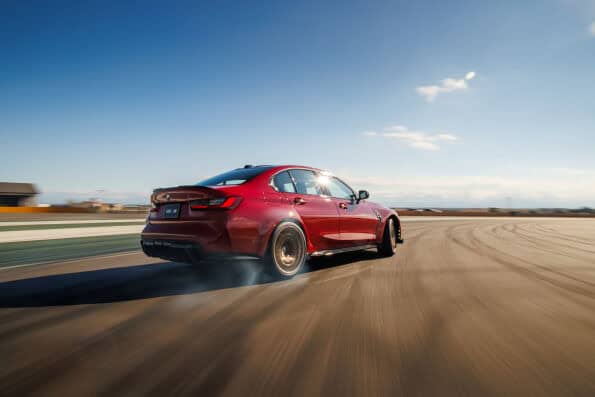
How BMW M shaved 75 pounds from the standard M3
The Handschalter is the lightest M3 in the current lineup. With the optional M Carbon Ceramic brakes fitted, BMW M says the car weighs nearly 75 pounds less than a standard M3. The savings come from a focused diet rather than one big single change.
The roof, hood, front splitter, front air intakes, mirror caps, rear diffuser, and rear spoiler are all carbon fiber reinforced plastic. The center console and interior trim use the same material. Standard M Carbon bucket seats finished in Anthracite Full Merino leather with CS-exclusive Mugello Red accents replace the heavier sport seats, while a titanium rear silencer cuts more than eight pounds out of the exhaust on its own.
Add it all up and the lightweight measures save about 42 pounds compared with a base M3 six-speed manual. Specify the optional M Carbon Ceramic brakes and you save another 31.5 pounds over the steel M Compound setup. That total of nearly 75 pounds is the kind of weight reduction normally reserved for full motorsport homologation specials.
Why the chassis is more than just a sticker pack
BMW M has reworked the chassis specifically around the manual gearbox and rear-wheel-drive layout, which carry different weight distribution characteristics than the all-wheel-drive Competition cars. M Servotronic steering, electronic chassis settings, engine calibration, and gearbox response are all unique to the Handschalter.
New springs and a new rear axle link drop the M3 CS Handschalter 6mm lower than the standard M3. Shock absorbers originally developed for the ultra-track M4 CSL are fitted, along with auxiliary springs to round out damping response. Specially tuned axle kinematics and unique wheel camber settings target steering precision, cornering grip and damping behavior.
Forged Style 927M alloy wheels come in Gold Bronze or black, with 275/35ZR19 fronts and 285/30ZR20 rears as standard. Owners can choose high-performance tires, track tires, or ultra-track tires (the last at $600). M Compound brakes with red or black calipers are standard, with M Carbon Ceramic brakes in red or gold available as an option. For drivers who plan serious track use, there is also an optional $1,100 M Front Strut Brace in cast aluminum to add front-end rigidity.

What the S58 inline-six delivers in this last-of-its-kind M3
Under the carbon-fiber hood sits the S58 3.0-liter M TwinPower Turbo inline-six, the same family of engine that powered the BMW M4 GT3 Evo to a class win at this year’s Rolex 24 at Daytona. In Handschalter trim it makes 473 hp at 6,250 rpm and 406 lb-ft of torque from 2,630 to 6,130 rpm.
Paired with the six-speed manual and rear-wheel drive, the M3 CS Handschalter hits 0 to 60 mph in 4.1 seconds (3.8 seconds with one-foot rollout) and tops out at 180 mph with the standard M Driver’s Package. Those numbers are slower than the automatic xDrive Competition cars on paper, but for buyers chasing the Handschalter, that is precisely the point.
The engine itself uses a sleeveless closed-deck crankcase, a forged crankshaft, and a cylinder head with a 3D-printed core that allows coolant ducts to be routed in shapes impossible with traditional metal casting. The oil and cooling systems are specifically prepared for sustained track use.
Track tools and everyday usability
M Drive Professional is standard, bundling M Drift Analyzer and M Laptimer with M Traction Control across ten intervention stages. Drivers can flip between ROAD, SPORT, and TRACK modes from the center console M Mode button, with each setting adjusting both driver assistance interventions and the information display.
Despite the track-bred brief, the M3 CS Handschalter keeps the kind of equipment buyers expect at this price. Comfort Access, dual-zone automatic climate control, Harman Kardon surround sound, Park Distance Control, Front Collision Warning, Lane Departure Warning, and Speed Limit Info are all standard. The M Carbon bucket seats are heated and electrically adjustable. An optional Daily Driver Package adds a power-operated trunk lid and Head-Up Display for owners who want to drive the car every day rather than save it for weekends.

How to spec the M3 CS Handschalter
Buyers get four exterior finishes to choose from. Isle of Man Green metallic and Black Sapphire metallic are no-cost options, while the two BMW Individual colors drawn from 40 years of M3 history (Imola Red and Techno Violet metallic) carry a $4,500 premium. The CS-specific touches include exposed carbon-fiber roof and hood channels, a frameless CS kidney grille with red contour lines, and yellow daytime running lights that mimic GT racing cars during the unlock sequence and on the move.
Why this is the M3 that will hold its value
Limited production runs of manual M cars have historically held their value extremely well. The previous-generation E92 M3 with the six-speed manual continues to outperform automatic versions on the used market, and the F87 M2 Competition manual is now trading above original sticker. The M3 CS Handschalter combines very limited production, the only manual CS ever, North America exclusivity, and the closing chapter of a six-generation nameplate. It is hard to see this car not becoming one of the most sought-after M3s of the modern era.
The public reveal happens at the All-BMW Petersen Cruise-In at the Petersen Automotive Museum in Los Angeles on Saturday, May 23, with the unveiling scheduled for 10:00 AM. Production begins in July with deliveries to follow in the fall.

Leave a Comment
More in News

How to Free a Frozen Handbrake (and What a New Cable Costs)

What Winter Tyres Actually Do for UK Drivers (and Whether You Need Them)

Renewing Car Insurance on the Day Cover Ends Costs Drivers £331 More, MoneySupermarket Shows

Every Driver Faces £500 Seatbelt Fines as AI Cameras Flag 19,145 Possible Offences

How to Remove Moisture From Inside Your Headlight Before It Costs You £500
Trending on Motoring Chronicle

Kia EV2 Qualifies for Full £3,750 Electric Car Grant From £24,245

2026 INFINITI QX80: Cutting-edge flagship boldly elevated with first-ever SPORT grade [Photo Gallery]
The Real Cost of Owning a Honda Civic for 5 Years: $41,930 (2026 Breakdown)

Ram 1500 Rumble Bee Muscle Trucks Start Under $60,000, Top Out at 777HP
