How Fast Can You Drive on a Spare Tire?


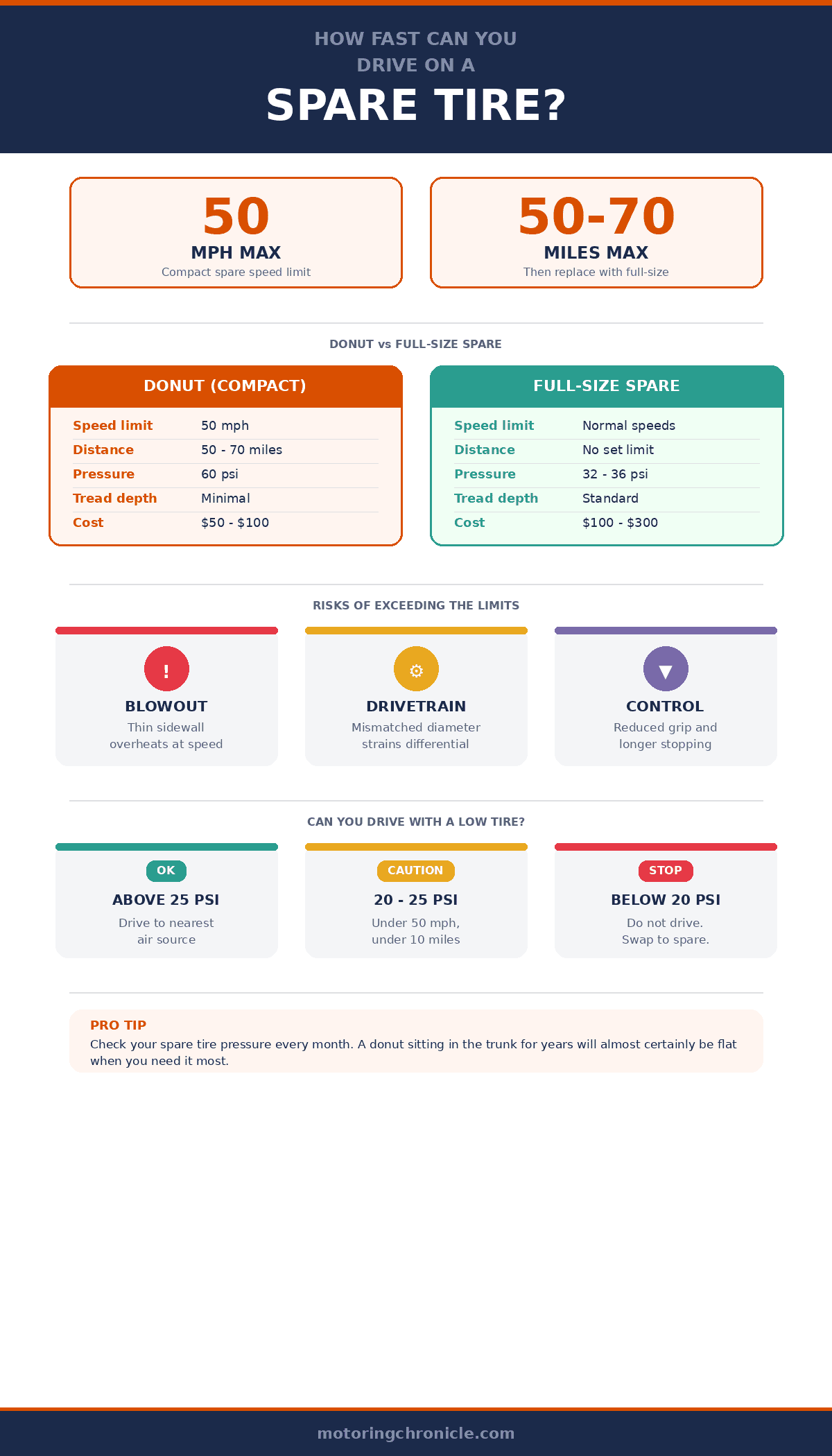
- Compact spare tires (donuts) are rated for a maximum of 50 mph and should not be driven more than 50 to 70 miles before being replaced with a full-size tire.
- Full-size spare tires can be driven at normal highway speeds and have no set distance limit, but they should still be checked for age and pressure before use.
- Driving on a low or flat tire without swapping to the spare risks permanent rim damage, tire sidewall destruction, and loss of vehicle control at any speed above a crawl.
The Speed and Distance Limits That Apply to Every Compact Spare
The number printed on the sidewall of most compact spare tires is 50 mph. That is the maximum speed the tire is rated to handle safely. The distance limit, depending on the manufacturer, falls between 50 and 70 miles. These are not suggestions. They are engineering limits set by the company that built the tire, and exceeding them increases the risk of a blowout, drivetrain damage, or loss of vehicle control.
The reason both numbers are so low comes down to how a compact spare is constructed. A donut tire is smaller in diameter, narrower in width, and built with a thinner sidewall and less tread depth than the full-size tires sitting at the other three corners of the vehicle. It exists for one purpose: to get the vehicle from the side of the road to the nearest tire shop. It is not designed for highway commuting, extended trips, or any driving beyond that single task.
What Makes a Donut Tire Different from a Full-Size Spare
Construction and Size
A compact spare tire, commonly called a donut, is roughly half the width and slightly smaller in diameter than a standard tire. The tread is shallow, the rubber compound is lighter, and the internal structure uses fewer reinforcing plies than a tire built for everyday use. The result is a tire that weighs significantly less and takes up far less trunk space, which is the entire reason automakers include them instead of a full-size spare.
A full-size spare matches the dimensions of the other four tires on the vehicle. It uses the same tread depth, the same sidewall construction, and is often mounted on a matching wheel. Full-size spares are more common on trucks, SUVs, and vehicles where the manufacturer has designated cargo space specifically for the larger tire. There is no speed or distance restriction on a full-size spare that is in good condition and properly inflated.
Tire Pressure Requirements
Compact spares run at a much higher pressure than standard tires. Most donuts require 60 psi, compared to the 32 to 36 psi typical for a full-size tire. This elevated pressure compensates for the smaller contact patch and thinner construction. A donut that has been sitting in the trunk for several years will almost certainly have lost pressure, and driving on an underinflated compact spare accelerates the already limited lifespan of the tire. Checking your spare’s pressure at least once a month, at the same time you check your other four tires, is a habit that prevents arriving at a roadside emergency with a flat spare. This is part of the same routine covered in checking your monthly fluid and pressure checks.
What Happens If You Drive Too Fast on a Donut
Heat Buildup and Blowout Risk
Speed generates heat in a tire. The faster the tire rotates, the more the rubber flexes, and the more thermal energy builds in the sidewall and tread. A standard tire is designed to dissipate that heat across a wide, thick structure with multiple reinforcing belts. A compact spare has none of those advantages. The thin sidewall and narrow contact patch trap heat far more quickly, and at speeds above 50 mph, the temperature can climb past the threshold where the rubber compound begins to degrade.
A blowout on a donut at highway speed is more dangerous than a blowout on a full-size tire. The smaller tire provides less surface contact with the road, and the vehicle is already handling differently with mismatched tire sizes at each corner. Losing that tire entirely at 65 or 70 mph puts the driver in a situation where vehicle control is severely compromised, especially if the spare was mounted on the front axle.
Differential and Drivetrain Stress
The smaller diameter of a compact spare means it rotates at a different speed than the full-size tires on the opposite side of the same axle. The differential, the component that allows the left and right wheels to spin at different rates in a turn, absorbs that mismatch during normal cornering. Running a donut introduces a constant speed difference that the differential was never designed to manage over long distances or at high speed.
On all-wheel-drive and four-wheel-drive vehicles, the problem is more severe. The transfer case and center differential rely on all four tires being the same diameter. A compact spare creates a persistent mismatch that generates heat and wear in components that are expensive to repair. Some AWD vehicle owner’s manuals explicitly state that a compact spare should only be used on a specific axle, and that the vehicle should be driven in two-wheel-drive mode if possible while the spare is in use.
Can You Drive with a Low Tire Instead of Swapping to the Spare
When the Tire Is Low but Not Flat
If the tire pressure monitoring system has triggered a warning but the tire still holds air, the safest action is to drive slowly to the nearest air source and reinflate. A tire running 5 to 10 psi below its recommended pressure will handle poorly and wear unevenly, but it can typically cover a short distance at reduced speed without structural failure. Keeping speed under 50 mph and avoiding sharp turns or hard braking reduces the risk of a sidewall collapse on the way to a gas station or tire shop.
If pressure has dropped below 20 psi, the tire is functionally flat. The sidewall is carrying load it was not designed to support, and the rim is close to making contact with the road surface. Driving on a tire at this pressure level, even slowly, can destroy the tire beyond repair and damage the wheel. At that point, the spare is the correct choice regardless of how inconvenient the swap might be. Knowing how to identify and respond to tire pressure issues is the same principle behind understanding whether a tire is actually punctured or just losing pressure from temperature changes.
When the Tire Is Completely Flat
A fully flat tire should not be driven on at any speed. The rubber folds under the weight of the vehicle, the rim grinds against the inner liner, and within a few hundred yards the tire is destroyed. The rim itself can also be damaged, turning a $150 tire replacement into a $500 tire-and-wheel replacement. Pull over as soon as it is safe to do so, engage the hazard lights, and swap to the spare. If the spare is also flat or the vehicle does not carry one, roadside assistance is the safest option.
How Fast Can a Donut Tire Go in Practice
Highway Driving on a Spare
The 50 mph limit creates an obvious problem on highways where the speed limit is 65 or 70 mph. Driving 15 to 20 mph below the flow of traffic is legal but introduces its own risk. Faster vehicles closing from behind at a significant speed differential increases the chance of a rear-end collision, especially in low-visibility conditions.
Staying in the right-hand lane with hazard lights active is the standard safety practice when driving on a spare at highway speeds. If the route to the nearest tire shop involves a long stretch of high-speed highway, consider taking surface streets even if the route is longer in distance. The lower speeds are easier on the spare, and the traffic around the vehicle is moving at a pace closer to 50 mph. The temporary inconvenience of a slower route is not worth the risk of a donut failure at interstate speed.
Weather and Road Conditions
A compact spare has minimal tread depth, which means its ability to channel water, grip wet pavement, or maintain traction on loose surfaces is significantly reduced compared to a full-size tire. In rain, the stopping distance on a donut increases noticeably, and the narrow contact patch is more prone to hydroplaning. In snow or ice, the tire offers almost no meaningful grip.
If the flat occurs during severe weather, lower the speed target further. Driving at 35 to 40 mph on a donut in heavy rain is a reasonable precaution that accounts for the tire’s limitations. The goal remains the same: reach a tire shop, not complete the day’s driving schedule. Following the same flat tire fix approach and having a plan before the emergency happens makes the entire process faster and safer.
What to Do After Installing the Spare
Immediate Steps
After mounting the spare, check its pressure with a gauge before driving. If the spare has been sitting in the trunk for years without attention, it may be well below the required 60 psi. Many gas stations have air compressors that can bring it up to the correct level. Driving on a donut that is underinflated compounds every risk already described.
Retorque the lug nuts after the first 25 to 50 miles of driving. A wheel that was mounted on the roadside with a scissor jack and hand wrench may not have the same torque as one installed with a shop impact gun. The lug nuts can loosen slightly as the wheel seats against the hub under load. Stopping to check them once is a small effort that prevents a wheel separation event.
Getting the Full-Size Tire Repaired or Replaced
A puncture in the tread area of a standard tire can often be repaired with a plug-patch combination for a fraction of the cost of a new tire. Sidewall damage, large punctures, or cuts cannot be safely repaired, and the tire must be replaced. The sooner the damaged tire is inspected by a professional, the sooner the vehicle returns to running on four matched tires with no speed or distance restrictions. Extending the life of your tires starts with regular pressure checks and rotation, and the same fundamentals that apply to daily driving apply to getting back on track after a flat. Keeping to a regular tire care routine reduces the chance of a roadside tire change in the first place.
Spare Tire Age and Shelf Life
Rubber degrades over time regardless of use. A spare tire that has been sitting in the trunk for six or seven years may look fine on the surface but can have weakened sidewalls and hardened tread compound that reduce its ability to perform safely even within the 50 mph and 50-mile limits. The tire’s manufacture date is printed on the sidewall in a four-digit code (the DOT number). The last four digits represent the week and year of production. A tire stamped 2318 was made in the 23rd week of 2018. Most manufacturers and safety organizations recommend replacing a spare tire that is more than six to ten years old, even if it has never touched the road.
Spare Tire Frequently Asked Questions
How fast can a donut tire go?
The maximum rated speed for most compact spare tires is 50 mph. This limit is set by the tire manufacturer and is based on the structural capacity of the thinner, narrower tire. Exceeding 50 mph increases the risk of heat buildup, blowout, and drivetrain damage from the mismatched tire diameter.
Can you drive 200 miles on a spare tire?
On a compact spare, no. The recommended maximum distance is 50 to 70 miles. Driving 200 miles on a donut pushes the tire well past its design limits and risks failure. On a full-size spare that is properly inflated and in good condition, 200 miles is not a concern.
Can you drive with a low tire?
If the tire is still holding air above 20 psi, you can drive carefully at reduced speed to reach an air source or tire shop. Keep speed under 50 mph, avoid hard braking and sharp turns, and cover only the distance needed to address the issue. Below 20 psi, the tire is functionally flat and should not be driven on. Swap to the spare or call for roadside assistance.
Should the spare go on the front or the back?
On a front-wheel-drive vehicle, mounting the compact spare on the rear axle is the standard recommendation. The rear tires carry less steering and braking load, and the handling difference from the mismatched tire is less pronounced. If the flat occurred on a front tire, move one of the rear tires to the front position and mount the spare on the rear. On rear-wheel-drive and AWD vehicles, consult the owner’s manual for the manufacturer’s specific guidance.
Sources

Leave a Comment
More in News
What Is The Optimal Speed For Fuel Economy?

How Does Tire Pressure Affect Fuel Economy?

What Is a Crossover SUV?

Mercedes Is Removing the Mechanical Link From Your Steering. Should You Be Worried?

Can an Electric AMG Actually Replace the V8? Here’s What We Know About the New GT 4-Door
Trending on Motoring Chronicle

Rolls-Royce announces Black Badge Spectre: the alter ego, amplified [Photo Gallery]

Largest fleet of bespoke Flying Spurs commissioned by world class resort [Photo Gallery]

Performance combined with efficiency: the new A6 plug-in hybrid models [Photo Gallery]

How Long Does Car Paint Last? Complete Timeline and Protection Guide