
Why the BYD Ti7 Could Be the Seven-Seat Family SUV Plug-In Hybrid to Beat


BYD has just confirmed that British families looking for a seven-seater with a plug will soon have a serious new option. The Ti7, a 5,146mm-long three-row SUV that sits at the top of BYD’s range globally, is officially coming to the UK. Final pricing is still a few weeks away, but the powertrain headline is already arresting: a 1.5-litre turbocharged petrol engine paired with two electric motors driving all four wheels, a 79-mile WLTP electric-only range, and a 0-62mph time of 4.8 seconds.
For anyone who has been shopping the seven-seat family SUV aisle in 2026 and quietly despairing at the choice, that combination changes the conversation. A petrol Kia Sorento, a hybrid Hyundai Santa Fe and a plug-in Skoda Kodiaq currently dominate the segment in the UK, and none of them get close to a sub-five-second sprint while also offering 79 miles of pure-electric driving. The Ti7 looks set to ask whether the segment leaders have been a little too comfortable.

BYD’s first proper seven-seater for the UK
Until now, BYD’s UK line-up has revolved around five-seat cars. The DOLPHIN, ATTO 3, SEAL and SEALION 7 cover hatchbacks, family SUVs and electric coupés, but a buyer who simply needs three full rows of seats has had to look elsewhere in the brand’s catalogue or wait. The Ti7 ends that wait, becoming the largest BYD ever sold here and the first the brand will pitch directly at the school-run, dog-and-grandparent market that keeps the Kia Sorento and Peugeot 5008 selling.
The Ti7 measures 5,146mm long, 1,995mm wide and 1,865mm tall, which makes it noticeably longer than a Sorento (4,815mm) and almost identical in length to a Volvo XC90. BYD says the boxy proportions and vertical rear were a deliberate choice to maximise the third row and the load space behind it. Inside, three rows of seating sit beneath what BYD describes as an upmarket cabin, and the company has already confirmed that the global version of the car is available with quilted upholstery, reclining captain’s chairs in the middle row and a panoramic roof. Whether all of those features make the UK car remains to be seen.
A plug-in hybrid powertrain that does not apologise
The Ti7 uses BYD’s Dual Mode Performance (DM-p) plug-in hybrid system, which is the brand’s high-output PHEV setup rather than the more efficiency-focused DM-i found in cars like the BYD ATTO 2 DM-i. The difference is in the electric motor count and the driveline. The Ti7 puts one electric motor on each axle, giving it full electric four-wheel drive, and adds a 1.5-litre turbocharged petrol engine. BYD has not yet confirmed combined power for the UK car, but the published 0-62mph time of 4.8 seconds tells its own story for a vehicle this size and shape.
Of more relevance to most buyers, the WLTP electric-only range is 79 miles. That is enough for a typical British weekly commute to be completed without burning a drop of petrol, with the engine then available for longer trips, the school holiday run to Cornwall or a Channel crossing. It also nudges the Ti7 past the 70-mile electric range floor that many company-car drivers watch closely, which has been a quiet but meaningful battleground for the segment in the past year.
How it lines up against the seven-seat field
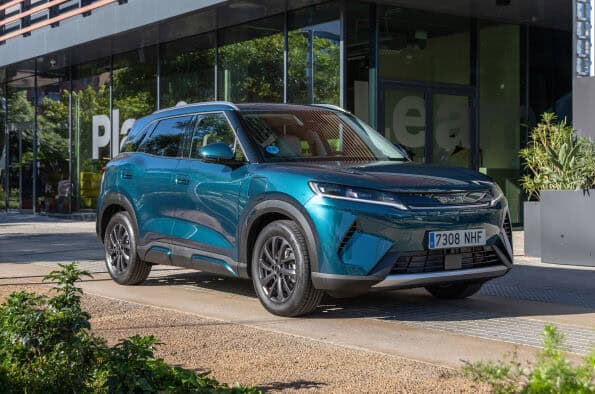
The Ti7 is walking into a busy room. The Kia Sorento PHEV manages a claimed 35 miles of electric range and a 0-62mph time of 8.4 seconds. The Hyundai Santa Fe plug-in offers a similar electric range. The Skoda Kodiaq iV plug-in hybrid, due in UK showrooms this year, is expected to land around 75 miles of WLTP EV range from a 25.7kWh battery. On paper, BYD looks ready to top all of them on electric distance and absolutely flatten them on performance.
Price will be the variable that decides whether that paper advantage translates into showroom traffic. BYD has built its UK reputation on undercutting Japanese and Korean rivals while matching their warranty and standard equipment lists. If the Ti7 lands somewhere between £45,000 and £52,000 once specifications are confirmed, it will be priced to make the Sorento and Santa Fe customer at least take a test drive. If BYD pushes higher to chase the Volvo XC90 PHEV and Mercedes GLE 350de, the math becomes a much tougher sell.
What we still need to know
BYD has been careful to release the Ti7’s UK news in stages. The dimensions, the powertrain layout, the electric range and the headline performance figure are now confirmed. What we are still waiting on includes the battery capacity in kWh, the AC and DC charging speeds, the trim line-up, the safety equipment list and the all-important price. BYD has told media that further details, including pricing and specifications, will be released in the coming weeks, which suggests a formal order book opening in the second half of 2026.
One question that British buyers will care about is how the Ti7 handles real-world towing and load carrying with seven on board. The brand has not yet quoted a UK towing capacity, but the global Ti7 has been certified for a 2,500kg braked tow. If that figure carries over, it would put the Ti7 within touching distance of large diesel SUVs that have traditionally owned the caravan and horsebox segment.
The verdict so far
It is too early to call the Ti7 the new seven-seat benchmark. The cabin needs to be tested, the ride judged on broken British B-roads, and the price tag confirmed. But the case for putting the Ti7 on a serious shortlist is already strong. It offers the rare combination of three full rows of seats, a useful electric-only range, and a powertrain that genuinely performs rather than simply gets the car moving. For a brand that did not sell a single car in the UK three years ago, arriving with a serious answer to the Sorento, Santa Fe, Kodiaq and even the XC90 PHEV is a striking statement of intent. Pricing news in the coming weeks will tell us whether it is also a credible one.

Leave a Comment
More in News

Drivers of Britain’s Dirtiest New Cars Now Pay £5,690 in HMRC’s Year-One Tax

What Your ABS Warning Light Actually Means (and Is It Safe to Drive?)

Buyers of Popular Electric Cars Miss a £3,750 Government Grant Rivals Get

Why Truckers Can Now Drive 16-Hour Days as Diesel Hits $6.29 a Gallon

What Limp Mode Actually Means (and What to Do When It Happens)
Trending on Motoring Chronicle

Rolls-Royce presents Phantom Cherry Blossom: a personal tribute to the beauty of transience [Photo Gallery]
Mercedes-Benz USA Expands Lineup with new 2026 Mercedes-AMG E 53 HYBRID Wagon [Photo Gallery]

Newark, Delaware’s Only Speed Camera Could Be Waiting on Any of 15 Different Streets

Timeless modernity: the Tourbillon’s debut in Japan and Singapore [Photo Gallery]