A 16 Cylinder Engine, 203 mph And A Straight Road In Italy. The Story Behind The Car Audi Just Rebuilt
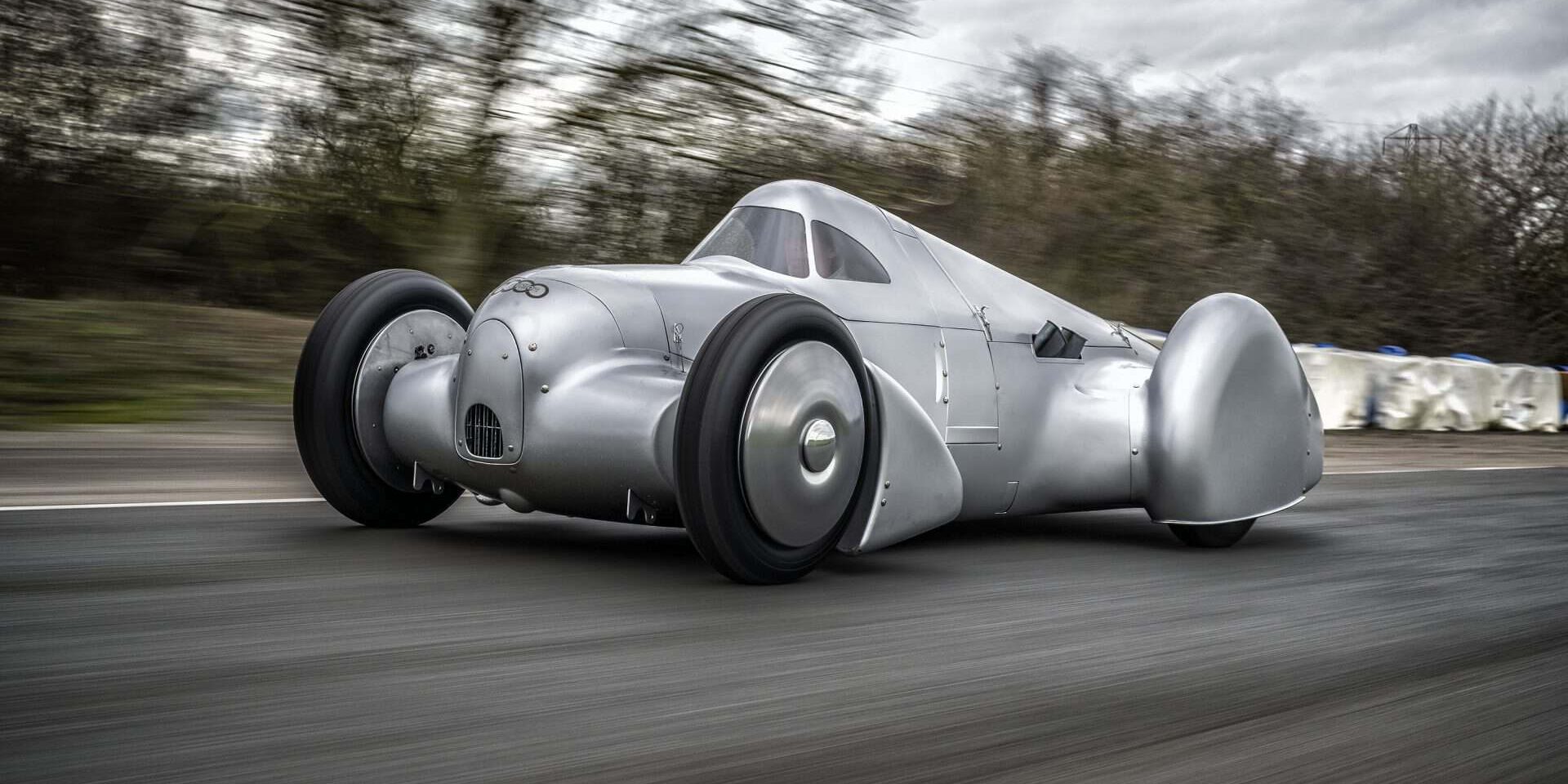
On the morning of February 15, 1935, Hans Stuck climbed into a silver car on a straight stretch of autostrada near the Italian city of Lucca. The car had a 16-cylinder supercharged engine mounted behind him, a streamlined aluminium body that tapered to a fin at the rear and a closed cockpit canopy that sealed him inside like a pilot. He accelerated through the flying-start mile at a measured speed of 326.975 km/h. That is 203 mph. In 1935. On a public road.
The Auto Union Lucca was declared the fastest road racing car in the world. Ninety years later, Audi has rebuilt it from scratch. The recreation took more than three years, was constructed entirely by hand by British specialists Crosthwaite and Gardiner, and was completed in early 2026. Every component was handcrafted for this single car. It was unveiled in the Italian city of Lucca in early May and will make its first appearance in motion at the Goodwood Festival of Speed from July 9 to 12.
This is the story of how the original car came to exist, and what happened to it after its moment of glory on that Italian road.
The Rivalry That Built It
The 1930s were consumed by an international obsession with speed. Grand Prix racing and record attempts were front-page news, followed with an intensity that is difficult to imagine today. In Germany, that obsession became a direct contest between two manufacturers: Daimler-Benz and Auto Union.
Auto Union was formed in 1932 from the merger of four companies: Audi, DKW, Horch and Wanderer. The four overlapping rings of its badge represented the four brands. The company entered Grand Prix racing in 1934 under the new 750-kilogram formula with the Auto Union Type A, a radical mid-engined car producing 295 PS. In its first season, Hans Stuck, an experienced racing driver and hill climb specialist, set three world speed records on March 6 and five more on October 20.
Daimler-Benz could not let that stand. In late October 1934, Rudolf Caracciola took a specially built Mercedes record car to a highway near Gyon in Hungary and set several international records, including an average speed of 316.592 km/h over the flying-start mile. That was the number Auto Union had to beat.
The engineers and mechanics at Auto Union’s racing division in Zwickau had a hot winter ahead of them.
Building The Rennlimousine
The team started with the car that had set the October records and began developing something faster. They built a wind tunnel model, tested it in open and closed cockpit configurations at the Berlin-Adlershof Aeronautical Research Institute, and incorporated the findings into a new body design. The use of wind tunnel data to shape a racing car was described at the time by Automobilrevue as a first in European racing car construction.
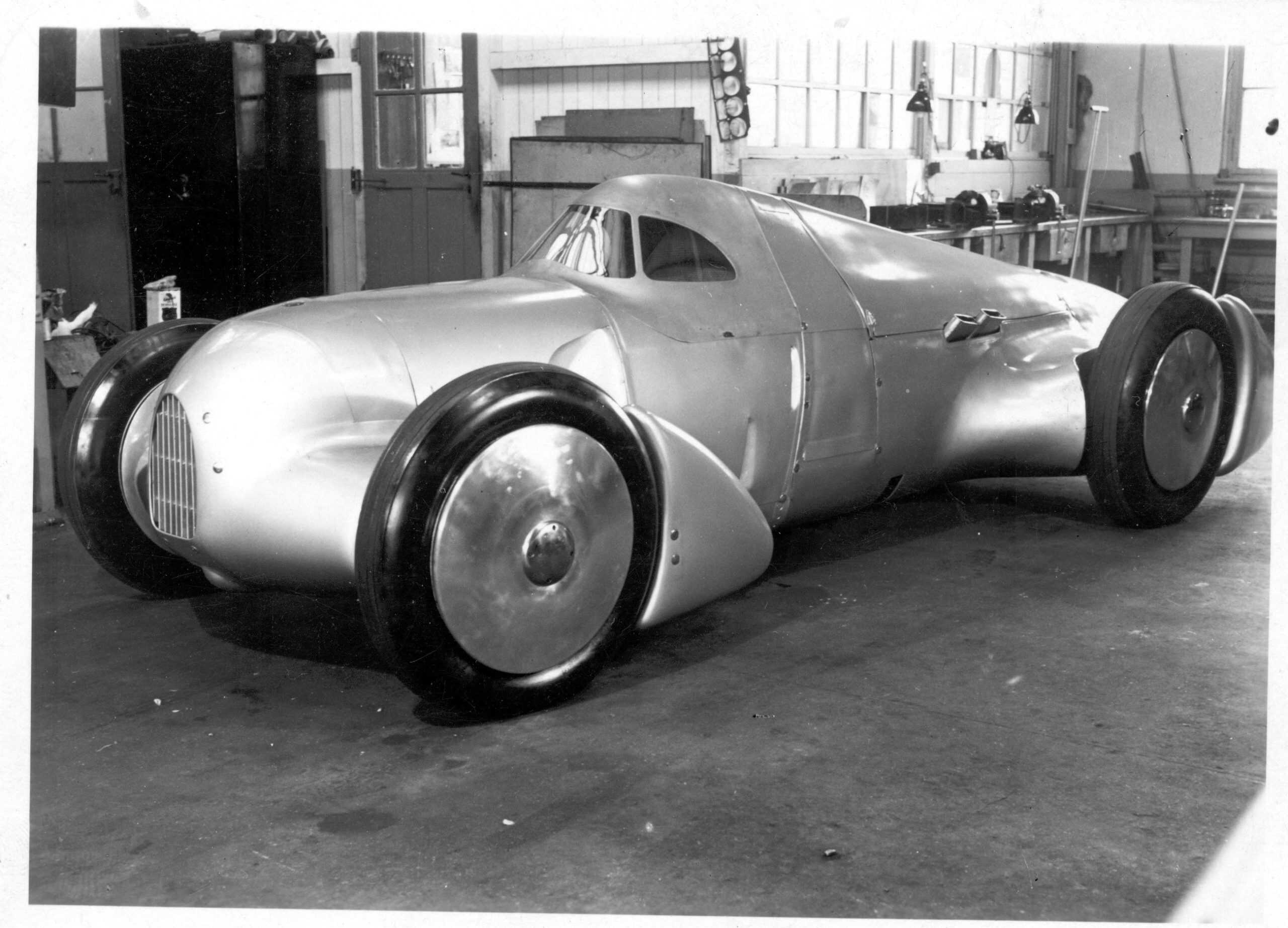
The result was a car unlike anything else on the road or track. The aluminium body was finely sanded and coated in clear lacquer over cellulose silver paint. Spoked wheels were fitted with smooth covers. Two circular openings at the rear fed air to the carburettor. The exhaust pipes pointed upward and exited through two outlets on each side. The elongated silhouette, with its fin-like rear end and teardrop-shaped wheel arches, gave the car a shape that was simultaneously functional and beautiful.
Under the bodywork sat a 16-cylinder supercharged engine with a displacement increased to approximately five litres for the 1935 season. In its early form it produced 343 PS, short of the 375 PS it would reach later that year, but enough for what was about to happen. The chassis and suspension were carried over from the 1934 racing car. The whole package was heavier than a Grand Prix car, earning it the period nickname Rennlimousine, which translates roughly as racing saloon.
The car was finished in December 1934. It was test-driven for the first time on Berlin’s Avus circuit on December 17.
The Search For A Straight Road
At the end of January 1935, Auto Union decided to attempt the record in Hungary, on the same stretch of road near Gyon where Caracciola had set his mark. The car arrived in Budapest on February 4. The team drove 40 kilometres south to the route the next day, but the weather was deteriorating rapidly. Two test runs were completed on February 5 before an exhaust pipe burned through and forced a halt.
With conditions in Hungary worsening, the organisers decided to move south of Milan. But the planned Italian route was covered in snow. So the team moved further south again, eventually finding a suitable stretch on the Florence to Viareggio road between Pescia and Altopascio, near the city of Lucca.
The road was close to perfect: level, high-grip, eight metres wide and virtually straight for around five kilometres. Test drives began on February 14. The team tried different configurations, adjusted the radiator grille and wheel covers, and analysed the data.
The next morning, February 15, Hans Stuck took the car out at 9 a.m. Word had spread. Automobilrevue reported that the streamlined single-seater caused quite a stir among prominent figures from Italian motorsport who had travelled to Lucca, and that thousands of spectators lined the route to watch. Independent timekeepers were on hand with chronometers triggered by photocells.
Stuck made several runs. The team sealed the front of the radiator, leaving only a small opening, and made further aerodynamic adjustments. Then, over two averaged runs, the flying-start mile record in International Class C fell: 320.267 km/h average speed. On the return leg of one run, the timing equipment recorded 11.01 seconds for a single kilometre, which worked out at exactly 326.975 km/h.
The Auto Union Lucca was the fastest road racing car in the world.
The Berlin Motor Show And The Propaganda Race
Auto Union wasted no time. The record had to be broadcast immediately to press the advantage over Daimler-Benz. At almost the same time as the Lucca run, a virtually identical version of the car was on display at the International Motor Show in Berlin, which ran from February 14 to 24. The show car had a larger grille than the Lucca version but was otherwise the same.
Since the mile record had not yet been officially ratified, the promotional poster created for the show listed all of Auto Union’s world and class records and described the Lucca car as the fastest road racing car in the world, citing the 326.975 km/h top speed. In the 1930s, speed records were not just engineering achievements. They were tools of national and corporate prestige, and Auto Union wielded them accordingly.
What Happened Next
Three months after Lucca, both Rennlimousinen were entered in the fifth International Avus Race in Berlin on May 26, 1935. Because the Avus was a non-formula event, the 750-kilogram weight limit did not apply, and the heavier record cars could race alongside the Grand Prix machines. The Lucca car, now carrying starting number 3, was driven by Prince Hermann zu Leiningen, an Auto Union team member since early 1934. The Berlin show car, number 4, was driven by Bernd Rosemeyer, a young driver signed for the 1935 season.
Rosemeyer hit 290 km/h in practice and started alongside Stuck on the front row for the first heat. But as he accelerated out of the north curve, his right rear tyre burst. He brought the car under control and rolled to the side of the track. His first circuit race for Auto Union was over.
In the second heat, Prince zu Leiningen started from the second row in the Lucca car. Driving alongside him was Rudolf Caracciola in a Mercedes, number 5. The two Auto Union cars and Caracciola battled for the lead, but the Lucca car’s coolant line failed under the sustained strain, and zu Leiningen was forced to retire. Victory at the Avus went to Mercedes.
The Rennlimousinen never raced again in that form. But the data gathered at Lucca and the Avus fed directly into the development of the cars that followed, including the legendary Auto Union Type C that would dominate the 1936 season.
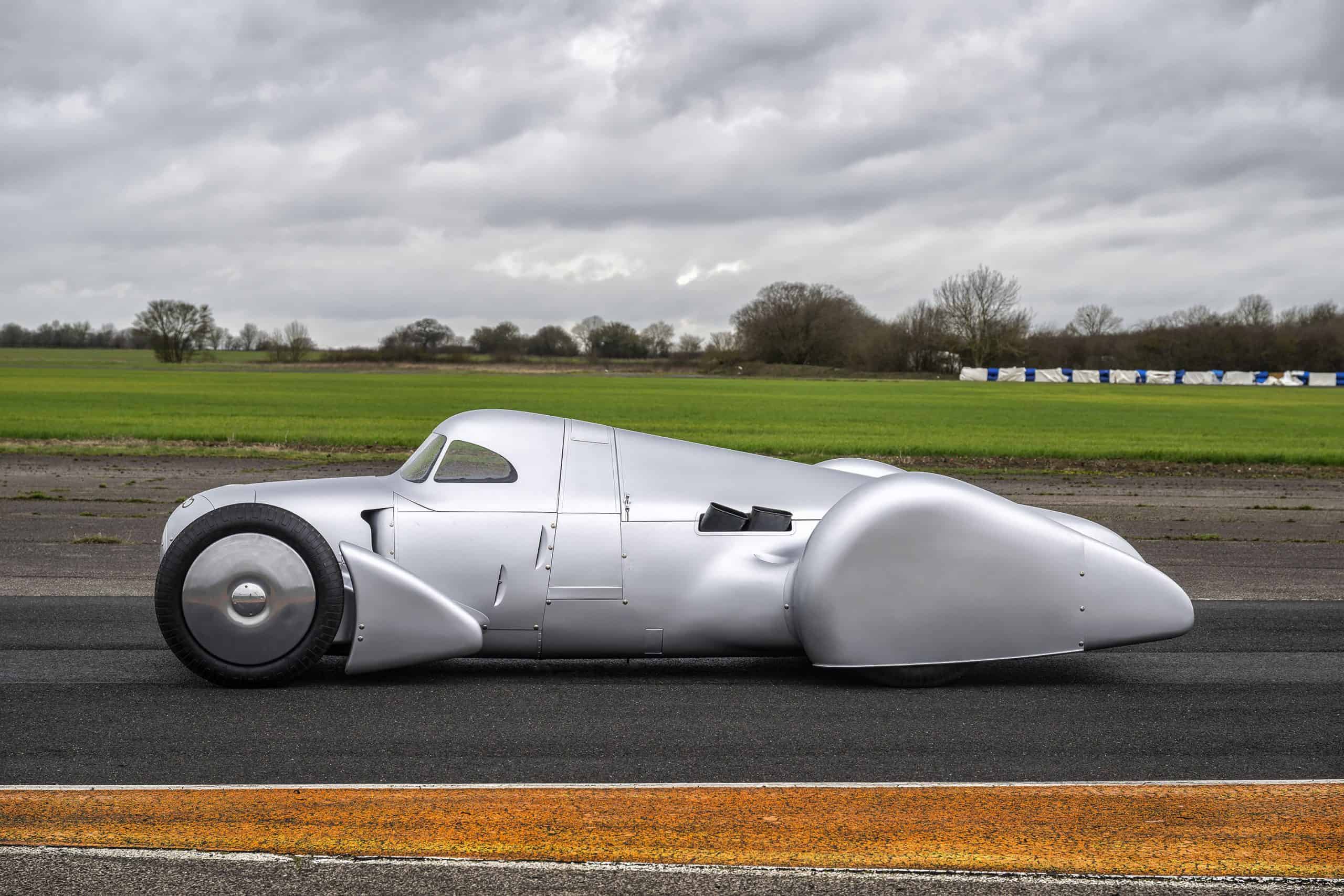
Driving shot at the first roll-out. Side view.
The Rebuild
No original Auto Union Lucca survived. Audi’s historic vehicle collection had no racing or record cars from the early Grand Prix era. In 2022, Audi Tradition commissioned Crosthwaite and Gardiner, the British restoration specialists, to recreate the car from historical photographs and archive documents.
The project took just over three years. Every component was handcrafted for this single build. The streamlined bodywork, including the cockpit canopy and the tapered tail, was particularly labour-intensive. The car was completed in early 2026 and tested in the Audi wind tunnel in late April, where it returned a drag coefficient of 0.43. For a car designed in 1934, without computational tools or modern materials, that is a remarkable figure.
There are two deliberate differences between the recreation and the original. The rebuilt car uses the 16-cylinder engine from the Auto Union Type C, which has a six-litre displacement rather than the original five-litre unit. The two engines are visually identical, and the swap allows the engine to be shared across Audi’s Silver Arrow collection. The car also incorporates modifications that were made for the Avus race, including an improved ventilation system, to prevent excessive thermal stress during demonstration runs. With minor changes to the radiator or body panels, it can be converted between the Lucca and Avus configurations.
Stefan Trauf, Head of Audi Tradition, described the car as a masterpiece of engineering tuned for high speeds and maximum performance, yet at the same time a beautiful car. Timo Witt, the project manager who has overseen Audi’s historic vehicle collection since 2015, said he was impressed by the agility and speed with which the original team responded to competition in the 1930s, noting that without that flexibility, the record-breaking drive in Lucca would not have been possible.
Seeing It In Person
The Auto Union Lucca was unveiled in the city of Lucca in early May 2026. Its first dynamic appearance, the first time anyone will see and hear this car moving under its own power, will be at the Goodwood Festival of Speed from July 9 to 12.
It is a one-off. There will not be another.
Technical Data
Engine: 16-cylinder with supercharger. Displacement: 6,005 cc (as fitted in the Auto Union Type C, 1936). Power output: 520 PS (382 kW) at 4,500 rpm. Fuel: 50% methanol, 40% premium unleaded, 10% toluene. Dimensions: 4,570 mm long, 1,200 mm high, 1,700 mm wide. Wheelbase: 2,800 mm. Kerb weight: 960 kg. Exterior colour: Cellulose silver. Production run: One.

Leave a Comment
More in News

How to Appeal a Parking Fine (and Actually Win Your Case)

Birmingham’s Clean Air Zone Has Now Raised £57 Million From Non-Compliant Drivers

HMRC’s Insurance Premium Tax Now Adds £68 to Every Driver’s Car Cover

What a Free DVSA Check Reveals About Recalls on the Car You Already Own

How Insurance Fraud Adds Up to £50 to Every Honest Driver’s Premium
Trending on Motoring Chronicle

Mercedes-AMG A 45 S Final Edition Priced From £67,965 as Send-Off Special
Renault Has Put A Folding Canvas Roof On The Electric Renault 4

Mat Armstrong’s Bugatti Veyron Refuses to Start, and Bugatti Won’t Even Answer the Phone

F50 Legacy Tour 2025: A journey through Tuscany to celebrate 30 years since the birth of an icon [Photo Gallery]