Two Illegal Tyres Can Cost New Drivers Their Licence, TyreSafe Warns


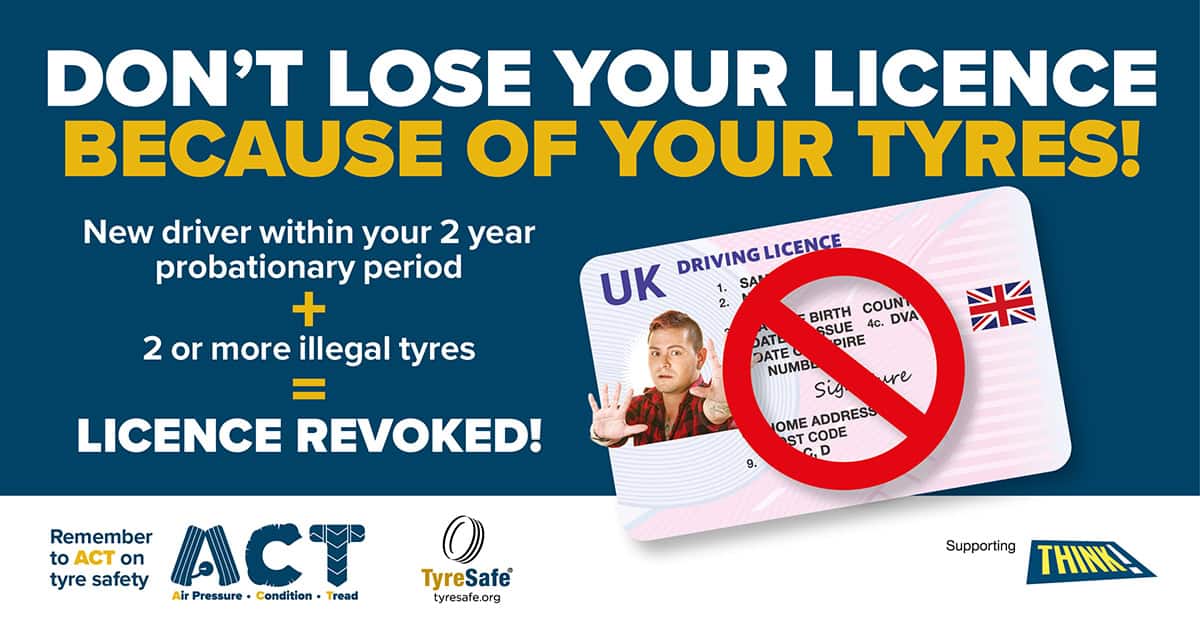
New drivers have less room for error on tyres than they might realise. Under the New Drivers Act, anyone who passes their test and racks up six penalty points within their first two years on the road has their licence automatically revoked, and two illegal tyres are enough to get there on their own. Road safety charity TyreSafe is relaunching its Young Driver Campaign this September, timed to run alongside a nationwide police crackdown specifically targeting young drivers.
Each illegal or unsafe tyre carries a fine of up to £2,500 and three penalty points, and that penalty applies per tyre, not per car. A driver stopped with two defective tyres on the same vehicle faces up to £5,000 in fines and six points in one stop, which for a new driver means an automatic ban and a full retest before they can get back behind the wheel legally.
Operation Spotlight Runs Through Early October
The National Police Chiefs’ Council is running Operation Spotlight, a dedicated enforcement operation aimed at young drivers, from 22 September to 5 October. Tyre condition sits alongside other common offences police check for in the operation, and TyreSafe’s campaign is timed deliberately to reach new drivers with the ACT message before, rather than after, they get pulled over.
The campaign also lines up with the government’s new Road Safety Strategy, published in January, which sets more ambitious targets for cutting the number of people killed or seriously injured on UK roads. Young and new drivers are a specific focus of that strategy: they remain disproportionately represented in serious collision statistics while making up a smaller share of licence holders overall.
Half of Young Drivers Don’t Know Whose Responsibility Tyres Are
TyreSafe’s own research found that 52% of UK drivers aged 17 to 24 don’t realise they’re legally responsible for the condition of the tyres on any car they drive, theirs or not. Borrow a parent’s car, a friend’s car, or a hire car with a worn tyre, and the driver behind the wheel is the one who faces the fine and the points, not the car’s owner.
That knowledge gap hits new drivers harder than anyone else on the road, purely down to how few points stand between them and losing their licence entirely. An experienced driver with a clean licence can absorb six points and keep driving, if more cautiously. A driver in their first two years cannot.
The ACT Checklist
TyreSafe built its advice around three checks it calls ACT: air pressure, condition, and tread. Air pressure should be checked roughly every two weeks and before any long drive, using the figures printed on a sticker inside the driver’s door pillar rather than a number on the tyre itself. Condition means a visual check for cuts, bulges, or embedded objects like screws or nails, which can cause a blowout on their own regardless of tread and pressure. Tread depth has a legal minimum of 1.6mm across the central three-quarters of the tyre, checkable in seconds with a 20p coin pushed into the main grooves; if the coin’s outer rim stays hidden, the tyre passes.
Stuart Lovatt, chair of TyreSafe, said young and new drivers face tighter restrictions on their licence than more experienced motorists, which raises the stakes when something goes wrong. “Tyres are one of the most critical safety factors on any vehicle, and young and new drivers have the responsibility to check that they are driving on safe, legal and compliant tyres,” he said. “The repercussions, if they don’t, can be extremely punitive when it comes to penalty points, financial penalties and operating costs.”
The campaign runs with backing from the DVSA, driving instructor bodies including the Motor Schools’ Association and the Driving Instructors’ Association, and several new-driver platforms, alongside the Department for Transport’s THINK! campaign. Schools, colleges, and driving instructors are being encouraged to share TyreSafe’s videos and step-by-step guides directly with learners in the run-up to Operation Spotlight.
A Five-Minute Check Against a Two-Year Ban
The maths is stark for anyone who has just passed their test. A five-minute tyre check costs nothing beyond the time it takes. Getting caught with two illegal tyres costs up to £5,000, an automatic licence revocation, and a full retest, on top of whatever it takes to actually fix the tyres afterward. For drivers who worked hard to pass their test once, the ACT checklist is the difference between keeping that licence through the riskiest years on the road and starting the whole process over again.

Leave a Comment
More in News

14 Percent of Keyless Car Owners Faced a Relay Theft Attempt, DVLA Data Shows

I travelled down the Champs-Élysées and around the Arc de Triomphe in a self-driving car

Every New Car Buyer Could Lose EV Discounts as Manufacturer Fines Drop by £3,000

What the Government’s Zero VAT Cut on Home Power Means for Every Electric Driver

DfT Proposes Penalty Points and Car Seizure for Driving Without a Valid MOT
Trending on Motoring Chronicle

Why Some Electric Car Drivers Now Face a £640 Road Tax Bill From Year Two

Stradman’s Lamborghini Gallardo Catches Fire, and the Aftermath Is Hard to Watch

2027 Audi A6 Sportback e-tron and Q6 e-tron arrive with enhanced digital design, technology and dynamics
Public EV Charging Now Averages 49 Cents a kWh as Seven States Top 50 Cents