
The Updated Audi Q4 E-Tron Can Power Your House, Tow 1,800 Kg And Starts From £46,260


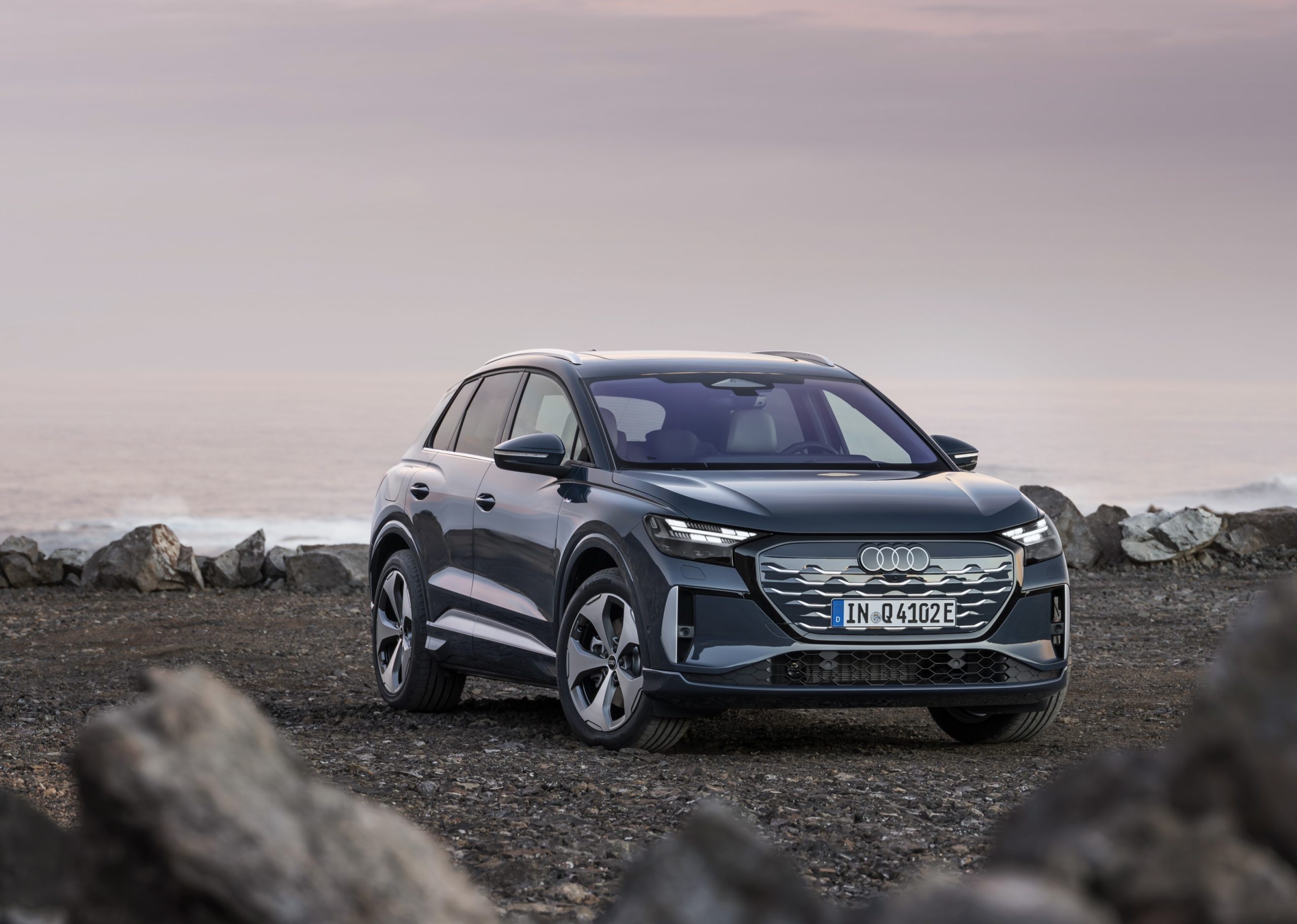
Audi’s most popular electric car has received its most substantial upgrade since launch, and the changes go well beyond a fresh set of bumpers. The 2026 Q4 e-tron gains bidirectional charging for the first time on any Audi, a completely redesigned interior, more range from improved efficiency, faster DC charging, and a towing capacity increase of 400 kg. UK orders open in June with prices starting at £46,260, or from $50,600 in the United States.
For anyone who has been waiting for the Q4 e-tron to mature into a more complete package before committing, this is the update that closes most of the gaps.
Bidirectional Charging And What It Actually Does
The headline feature is bidirectional charging, and it comes in two forms. The first, Vehicle-to-Load or V2L, is available on all markets including the UK. It allows the car’s high-voltage battery to power external electrical devices through a standard domestic power socket built into the boot, delivering a continuous 2.3 kW at 230 volts. An optional adapter on the side charging port offers the same 2.3 kW domestic socket or a 3.6 kW camping socket for higher-draw equipment.
In practical terms, this means you can charge e-bikes directly from the car on a day out, run power tools at a location without mains electricity, or keep a camping setup running overnight without a generator. It is not a gimmick. For families, tradespeople, or anyone who spends time away from a plug socket, V2L turns the car into a mobile power source.
The second form is Vehicle-to-Home, or V2H, which allows the car to feed stored energy back into your household electricity supply through a compatible DC wallbox. This is particularly useful for homes with solar panels, where excess energy generated during the day can be stored in the car’s battery and fed back into the house during the evening when electricity rates are higher. The car can supply energy from its battery when the state of charge sits between 20 and 80 per cent, ensuring it always retains enough range for driving.
V2H is currently available in Germany, Austria, and Switzerland, where the regulatory framework for bidirectional home energy is already in place. Audi has not yet confirmed a UK launch date for the V2H function, though the hardware is present in every car. As UK regulations around vehicle-to-grid and vehicle-to-home technology continue to develop, this is a feature that could be activated through a future software update. In the meantime, V2L works everywhere from day one.
More Range From Better Efficiency
Rather than fitting a larger battery, Audi has extracted more range from the existing hardware through a series of engineering improvements that add up to roughly a 10 per cent efficiency gain over the outgoing model.
The rear-mounted electric motor has been redesigned as the new APP350 unit, a permanently excited synchronous motor with updated power electronics using silicon carbide semiconductors. These reduce switching losses and improve efficiency, particularly under partial load conditions, which is where most real-world driving takes place. New software modulation techniques also make better use of available battery voltage, delivering more usable power even when the charge level is below 100 per cent.
The transmission has been re-engineered with a newly developed low-viscosity lubricant that reduces friction losses. In cold weather, this alone can add up to seven miles of range on a full charge, addressing one of the most common complaints about electric cars in British winters.
The combined effect across all variants is a range increase of between 10 and 20 miles depending on the model. The most efficient version, the Q4 Sportback e-tron performance with the larger 82 kWh battery, achieves up to 367 miles on a single charge, though Audi notes that final UK specifications are still to be confirmed.
For the entry-level models with the smaller 63 kWh battery and 204 PS rear-wheel drive, the gain is around 18 miles. That may not sound dramatic in isolation, but on a car that was already competitive on range, every additional mile of real-world capability makes a difference to daily usability.
Faster Charging
DC charging capacity on the larger-battery quattro performance models has increased from 175 kW to 185 kW. At a compatible rapid charger, the 82 kWh battery can charge from 10 to 80 per cent in approximately 27 minutes. The Q4 Sportback e-tron quattro performance can add 111 miles of range in just 10 minutes of charging.
The battery can now be preconditioned for charging either automatically, when the navigation system detects you are heading to a rapid charger, or manually through the infotainment system. Preconditioning brings the battery to its optimal temperature before you arrive at the charger, which means you hit the peak charging rate sooner and spend less time plugged in overall.
Plug and Charge is also new as standard equipment. At compatible charging stations, the car automatically authenticates itself when the cable is connected, starts the session, and handles billing at the end without any need to use an app or tap a card. It is a small convenience that removes one of the lingering irritations of public charging.
Towing Capacity Up To 1,800 Kg
The quattro all-wheel drive models now offer a braked towing capacity of 1,800 kg, an increase of 400 kg over the previous version. The nose weight is 90 kg. This is a significant upgrade for anyone who tows a caravan, trailer, or horsebox, and it brings the Q4 e-tron into contention with a much wider range of towing requirements than it could previously handle.
For context, 1,800 kg covers most single-axle caravans, medium-sized boat trailers, and standard car transporters. It does not match the towing capacity of larger electric SUVs, but for a car in this size and price class, it is competitive and addresses what was previously a notable limitation.
A Completely New Interior
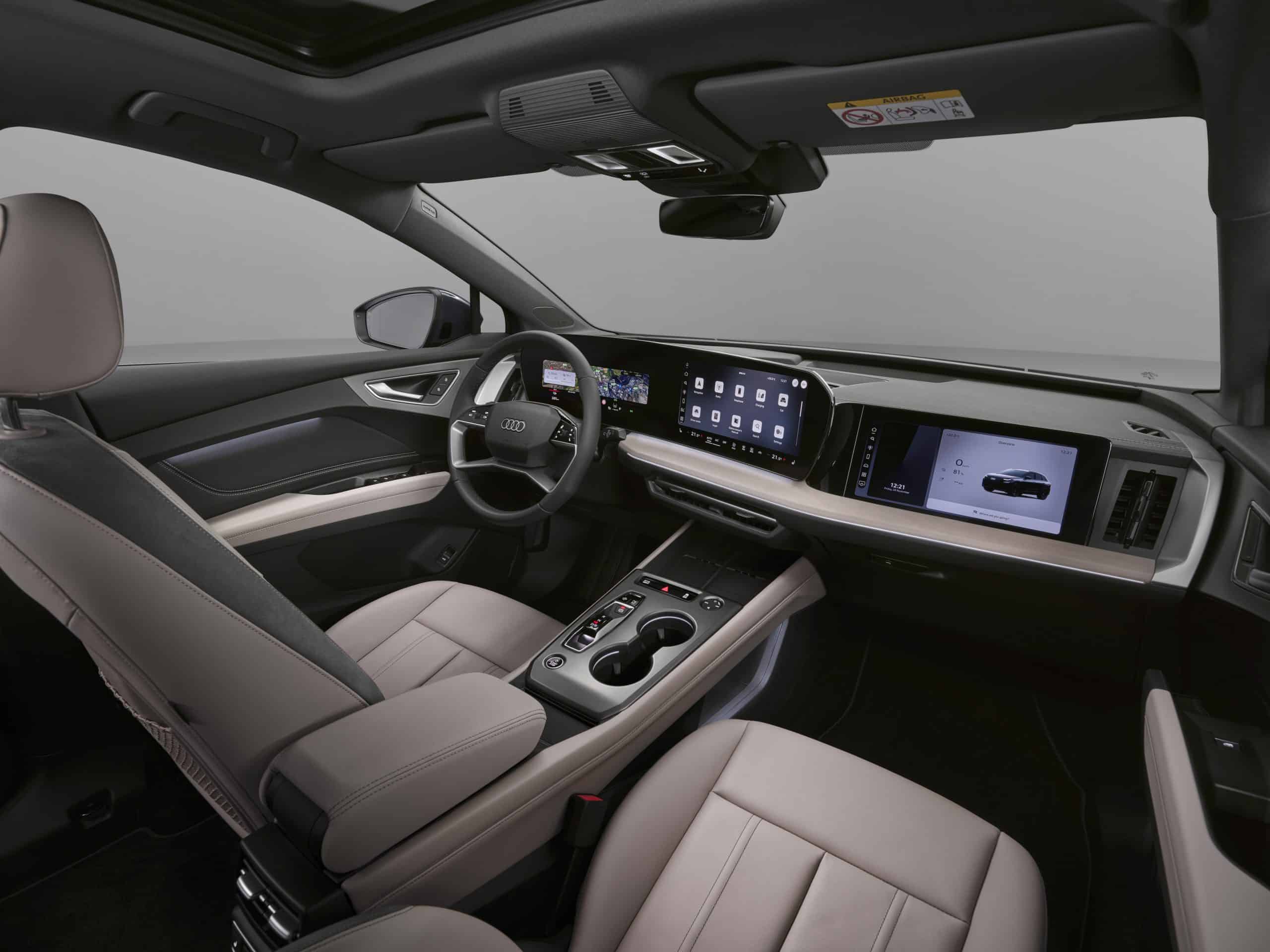
The cabin has been redesigned from the ground up around what Audi calls the digital stage. A panoramic display pairs an 11.9-inch instrument cluster with a 12.8-inch MMI touch display running on Android Automotive OS, giving direct access to apps through the Audi Application Store without needing a connected smartphone.
An optional 12-inch passenger display is available for the first time, the largest Audi has fitted to any model, featuring a customisable standby design that blanks when not in use. An augmented reality head-up display projects navigation arrows and driver assistance prompts onto the windscreen in two layers, with AR content appearing to float around 10 metres ahead of the driver.
The intelligent Audi assistant now integrates ChatGPT, allowing natural language conversations with the car. Occupants can ask questions, request information, or control vehicle functions by voice without needing to learn specific commands. Two cooled wireless charging trays, each delivering 15 watts, sit in the centre console alongside two USB-C ports, with two more available optionally in the rear.
The physical environment has been upgraded too. A Softwrap surface spans from the doors across the full width of the dashboard, creating a cohesive feel. Sport seats are standard across all trims. Cushioned knee pads, premium stitching, and scratch-resistant surfaces raise the perceived quality compared to the outgoing model. An optional Sonos premium sound system is available, and dynamic interaction lighting below the windscreen responds to navigation prompts and assistant interactions.
Updated Exterior And Lighting
The exterior changes are evolutionary rather than revolutionary, but they sharpen the car’s presence noticeably. The Singleframe grille is now colour-matched to the body, short front overhangs and functional air intakes improve aerodynamics, and a redesigned rear diffuser and spoiler clean up the airflow at the back.
The more significant update is the lighting. Digital LED daytime running lights at the front use segmented technology to create selectable light signatures that can be changed through the infotainment system. At the rear, second-generation digital OLED lights use six panels with 284 segments to generate dynamic light patterns that refresh multiple times per second.
An optional proximity detection system uses the rear lights to warn following vehicles if they come too close to the car when it is stationary, adding a genuine safety function to what might otherwise be a purely aesthetic feature. Three new exterior colours and five new wheel designs round out the visual changes.
UK Pricing And Availability
Orders open in the UK during June 2026 with deliveries expected later in the summer. The range is structured across four trim levels: Sport, S line, Black Edition, and Vorsprung, each available with three powertrain options.
The entry point is the Q4 e-tron Sport with 204 PS rear-wheel drive at £46,260. The mid-range Q4 e-tron performance Sport with 286 PS comes in at £50,960, and the all-wheel drive Q4 e-tron quattro performance Sport with 340 PS starts at £55,960. The Sportback body style adds £1,900 across the entire range.
At the top of the range, the Vorsprung specification with quattro drive and 340 PS reaches £68,660. For US buyers, the Q4 e-tron starts at $50,600.
All models are offered with a choice of 63 kWh or 82 kWh batteries, and standard equipment across the range includes an electric tailgate, the 520-litre boot expanding to 1,490 litres with the rear seats folded, parking system plus with distance display, lane departure warning with emergency assist, and traffic sign recognition.
Sources
Audi Q4 e-tron: The Electric Bestseller Gets an Upgrade (Audi MediaCenter) 2026 Audi Q4 e-tron Overview (Audi USA) 2026 Audi Q4 e-tron Pricing (Edmunds)

Leave a Comment
More in News

How to Free a Frozen Handbrake (and What a New Cable Costs)

What Winter Tyres Actually Do for UK Drivers (and Whether You Need Them)

Renewing Car Insurance on the Day Cover Ends Costs Drivers £331 More, MoneySupermarket Shows

Every Driver Faces £500 Seatbelt Fines as AI Cameras Flag 19,145 Possible Offences

How to Remove Moisture From Inside Your Headlight Before It Costs You £500
Trending on Motoring Chronicle

Why a Blocked DPF Fails Your MOT and Costs £1,000 to Put Right

Millions of Electric Car Drivers Now Pay 77p a Unit for Public Charging, More Than Petrol
Why Staging a Car Crash Could Soon Mean Life in Federal Prison

How to Tell if a Slow Puncture Is Repairable (and What It Costs)
