
Mitsubishi ASX VR-e Electric Car From $46,740 RRP, $45,990 Drive-Away


- The Mitsubishi ASX VR-e costs $46,740 to $64,990 RRP across four grades, with National Launch Drive-Away prices of $45,990 to $68,990.
- The maker’s WLTP range runs from 403 km on the LS to 328 km on the GSR, and DC fast charging peaks at 134 kW.
- An 8 year/160,000 km battery warranty and ten capped services totalling $4,490 come with the car, but the 10 year warranty needs every service done at a Mitsubishi dealership.
Four Grades, and the Drive-Away Price Is Not Always Lower
Mitsubishi Motors Australia has priced its first battery electric ASX, the VR-e, and set a National Launch Drive-Away offer on all four grades. The cars reach showrooms in late 2026. The entry LS has a recommended retail price of $46,740 and a launch drive-away price of $45,990. The Aspire is $53,990 on both measures. The Exceed lists at $57,990 RRP and $58,990 drive-away, and the flagship GSR at $64,990 RRP and $68,990 drive-away.
“The Mitsubishi ASX VR-e has generated great excitement since we confirmed its arrival in Australia,” said Shunichi Kihara, chief executive of Mitsubishi Motors Australia.
Kihara spoke of what the car offers local buyers.
“For us, the ASX VR-e is an exciting opportunity to bring Australian customers the latest in BEV technology, backed by the trust and experience Mitsubishi has built over many decades in this market.”
The two price columns do not move together. The LS drive-away price sits $750 below its RRP, which is the only grade where the launch figure undercuts the sticker. The Aspire is identical either way. The Exceed costs $1,000 more drive-away than its RRP, and the GSR costs $4,000 more. The maker has not itemised what each drive-away figure includes, so ask the dealer what the gap between the two columns covers.
The steps between grades run $7,250 from LS to Aspire, $4,000 from Aspire to Exceed and $7,000 from Exceed to GSR, a spread of $18,250 from bottom to top at RRP.
What Each Grade Adds
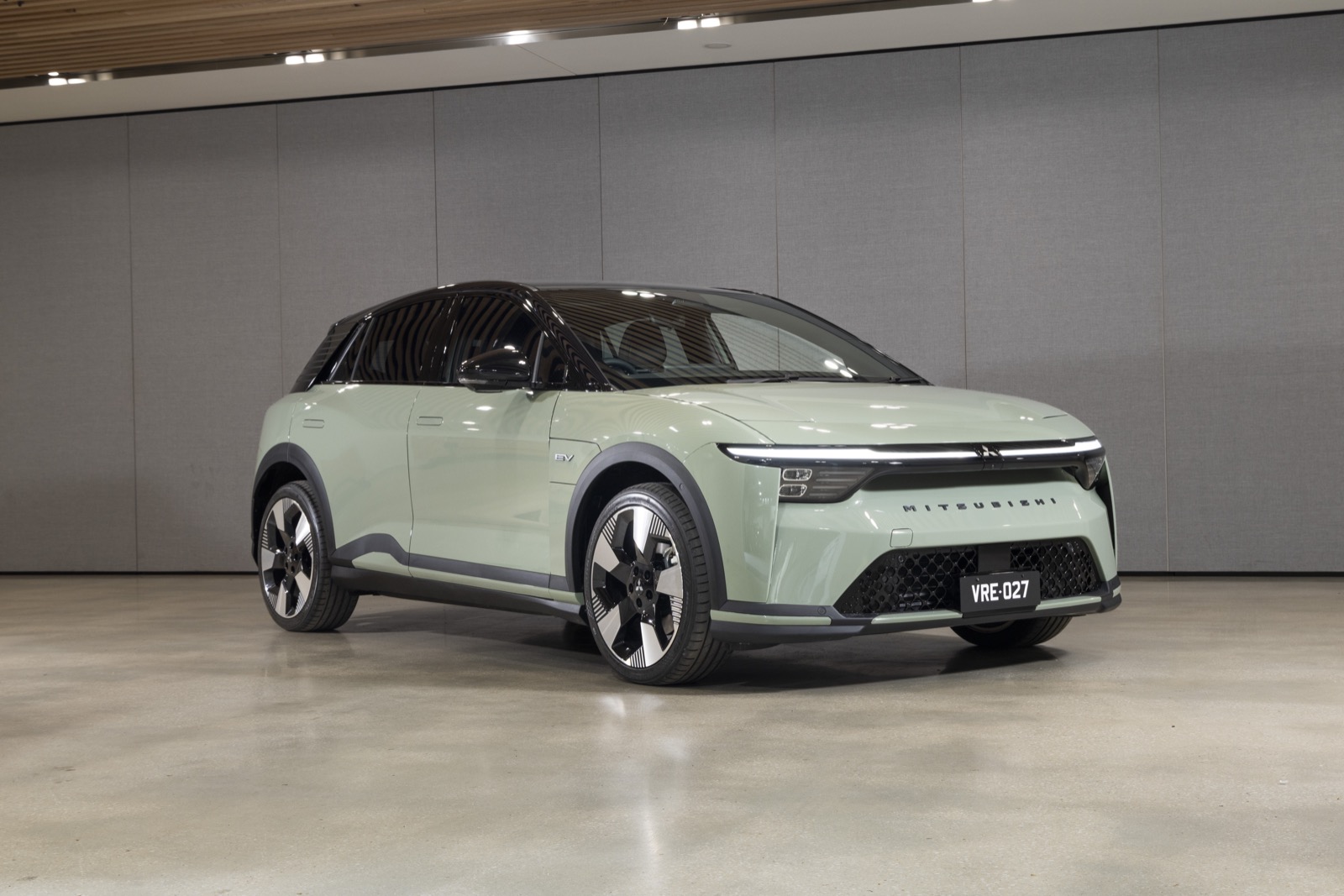
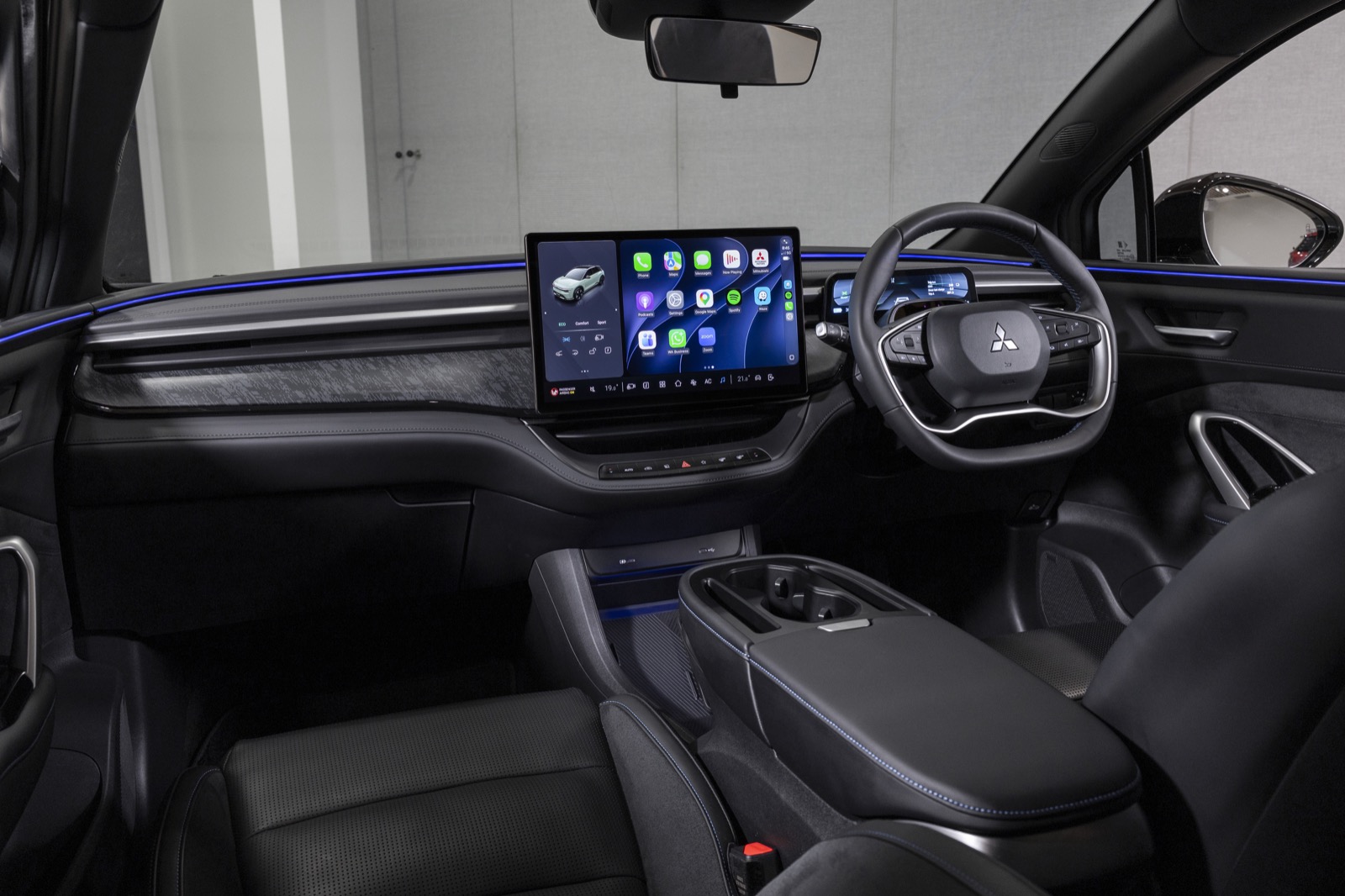
All four grades share a 57.7 kWh lithium iron phosphate battery from CATL, a 15.6 inch central touchscreen, a 9.2 inch driver display, wireless Apple CarPlay and Android Auto, dual-zone climate control, a driver monitoring system and vehicle to load output through the external AC charging port. The body measures 4,315 mm long, 1,885 mm wide and 1,535 mm tall on a 2,800 mm wheelbase, and the maker quotes a drag coefficient of 0.26. Pininfarina designed it.
The LS, Aspire and Exceed each use one rear motor driving the rear wheels, rated at 171 kW and 345 Nm. The LS runs 18 inch alloys, cloth seats, manual seat adjustment, six speakers and a rear view monitor with two rear parking sensors.
The Aspire adds automatic flush door handles, power front seats with memory, heating and cooling, 64 colour ambient lighting, a front boot (frunk) with an electric release, adaptive driving beams, six parking sensors at each end, a 360 degree camera and autonomous parking.
The Exceed adds 20 inch two-tone wheels, a panoramic glass roof, a hands-free electric tailgate and a 12 speaker SEAS audio system. The GSR carries all of that and adds a second motor at the front, for all-wheel drive with 342 kW and 700 Nm, a two-tone paint finish with a black roof, microsuede seat trim with blue stitching and a 0 to 100 km/h time of 3.9 seconds by the roll-out method. The maker calls it the most powerful Mitsubishi it has sold locally.
The active safety list includes adaptive cruise control with lane following, automated emergency braking, forward collision warning, blind spot detection, rear cross traffic alert, lane departure warning, traffic jam assist and traffic sign recognition. The maker states no ANCAP rating for the VR-e, and ANCAP’s own site shows none for it yet, so confirm the rating at ancap.com.au before signing. The petrol ASX on sale carries its own ANCAP rating, which does not transfer to the electric car.
Kihara credited the engineering partnership with Foxtron Vehicle Technologies.
“Our collaboration with Foxtron Vehicle Technologies has brought together FVT’s advanced EV technology and Mitsubishi’s deep understanding of Australian customers and driving conditions, which makes ASX VR-e drive and feel the way a Mitsubishi should.”
Mitsubishi says suspension and steering were tuned after road testing on local roads and in Taiwan and Japan. Steering effort has three settings (light, standard and heavy) chosen on the central screen, separate from the ECO, Comfort and Sport drive modes.
Range and Charging Times
The maker’s WLTP figures fall as the grade climbs: 403 km for the LS, 398 km for the Aspire, 380 km for the Exceed and 328 km for the GSR. Divide each RRP by its range and the LS costs about $116 for every WLTP kilometre, the Aspire about $136, the Exceed about $153 and the GSR about $198. The GSR gives up 75 km against the LS for $18,250 more.
On a CCS2 public fast charger the car accepts up to 134 kW, and the maker puts a 10 to 80 per cent charge at about half an hour. That is 40.4 kWh of a 57.7 kWh pack in roughly 30 minutes, an average near 81 kW, well under the peak figure. Home charging is slower. A 6.6 kW AC charge from 10 to 100 per cent takes about 10 hours, and the standard Mode 2 cable, at 3.5 kW, takes about 20 hours. The maker calls these times indicative and says charging conditions change them.
A Mode 3 cable is a dealer-fit accessory. Mitsubishi has also partnered with JET Charge, so owners can buy a home charging setup through a dedicated Mitsubishi web page. Anyone who plans to charge at home daily should price the wall unit and installation alongside the car, as 20 hours on the Mode 2 cable suits an occasional top-up. The car’s app shows charge history and lets owners pre-cool the cabin and open the windows remotely, and over-the-air updates add features after delivery.
Battery Warranty and the 10 Year Condition
The drive battery carries a warranty of eight years or 160,000 km for defects in materials and factory workmanship. A separate Drive Battery Capacity Care Program promises that the battery keeps at least 70 per cent of its usable energy capacity over that period. For comparison, Mitsubishi’s warranty page sets the same program at 66 per cent for the Outlander plug-in hybrid, and that page does not list the VR-e yet, so the 70 per cent figure rests on the maker’s statement for the new car.
The headline cover is the Diamond Advantage 10/10/10 package: a 10 year/200,000 km manufacturer’s warranty, 10 year capped price servicing and 10 year roadside assistance. Kihara pointed to it as the reassurance for buyers.
“The result is a distinctively designed, beautifully detailed and connected electric vehicle that we believe will appeal strongly to Australian customers. As a software-defined vehicle, it also has the ability to evolve through software updates over its life. And importantly, ASX VR-e customers will have the confidence of our full Diamond Advantage 10/10/10 aftersales program,” he said.
The condition sits in the fine print. The 10 year/200,000 km warranty applies when every scheduled service is completed within the specified intervals at a Mitsubishi dealership. Miss that, or service the car elsewhere, and the cover is 5 years or 100,000 km, whichever comes first. Some government, rental and national business customers are excluded. Mitsubishi’s warranty page also lists a 5 year perforation corrosion warranty with its 10 year cover, and says warranties transfer to the next owner, so ask whether both apply to the VR-e.
Roadside assistance follows the same pattern. It starts at 12 months and extends by a further 12 months each time an eligible capped price service is completed, up to 10 years.
Ten Years of Capped Servicing Costs
Every VR-e has 12 month or 15,000 km service intervals, whichever comes first. The capped price schedule runs for the first ten scheduled services, or 10 years or 150,000 km, whichever comes first. Service 1 at 12 months costs $199, service 2 at 24 months $449, service 3 at 36 months $199, service 4 at 48 months $449 and service 5 at 60 months $199. Service 6 at 72 months jumps to $799, service 7 at 84 months drops to $299, service 8 at 96 months returns to $799, service 9 at 108 months costs $299 and service 10 at 120 months, or 150,000 km, costs $799.
The ten services add up to $4,490, an average of $449 a visit. The first five cost $1,495 between them and the last five $2,995, with services 6, 8 and 10 at $799 each, about four times the first visit. An LS buyer at $45,990 drive-away who completes every service on the schedule will have spent $50,480 on the car and its capped servicing.
Two limits apply. The capped schedule stops at 150,000 km, while the warranty runs to 200,000 km, so a car that covers distance faster than 15,000 km a year reaches the end of the price cap before the end of the 10 years. Mitsubishi’s servicing page also excludes consumables such as brake pads, wiper blades, tyres and batteries, plus accident damage and extra work a dealer recommends, and says non-scheduled items cost extra. The same page says Mitsubishi can vary the program’s terms without notice, so get the VR-e schedule in writing at purchase.
What To Check Before Ordering
Ask each dealer for an itemised drive-away quote. The LS is the only grade where the launch figure sits under the RRP, and the maker has stated no end date for the National Launch Drive-Away offer, so ask whether one applies. Set the VR-e’s total against another electric SUV, such as the XPENG G6 drive-away prices on the site.
Then work out your own driving. The EV Council fuel cost figures put the fuel price rise at $442 extra a year for a small petrol SUV driven 15,000 km, against $48 for an equivalent electric car charged mostly at home. A car covering 15,000 km a year completes its tenth capped service at the 10 year mark, and a car covering more reaches the 150,000 km limit sooner. A buyer who plans to service away from a Mitsubishi dealership gives up the 10 year warranty and keeps the 5 year/100,000 km cover, so that choice belongs in the price comparison.
Finally, check what is unconfirmed: the ANCAP rating, the offer end date and the VR-e entry on Mitsubishi’s capped price servicing page. Mitsubishi’s site carries a register-your-interest link for the car. The Mode 3 cable is a dealer-fit accessory, so ask its price, and the Mitsubishi Pajero launch accessories story covers how the brand handles accessories on another new model.
Want more car content? Add us as a preferred source on Google to your favourites list for the best automotive news and analysis on the internet.
If you enjoyed this article, be sure to follow us on Microsoft Start.
Reviewed by Preetam Gadekar

Leave a Comment
More in News
Perth Petrol Jumped 13 Cents to 206.8 Wednesday, $42 a Tank Between Sites
Used Non-Hybrid Petrol Cars Lost Five Times More Value in 2026 Than 2025
Virginia’s Hampton Roads Tunnel Tolls Rise Jan. 1, Peak E-ZPass Hits $3.52
Long Beach Speed Camera Fines of $50 to $500 Start Dec. 7
Why Cars Stall: One Parts Maker Lists Stalling for Only Five of 14 Components
Trending on Motoring Chronicle

Tennessee Will Require Proof of Lawful Presence for New Plates From Jan. 1
Why Hagerty’s Index Shows Classic Car Values at Their Lowest Since 2018
Why Any Warning Light on Your Dashboard Will Now Automatically Fail Your MOT

Legal Challenges Could Freeze Some Car Finance Payouts as Final Deadline Passes
