GM EVs Can Power Your Home and Cut Bills Through Bidirectional Charging


Most electric cars only draw power in one direction, pulling electricity from the wall to fill their batteries. General Motors is building its electric vehicles to send power the other way too, a feature that can turn a parked EV into a home backup generator and, in some areas, a way to lower electricity bills.
Models including the Chevrolet Equinox EV, GMC Sierra EV, and Cadillac LYRIQ are built with bidirectional charging. GM has explained how the technology works across two features, Vehicle-to-Home and Vehicle-to-Grid, and what owners need to use each one.
Vehicle-to-Home Turns Your EV Into a Backup Generator
Vehicle-to-Home, or V2H, lets a compatible GM EV power a house during an outage. If a storm knocks out the grid, the car can feed electricity back into a properly equipped home to keep essentials running, such as the refrigerator, lights, and air conditioning.
Using it takes more than the car alone. Owners need a V2H-capable GM EV plus the GM Energy V2H system, which includes a bidirectional charger and an enablement kit. The setup is designed so the vehicle can run home appliances safely without pushing electricity back down the public power lines, where utility crews may be working during a repair. GM notes that some devices, including medical equipment, should not be run from the charger and enablement kit, so households that depend on such devices still need a dedicated power source.
Vehicle-to-Grid Can Help Lower Electricity Bills
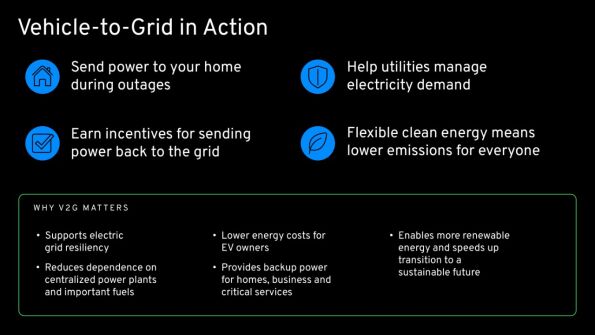
The second feature, Vehicle-to-Grid or V2G, connects a compatible GM EV to the local power grid through participating utility programs where they are available. In that setup, the vehicle can send energy back to the grid during normal operation, which can support local infrastructure and, in some cases, save the owner money.
Electric grids face heavy strain during heat waves and winter storms as demand climbs. To meet those peaks, some utilities run expensive, higher-emission backup plants. GM points out that thousands of parked and plugged-in EVs feeding small amounts of power back could help meet that demand without firing up the extra plants. For owners, the appeal is the chance to use less grid power during costly peak hours and potentially trim monthly bills.
What Owners Need and the Fine Print
Both features depend on the right equipment and local support. GM lists the requirements as a compatible GM EV, active OnStar services where they apply, GM Energy bidirectionally capable products, a properly equipped home, and, for V2G, an available utility program in the owner’s area.
The company is clear that savings are not guaranteed. Potential savings vary with the local utility tariff, time-of-use rate eligibility, electricity usage, charging and discharge behavior, the vehicle’s state of charge, equipment configuration, and other factors. Power supply during an outage can also be interrupted and depends on conditions and usage. In other words, the hardware sets up the capability, but how much value an owner sees will depend on where they live and how their utility handles these programs.
Why Bidirectional Charging Appeals to EV Buyers
For shoppers weighing an electric vehicle, bidirectional charging adds a practical reason beyond daily commuting. A home in a storm-prone region gains a backup power option that doubles as the family car, which can reduce the need for a separate standby generator. Buyers in areas with time-of-use electricity rates may value the chance to shift when they draw and return power.
The capability is becoming a point of difference among electric vehicles, and GM is fitting it across a growing list of models rather than reserving it for a single flagship. Owners who want to take full advantage will still need to budget for the GM Energy hardware and check what their utility supports, but the underlying ability is built into the vehicles from the start. As more utilities open V2G programs, the EV sitting in the garage could play a larger part in how a household manages its energy.

Leave a Comment
More in News

Defrosting Your Windscreen the Wrong Way Can Crack It in Seconds This Autumn

Aion V review: Promising debut EV from a new brand to the UK
Only 33 Percent of UK Drivers’ Car Insurance Complaints Succeed With the Financial Ombudsman

What Actually Happens When You Make a Car Insurance Claim After a Crash
London Drivers Pay £577 for Car Insurance, 76 Percent More Than Wales, Go.Compare Reveals
Trending on Motoring Chronicle
Aerospace industry-grade carbon fibre comes to supercars with McLaren ART carbon [Photo Gallery]

Seven common myths about electric vehicles, debunked
Reimagined for premium living and rugged adventure: Kia reveals the next-generation 2027 Telluride SUV

HMRC Tax Change Costs Pickup Truck Drivers Up To £2,000 More a Year