Why A Man Who Walked To The North Pole In Darkness Drives A Lamborghini Temerario


Mike Horn has circumnavigated the globe via both poles. He has walked solo along the entire equator without motorised transport, a journey that took 18 months. He has followed the Arctic Circle for 20,000 kilometres without stopping, climbed four of the world’s highest mountains without supplemental oxygen, and trekked to the North Pole in total winter darkness for 183 days straight. When asked why, his answer is disarmingly simple.
“On average we have 30,000 days of life, and we’ll spend half of that asleep. Don’t wait until tomorrow, be Temerario: fearless, intrepid.”
That word, Temerario, is why Horn and Lamborghini found each other. It is the name of the Italian manufacturer’s newest supercar, and it translates roughly as bold to the point of recklessness. For a man who has spent three decades deliberately placing himself at the outer limit of human endurance, the fit is not subtle. But then, neither is the car.
The Machine Behind The Name
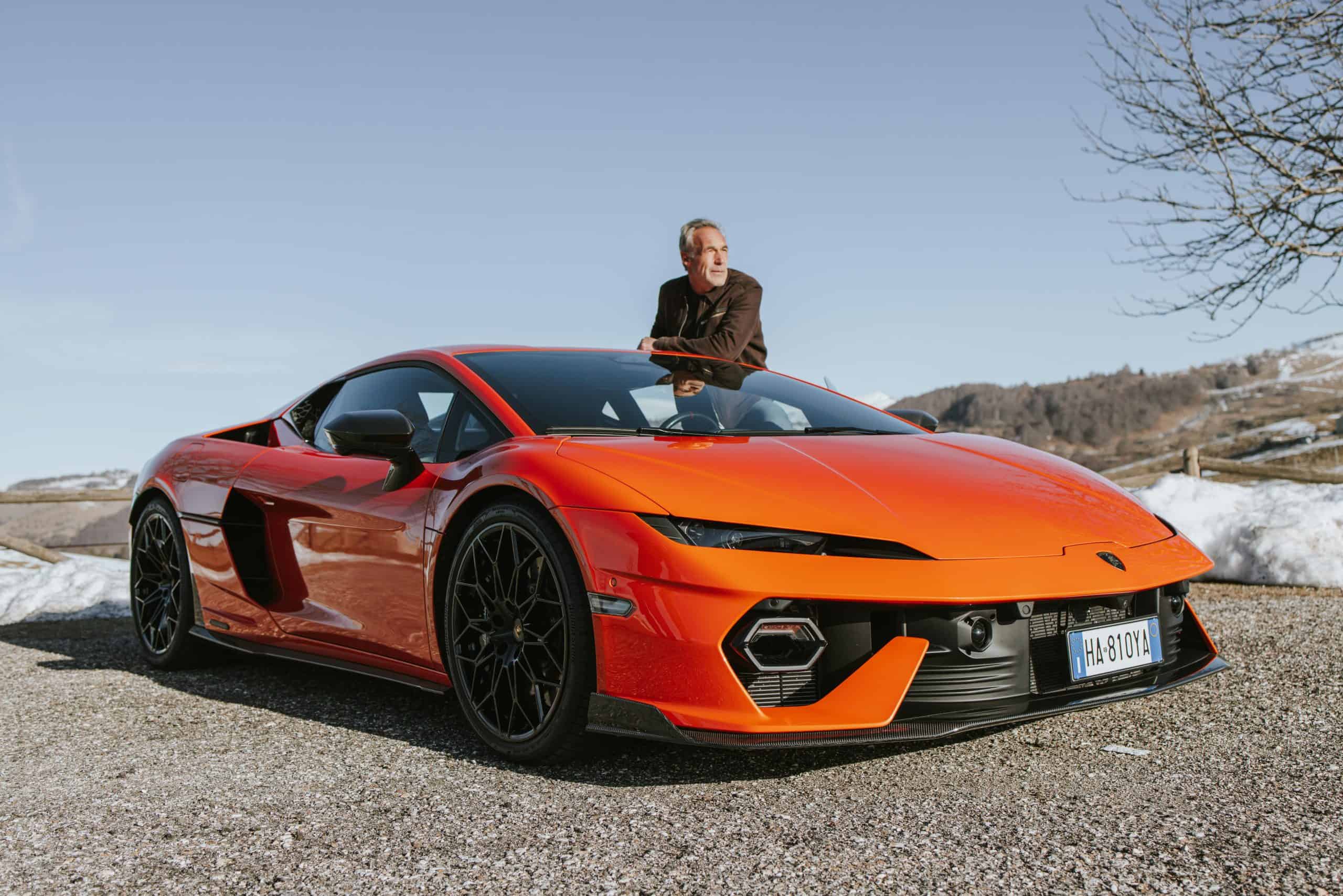
The Lamborghini Temerario is what the company calls a High-Performance Electrified Vehicle. Beneath the bodywork sits a brand new twin-turbocharged V8 paired with three electric motors, producing a combined output of 920 CV. The V8 alone revs to 10,000 rpm, making the Temerario the first and only production super sports car to reach that threshold. For context, a Formula 1 engine is capped at 15,000 rpm. Most road car engines run out of breath somewhere between 6,500 and 8,000. The Temerario sits in territory that was previously the exclusive preserve of naturally aspirated exotics like the Lexus LFA and the Ferrari LaFerrari.
The three electric motors do not simply supplement the combustion engine. They transform the way the car delivers its power. Instant torque from standstill, seamless transitions between electric and hybrid modes, and the ability to recover energy under braking all feed into a powertrain that Lamborghini describes as emissions reduction with heightened performance. In real terms, that means a car that is measurably faster than its predecessor while consuming less fuel in combined driving. The official figures list combined consumption at 11.2 litres per 100 km plus 4.3 kWh of electrical energy, with CO2 emissions of 272 grams per kilometre.
This is Lamborghini’s answer to the question every supercar manufacturer is grappling with: how do you electrify without diluting the experience? Ferrari went hybrid with the SF90. McLaren built the Artura around a V6 and electric motor. Lamborghini has chosen to keep the V8, keep the revs stratospheric, and let the electric motors handle the heavy lifting at lower speeds. It is a different philosophy, and one that prioritises the visceral sensation of a high-revving engine above all else.
Born On The Track
The Temerario also has a racing sibling. The Temerario GT3 is the first competition car designed and developed entirely in-house by Lamborghini and its Squadra Corse racing department. It uses the same V8 engine but without the hybrid system, as current GT3 regulations do not permit electrified powertrains. It is already being prepared for entry into GT3 championships worldwide.
For Horn, the connection between the road car and the race car mirrors his own experience. “My world is uncompromising, like Lamborghini,” he says. “I must always perform at my absolute best. I plan, I design every expedition, every iteration. I lead my team to perform at the pinnacle of possibility, and we are subject to the extremes of emotion: excitement, elation, pure adrenaline and of course fear. But fear is simply the unknown. When you face it and overcome it, you transcend to another level.”
It is a bold claim from anyone else. From a man who has spent 183 consecutive days walking through polar darkness, it lands differently.
Living On The Knife Edge
For the Temerario’s latest campaign film, titled Born Temerario, Lamborghini did not put Horn on a track or a closed road in the desert. They put him on snowy mountain roads in Italy, the kind of environment where the consequences of getting it wrong are immediate and real. It is a deliberate choice. Horn does not operate in controlled environments. His career has been defined by conditions that cannot be predicted, only responded to.
“Exploring on that knife edge, the cutting edge, is being in control but out of control at the same time,” he says. “This is adventure, this is exploration. It’s how I want my journey to be, the way I live my life.”
The parallel with driving a 920 CV supercar on a snow-covered alpine pass is obvious, but Horn pushes it further. “How you look out of the window at the race ahead is up to you. Discovery doesn’t lie at the very top of the mountain, or in the places you think you are trying to reach. Every time you head out there, you explore yourself and your potential. That is living.”
Horn’s philosophy strips away the marketing polish and gets to something more fundamental about why people are drawn to cars like the Temerario in the first place. It is not about top speed figures or lap times, though the Temerario has both in abundance. It is about the experience of operating at a level where concentration, skill, and machine work together at their absolute limit.
What The Temerario Means For Lamborghini
The Temerario occupies a pivotal position in Lamborghini’s line-up. It sits below the Revuelto flagship, which uses a V12 hybrid producing 1,015 CV, and represents the more attainable entry point into the brand’s future. If the Revuelto is Lamborghini’s statement of intent, the Temerario is the car that will actually sell in volume and define what the company looks like for the next decade.
Lamborghini’s broader heritage gives the Temerario a rich lineage to draw from. The company has always named its cars after fighting bulls, and the tradition of fearless, uncompromising machines stretches back through the Miura, the Countach, the Diablo, and the Murcielago. The company treats its past with the same intensity it brings to its future. The Temerario carries that weight, and the hybrid powertrain suggests Lamborghini has found a way to move forward without leaving its identity behind.
For Horn, none of that history is lost. “I am not arrogant, but I find the comparisons compelling,” he says. “Like the Temerario, it’s an intrepid explorer on road, and its GT3 race car brother is formidable on track. I’m not afraid to lose, but I’m going out there to win.”
He pauses, then offers the line that Lamborghini will almost certainly use on a poster somewhere: “The conclusion of our lives is always ultimately the same. It’s what we do with our waking hours in between start and finish, how we embrace our voyage that matters.”
Thirty thousand days. Half of them asleep. Horn is not wasting the rest.

Leave a Comment
More in News

Are There Warning Signs Before a Cam Belt Breaks? Usually One, and It Is Not the Belt

Fife and Dundee Cars Fail 38.6% of First Attempt MOTs, Nearly Double Sutton’s 20.3%

How to Tell If Rust Will Fail Your MOT (and What a Repair Costs)

Why Your Car Clicks But Won’t Start (and What to Do)
Diesel Drivers Pay £31 More Per Tank Than a Year Ago, DESNZ Data Shows
Trending on Motoring Chronicle
Average Used Car Now Costs £17,655 as Older Models Jump 10 Percent in a Year
Aston Martin Valkyrie ready for its moment of destiny in the 24 Hours of Le Mans

How a Deer Strike This Autumn Could Cost UK Drivers £2,713 in Repairs
Kia wins seven 2026 Best Cars for the Money Awards from U.S. News & World Report