What Is a Crossover SUV?


- A crossover SUV uses a unibody car platform instead of the body-on-frame truck chassis found in traditional SUVs, giving it a smoother ride and better fuel economy.
- Crossovers are lighter, easier to park, and more affordable to run than truck-based SUVs, which is why they account for the majority of SUV sales in the United States.
- If you need heavy towing capacity or serious off-road capability, a traditional body-on-frame SUV is the right tool. For daily commuting, family duties, and light trail use, a crossover does the job with fewer compromises.
The Platform That Separates a Crossover from a Traditional SUV
The terms “crossover” and “SUV” get used interchangeably at dealerships and in advertising, but they describe two different types of vehicles built in two fundamentally different ways. The distinction comes down to the platform sitting underneath the body panels. A traditional SUV sits on a body-on-frame chassis, the same ladder-style steel structure used in pickup trucks. A crossover SUV is built on a unibody platform, where the body and the structural frame are a single integrated unit, the same construction method used in sedans and hatchbacks.
That single difference in architecture affects everything about how the vehicle drives, how much fuel it uses, how much weight it can tow, and how it performs in a crash. Understanding it is the fastest way to figure out which type of vehicle fits your actual driving needs rather than your assumptions about the segment.
How Unibody Construction Changes the Driving Experience
Ride Quality and Handling
A unibody platform is structurally rigid in a way that benefits on-road comfort. The body and frame move as a single piece, which reduces the flexing and vibration that body-on-frame vehicles transmit to the cabin over expansion joints, potholes, and rough pavement. Crossovers ride more like the sedans they share their platforms with, and that shared engineering extends to the suspension tuning, steering calibration, and noise insulation.
Handling is noticeably sharper in a crossover compared to a truck-based SUV of similar size. The lower center of gravity that comes with unibody construction reduces body roll through corners, and the lighter overall weight means the brakes and tires have less mass to manage. For drivers who spend the majority of their time on paved roads, the crossover platform delivers a more composed, car-like feel behind the wheel. That lighter footprint also affects how quickly tires wear. Keeping your wheel alignment in check goes a long way toward getting even wear out of the smaller tire sizes most crossovers run.
Fuel Economy
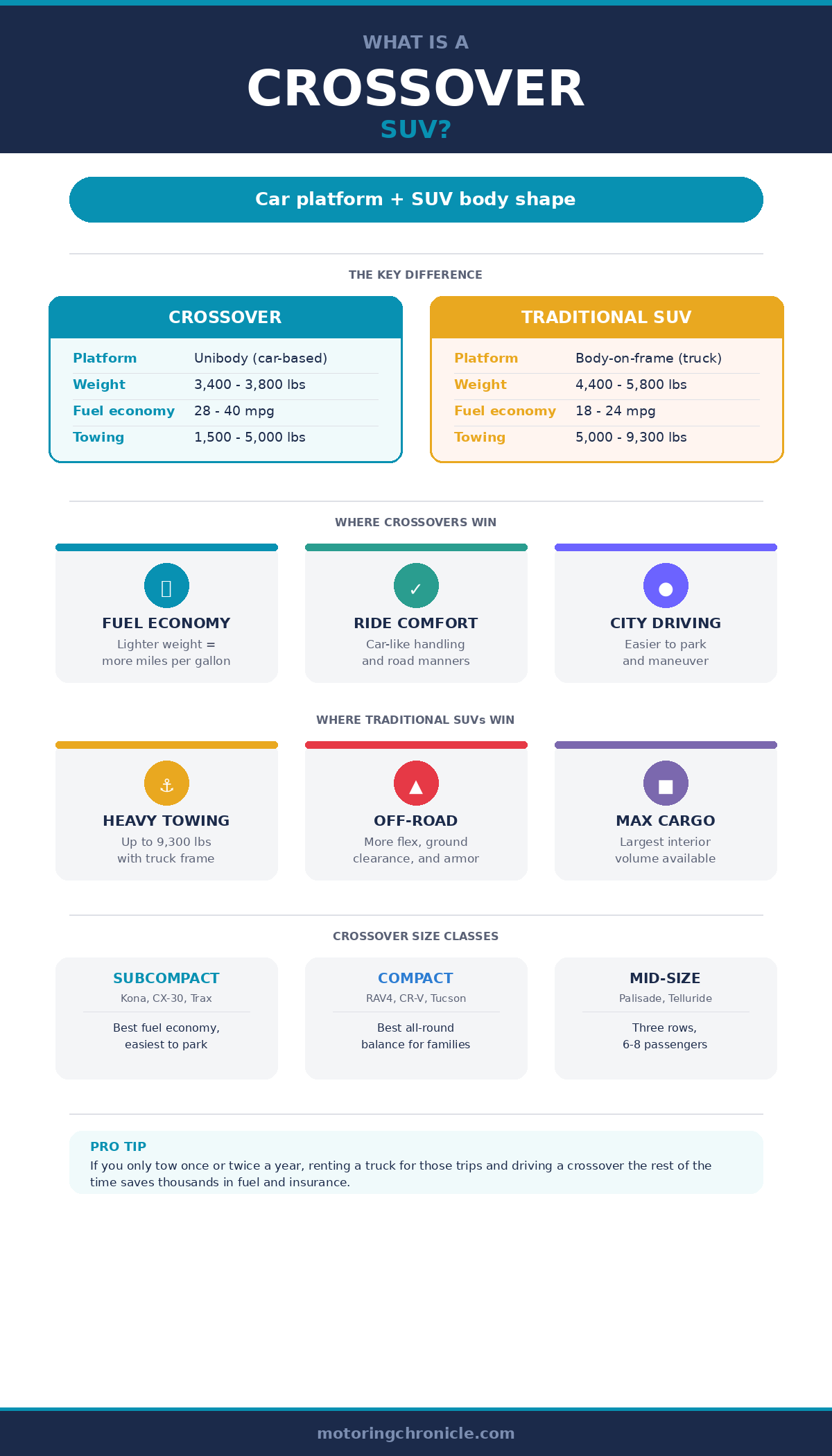
Weight is the single largest factor in fuel consumption, and crossovers are considerably lighter than their body-on-frame equivalents. A compact crossover like the Toyota RAV4 or Honda CR-V typically weighs between 3,400 and 3,800 pounds. A traditional mid-size SUV like the Toyota 4Runner or Chevrolet Tahoe sits between 4,400 and 5,800 pounds. That difference of 1,000 to 2,000 pounds shows up directly at the fuel pump.
A modern compact crossover returns between 28 and 40 mpg combined depending on the powertrain. Hybrid variants push that number even higher. A truck-based SUV in the same price range typically delivers 18 to 24 mpg combined. Over 15,000 miles of annual driving, the fuel cost difference between a 30 mpg crossover and a 20 mpg traditional SUV amounts to hundreds of dollars per year at current gas prices. For drivers looking to reduce that cost further, the same principles that apply to sedans also apply to crossovers. The basics of improving your gas mileage work just as well in a unibody SUV as in any other car.
Where Traditional SUVs Still Have the Advantage
Towing Capacity
Body-on-frame construction gives traditional SUVs a significant towing advantage. The steel ladder frame distributes the load of a heavy trailer across a rigid structure designed to handle torsional stress. A Chevrolet Tahoe can tow up to 8,400 pounds when properly equipped. A Ford Expedition reaches 9,300 pounds. These numbers place truck-based SUVs in the same towing class as the pickup trucks they share their platforms with.
Crossovers are not designed for that kind of load. Most compact crossovers are rated to tow between 1,500 and 3,500 pounds. Some mid-size crossovers reach 5,000 pounds with the right equipment. Attempting to tow beyond a crossover’s rated capacity puts excessive strain on the unibody structure, the transmission, and the cooling system. If your regular routine involves pulling a large boat, a horse trailer, or a camper over 4,000 pounds, a body-on-frame SUV or pickup truck is the right choice for the job.
Off-Road Capability
A body-on-frame SUV flexes over uneven terrain in a way that a unibody crossover cannot match. The separate frame allows the suspension to articulate more freely, keeping all four wheels in contact with the ground over deep ruts, rock gardens, and steep trail obstacles. Traditional SUVs also tend to have more ground clearance, shorter overhangs, and available locking differentials built for slow-speed trail work.
Crossovers with all-wheel drive handle gravel roads, muddy tracks, and light snow with confidence. Some models, like the Subaru Outback or Jeep Cherokee Trailhawk, come with dedicated off-road modes and additional ground clearance that push into moderate trail territory. What crossovers cannot do is sustain the kind of abuse that dedicated off-road vehicles are built to absorb. The unibody structure is less tolerant of repeated high-impact loads, and the lighter drivetrain components are not rated for continuous low-range crawling.
Why Crossovers Dominate the Market
The Shift from Sedans and Truck-Based SUVs
Crossovers are the best-selling vehicle segment in the United States. The Toyota RAV4 and Honda CR-V have consistently ranked among the top-selling vehicles of any type in recent years, outselling many sedan and truck nameplates. The reason is practical. Crossovers offer more cargo space and a higher seating position than a sedan, with fuel economy and driving dynamics that are much closer to a car than to a truck.
The higher seating position is one of the most cited reasons buyers give for choosing a crossover over a sedan. Sitting above surrounding traffic improves forward visibility and gives drivers a greater sense of control in congested conditions. The taller body also makes getting in and out easier for older passengers and anyone with limited mobility, a factor that sedan and coupe body styles cannot match without aftermarket modifications.
Cargo flexibility reinforces the appeal. Most crossovers feature a flat cargo floor with a rear hatch that opens to a wide loading area. Folding the rear seats creates a long, usable load space that handles flat-pack furniture, sports equipment, strollers, and luggage without the bed exposure of a pickup truck or the limited trunk depth of a sedan.
Safety and Crash Performance
Modern crossovers perform extremely well in crash testing. The unibody construction allows engineers to design crumple zones that absorb impact energy in a controlled sequence, directing force away from the passenger cabin. Several compact crossovers, including the Mazda CX-50, Hyundai Tucson, and Subaru Forester, have earned both NHTSA five-star overall ratings and IIHS Top Safety Pick+ designations.
Standard safety equipment on current crossovers typically includes automatic emergency braking, lane departure warning, adaptive cruise control, and blind-spot monitoring. Many of these features were limited to luxury vehicles a decade ago and are now included at no extra cost in base-trim crossovers from most manufacturers.
Common Crossover SUV Size Classes
Subcompact Crossovers
Subcompact crossovers are the smallest in the segment. Models like the Hyundai Kona, Mazda CX-30, and Chevrolet Trax offer the highest fuel economy and the smallest exterior footprint, making them the easiest to park and maneuver in tight urban environments. Cargo space is limited compared to larger crossovers, and rear-seat legroom can feel cramped for taller passengers. These are ideal for single drivers, couples, or small families who prioritize city driving and fuel cost over interior space.
Compact Crossovers
The compact class is where the bulk of crossover sales happen. The Toyota RAV4, Honda CR-V, Nissan Rogue, and Hyundai Tucson are the dominant players. These vehicles offer a strong balance of interior space, cargo volume, fuel efficiency, and price. Most seat five comfortably and return between 28 and 40 mpg combined. Available hybrid and plug-in hybrid powertrains push efficiency even higher. For the average family that needs one vehicle to handle commuting, grocery runs, road trips, and school drop-offs, the compact crossover is the most versatile answer in the current market.
Mid-Size and Three-Row Crossovers
Mid-size crossovers like the Hyundai Palisade, Kia Telluride, and Toyota Grand Highlander stretch the unibody platform into three-row territory. These vehicles seat six to eight passengers and offer cargo capacity that rivals traditional SUVs while maintaining the car-based driving dynamics and fuel economy advantage of a crossover. Towing capacity typically tops out between 3,500 and 5,000 pounds, which is enough for small utility trailers and lightweight campers but well short of what a body-on-frame SUV can manage. Keeping a larger crossover running well on a seasonal maintenance schedule is the most effective way to protect the investment over six or seven years of family duty.
How to Decide Between a Crossover and a Traditional SUV
The decision comes down to how you actually use the vehicle, not what you think you might need someday. If 90 percent of your driving is paved roads, highway commuting, and weekend errands, a crossover is the more efficient, more comfortable, and less expensive choice. It will cost less to buy, less to insure, less to fuel, and less to maintain over the ownership period.
If you regularly tow loads over 5,000 pounds, drive on unpaved trails with significant obstacles, or need the absolute maximum cargo volume for commercial or recreational purposes, a traditional body-on-frame SUV is the right tool. The ride quality and fuel economy penalty are the price of that capability, and for drivers who use it, the trade-off is worth it.
For drivers who fall somewhere in between, renting a truck-based SUV or pickup for the occasional towing trip and driving a crossover the remaining 50 weeks of the year is often the most cost-effective approach. The tire care and longevity benefits alone from running a lighter vehicle on everyday roads add up over the life of the ownership cycle.
Crossover SUV Frequently Asked Questions
Is a crossover the same as an SUV?
Not technically. Both are tall, wagon-style vehicles with elevated seating positions and cargo hatches, but they are built on different platforms. A crossover uses a unibody car platform. A traditional SUV uses a body-on-frame truck platform. The distinction matters for ride quality, fuel economy, towing capacity, and off-road capability. In everyday conversation and marketing, the two terms are often used interchangeably.
Are crossovers good in snow?
Yes, especially with all-wheel drive. A crossover with AWD and a set of winter tires handles snow-covered and icy roads with confidence. The lighter weight compared to a traditional SUV can be an advantage in slippery conditions, as there is less momentum to manage during braking and cornering. Ground clearance is lower than a truck-based SUV, so very deep, unplowed snow can become an issue at thresholds where a taller vehicle would still push through.
Can a crossover tow a trailer?
Most crossovers can tow light loads. Compact models are typically rated between 1,500 and 3,500 pounds, which covers small utility trailers, jet skis, and lightweight pop-up campers. Mid-size crossovers can reach 5,000 pounds with the right equipment. For anything heavier, a body-on-frame SUV or pickup truck is the safer and more capable option.
Why are crossovers so popular?
They combine the higher seating position and cargo space of an SUV with the fuel economy, ride comfort, and handling of a car. For the majority of buyers who never need to tow a heavy trailer or navigate a rock-strewn trail, the crossover delivers the practical benefits of an SUV without the weight, fuel cost, and driving compromises of a truck-based platform.
Sources

Leave a Comment
More in News

How Does Tire Pressure Affect Fuel Economy?

Mercedes Is Removing the Mechanical Link From Your Steering. Should You Be Worried?

Can an Electric AMG Actually Replace the V8? Here’s What We Know About the New GT 4-Door

2026 Mitsubishi Outlander Plug-In Hybrid Mid-Cycle Refresh Pricing To Start At $43,245

World premieres of new GLE and GLS marked by five-millionth model assembled at MBUSI in Tuscaloosa
Trending on Motoring Chronicle

Discovery gears up for luxurious road trips with new Tempest and Gemini editions [Photo Gallery]

Historic and modern Bugatti craftsmanship at Monterey car week 2025 [Photo Gallery]

How EV Brakes Actually Wear Faster Than You Think

The Amelia Concours-Winning 1938 Alfa Romeo 8C Earns The Peninsula Classics Best of the Best Award 2025