What a Red X Actually Means on the Motorway (and What to Do)

- A red X above a motorway lane means the lane is closed and you must not drive in it, so move into an open lane as soon as it is safe.
- Driving in a Red X lane can bring a fixed penalty of up to £100 (about $130) and three penalty points, and in some cases a court appearance.
- The lane stays closed until a sign shows a speed limit or the word END, even after you have passed the hazard.
A Red X Means the Lane Is Closed, and Driving in It Can Cost You £100 and Three Points
A red X above a motorway lane, or on a sign beside the carriageway, means that lane is closed and you must not drive in it. Move into an open lane as soon as it is safe, leave gaps for other drivers to do the same, and stay out of the closed lane until a sign cancels it. National Highways says that if you are caught you could receive a fixed penalty of up to £100 (about $130) and three penalty points, and in some cases more severe penalties or a court appearance.
That covers what to do. The sections below explain what the Highway Code says, which signs lead up to the X, why lanes close before you can see a problem, and what to do if you realise you have already passed one.
What the Law Says: Highway Code Rule 258
Rule 258 of the Highway Code says red flashing lights and a red X on a sign identify a closed lane in which people, stopped vehicles or other hazards are present. When you approach one, you must follow the instructions on signs in advance of the closed lane to move safely to an open lane. The rule also says you "MUST NOT drive in a closed lane".
The same rule says a sign tells you when the lane is no longer closed, by displaying a speed limit or the word END. Until you see that, the lane stays closed.
Rule 258 adds three warnings. There can be several hazards in a closed lane. Emergency services and traffic authorities use closed lanes to reach incidents and help people in need. And where the left lane is closed at an exit slip road, the exit cannot be used.
A full closure works differently. Where red flashing lights and closure of all lanes show on a sign, the road is closed. You must not go beyond the sign in any lane, or use the hard shoulder to avoid the closure, unless a police or traffic officer directs you to.
The Signs You Will See Before and After the Red X
National Highways describes a typical sequence. First comes a lane closure warning with a speed limit to obey. Next, a sign tells you to move into the next available lane as indicated by an arrow, and that sign might repeat. Then the Red X appears, and you must not enter or proceed in that lane. Finally, you see the national speed limit or a message that the restriction has ended.
Amber flashing lights come earlier in the system. Rule 257 says they warn of a hazard ahead, and you should reduce your speed and be prepared for the hazard. You should only speed up again when you pass a signal that is not flashing, or a sign showing the national speed limit or the word END, and you are sure it is safe.
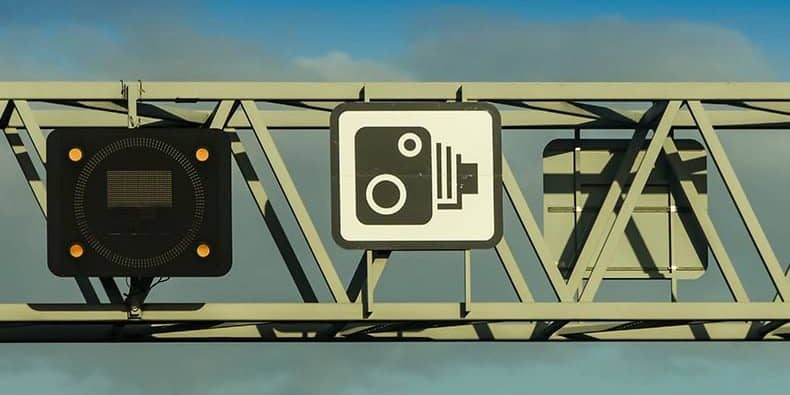
The signal appears in two forms. A single sign at the side of the motorway can show advice for all lanes, and lane-specific signs sit on the overhead gantries. National Highways says it is against the law to drive in a lane the Red X applies to, whichever form shows it.
Sometimes the X is set far ahead of the incident. National Highways says that gives emergency services access, or helps you rejoin the motorway from an emergency area. It asks drivers to leave gaps in the traffic so others can move into an open lane.
Do not slip back into the closed lane after passing a hazard. National Highways warns there might be other hazards further along the same lane.
Why Lanes Close Before You Can See Anything Wrong
The Highway Code explains in Rule 255 that signs and signals warn you of hazards ahead, such as an incident, fog, a spillage or road workers on the carriageway that you cannot yet see. The Red X belongs to that system.
National Highways says the Red X tells you when a lane is closed, which helps drivers and passengers who might have got into difficulty, and gives emergency services, recovery operators and its road workers a safe place to work.
On motorways where the hard shoulder works as an extra lane, Rule 269 says a red X or a blank sign above it means you must not use it except in an emergency. You can only use it as a lane when a speed limit shows above it. Rule 270 says emergency areas, marked by blue signs with an orange SOS telephone symbol, must only be used in an emergency.
Speed is the other reason signs come early. Rule 254 says traffic on motorways usually travels faster than on other roads, so you have less time to react, and it tells drivers to use their mirrors earlier and look much further ahead. A lane closure sign that appears well before the X gives you that time.
In practice, treat the first amber flashing signal as your cue. Check your mirrors, look for a gap in the next lane, reduce your speed as the sign asks and move across early, so you are not trying to squeeze in beside a lorry at the last second.
What to Do If You Realise You Have Already Passed a Red X
Move into an open lane as soon as you can do so safely, using your mirrors and indicators as normal. The Highway Code tells drivers to follow the signs in advance of a closed lane to move to an open one, and the same logic applies if you spot the X late.
Do not stop in the lane, do not reverse and do not cut across other traffic. Rule 263 says you must not reverse along any part of a motorway unless directed by a police or traffic officer. Rule 271 says you must not stop on any carriageway except in an emergency, or when told to by the police, traffic officers, an emergency sign or red flashing light signals.
The penalty for driving in a Red X lane is a fixed penalty of up to £100 (about $130) and three points, according to National Highways, and in some cases the penalties are more severe or end in court. The Highway Code says closures shown by red flashing lights are enforced by the police.
Edge Cases: Exit Slip Roads, Hard Shoulders and Police Directions
Exit slip roads catch people out. If the left lane is closed at your exit, Rule 258 says that exit cannot be used, so plan to leave at the next junction and move over in plenty of time.
A police or traffic officer can direct you to use a closed lane or the hard shoulder. Both Rule 258 and Rule 269 allow for that, and it is the only time those rules give way.
A single sign can show a Red X for one lane alongside warnings and advice for others, as Rule 256 explains, so read the whole sign before you move.
Rule 264 adds a courtesy that helps everyone. If you are in the left lane and it is safe, move into the adjacent lane to give more space to emergency services, traffic officers, recovery workers and stopped vehicles on the hard shoulder or in an emergency area.
The rule is simple to follow and costly to ignore. Leave the lane early, leave gaps for others, and stay out until the sign says END or shows a speed limit.
Sources:

Leave a Comment
More in News

Tyres Make Up 60.6% of Dangerous MOT Defects While Lights Fail 10.4% of Cars

Vehicle Offences Fell 6.7% to 312,231 but Rose 19.9% in Gwent, ONS Shows
Every Driver Missing a ULEZ Payment Faces £180 as TfL Accepts 72% of Challenges

NHTSA Opens Defect Petition on Camshaft Claims in 54,787 Ford 7.3L Trucks and Vans

2027 Fiat Topolino Adds Open-Air Roof and Free Street-Legal Kit From $13,995
Trending on Motoring Chronicle

UK New Car Market Posts Best May Since 2019 as Private Buyers Return

Taking pride in perfection: The first officially certified and uniquely authentic Bugatti EB110 America [Photo Gallery]

Dodge Extends Durango Taillamp Warranty to Five Years, Unlimited Miles

Car Insurance Rises for the First Time in Two Years as Claims Hit £5,464