How Long Does an Auxiliary Belt Last? Almost Nobody Will Tell You


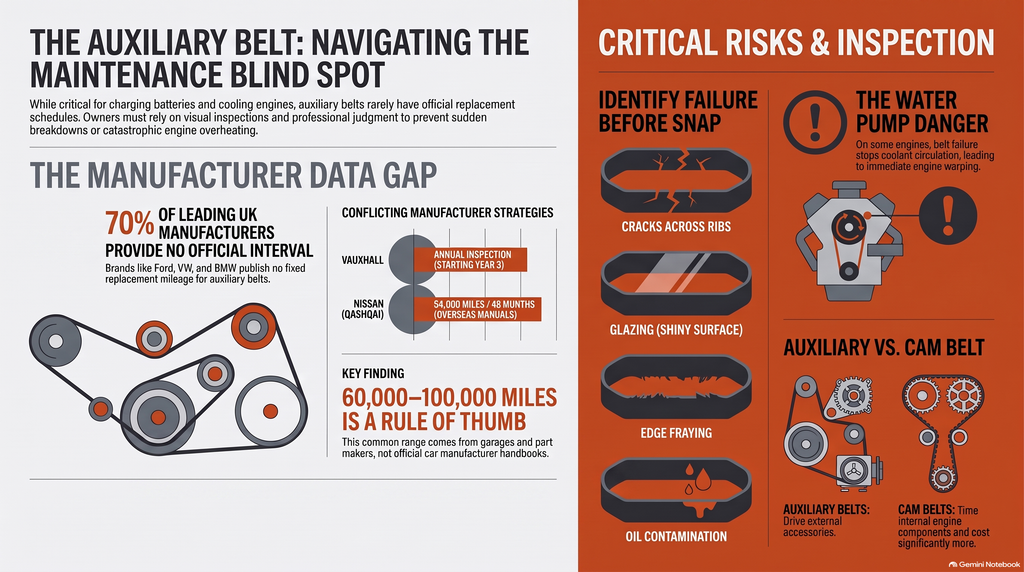
Most auxiliary belts are replaced somewhere between 60,000 and 100,000 miles, or whenever the belt looks past its best, and for most cars on British roads that range comes from garages, parts makers and repair guides rather than from the manufacturer. We checked what ten of the most common cars in the UK publish about this belt, and seven publish nothing at all. On some engines the belt also does a second job, one that turns a failure from an inconvenience into something far more serious than a flat battery.
Key takeaways:
- Most manufacturers publish no replacement interval for this belt, so its condition decides when it comes off.
- Where an official instruction does exist, it can be an annual inspection rather than a mileage figure, which is a different thing to ask a garage for.
- The signs are a squeal on start-up, cracking or glazing on the ribbed face, and a belt that has begun to fray at the edges.
What the Auxiliary Belt Does, and What It Is Called
This is the belt visible with the bonnet up, running around a set of pulleys at one end of the engine. It drives everything bolted to the outside of the engine that needs turning, and it is the belt most drivers have seen without knowing what it is called.
Half the confusion around it is a naming problem, and the other half is that it gets mixed up with a completely different belt that costs several times as much to replace.
One Belt, Several Names
Auxiliary belt, drive belt, ancillary belt and fan belt all describe the same component. Fan belt is the oldest of them, from the years when the belt turned the engine’s cooling fan, a job now done by an electric fan on almost every car. Serpentine belt is the American name and turns up constantly in online searches.
The American name describes the shape of the route. One long belt snakes around the crankshaft pulley, the alternator, the tensioner and whatever else the engine carries, held against each one by tension rather than teeth. The face that contacts the pulleys is ribbed along its length, which is what stops it wandering sideways.
A quote for any of those names is a quote for the same job. What changes the price is the engine, how much has to come off to reach the belt, and whether the tensioner is included in the work.
What It Drives
On a typical car the belt turns the alternator, which charges the battery and runs the electrics, the air conditioning compressor, and the power steering pump on cars with hydraulic assistance. Cars with electric power steering take that load off the belt entirely. On some engines it also turns the water pump, which is where the stakes change.
It is a different part from the cam belt. That one sits inside the engine behind a cover, out of sight, and times the opening and closing of the valves against the movement of the pistons. The auxiliary belt drives accessories. The cam belt keeps the engine’s internals from colliding.
Garages deal with the two being confused every week of the year. A cam belt job runs into hundreds of pounds and takes most of a day on many cars. An auxiliary belt is a far smaller piece of work, and anyone quoted a large figure for what they thought was the outside belt should check which belt the quote covers.
How It Fails
Belts fail by drying out and hardening. Cracks appear across the ribs, at first fine and then deep enough to see with a torch, and sections of rib eventually break away. A belt that has been slipping develops a glazed, shiny face, which cuts its grip further and makes the slipping worse.
Fraying along one edge points at misalignment rather than age. Something in the run of pulleys is sitting a fraction out of line, and replacing the belt without finding the cause gives the new one the same short life.
The tensioner and idler pulleys fail on their own account. A spring-loaded tensioner weakens over years, and the bearings inside idler pulleys wear until they rumble. Either can destroy a belt, or throw it off the engine entirely.
Oil is the other enemy. A leaking crankshaft or camshaft seal drips onto the belt, and oil softens the rubber and attacks the ribs, the same failure path that finishes a contaminated cam belt early.
What the Manufacturers Actually Publish
We took the ten most common cars licensed in the UK, ranked from Department for Transport vehicle licensing statistics for the first quarter of 2026, and checked one representative engine from each against the manufacturer’s own handbooks, owner sites, official parts shops and archived versions of pages that had changed, in September 2026.
An answer meant a figure or an instruction published by the manufacturer for that engine. Repair guides, forum threads and parts retailer estimates did not count. Of the ten, three gave an answer and seven gave nothing.
Seven of Ten Publish Nothing
The seven are the Ford Fiesta and Focus, the Volkswagen Golf and Polo, the Toyota Yaris, the MINI Cooper and the BMW 3 Series. Across handbooks, owner portals and parts systems, no replacement interval for the auxiliary belt surfaced for any of them.
Not found means we could not locate a published figure, rather than that no figure exists inside a dealer system we cannot see. It is the same pattern we documented when cam belt intervals stopped appearing anywhere an owner could look them up, on a belt where the stakes are usually lower.
For an owner of one of those seven, the practical position is that there is no published schedule to work to. The belt comes off when a garage judges it worn, or when it fails, and a dealer working from the manufacturer’s live service data is the only route to anything more definite.
The Vauxhall Instruction
Vauxhall is the exception worth knowing about. The handbooks for the Corsa 1.4 16V and the Astra 1.6 16V set no replacement mileage for the drive belt at all. What they do set is an instruction to have the belt inspected once a year, starting three years after the car was registered, with identical wording across six separate print runs covering both models.
An inspection instruction is not a replacement interval, and the difference changes what an owner asks for. It tells a garage to look at the belt annually and judge its condition. It names no mileage at which the belt comes off, and no age at which it is considered finished.
Acting on it costs nothing extra at a service. Ask for the drive belt and tensioner to be inspected as part of the work, and ask for the condition to be written on the invoice rather than mentioned in passing. A record of annual inspections is worth having when the car is sold.
The instruction covers a lot of cars. At the end of March 2026 there were 919,683 Corsas and 541,579 Astras licensed in the UK across all generations.
The One Real Replacement Figure, and Where It Comes From
The third answer is the only conventional interval in the whole exercise, and it is not a British document. Nissan’s periodic maintenance schedule for the 1.5 dCi engine used in the Qashqai sets the accessory belt at 90,000 km, about 54,000 miles, or 48 months, whichever arrives first.
That schedule was published for the South African market. It is solid evidence of what Nissan tells owners there, and no evidence at all of what applies to a Qashqai in Britain. Service schedules differ between markets with fuel quality, climate and local requirements, and the same engine can carry different figures in different countries.
It is also the same document that supplied the only current cam belt figure we could verify for a Qashqai, which says something about where these numbers now live. A British owner who wants the UK figure is back to asking a Nissan dealer against the registration.
Cars That Calculate It Instead
MINI and BMW publish nothing for a stated reason. Both use Condition Based Service, which works out what maintenance a car needs from how it has been driven rather than from a printed table of fixed intervals.
That is a design choice rather than an omission. The car monitors its own use and reports what is due, and the schedule reaching the owner is specific to their car rather than an average across the model.
It leaves one gap. A buyer looking at a used MINI or 3 Series has no published figure against which to check a seller’s claim about the belt, and the car’s service data is read at a dealer rather than found online.
So Where Do the Common Figures Come From?
Almost every page covering this subject quotes a range of roughly 60,000 to 100,000 miles. That range comes from garages, belt manufacturers and repair guides, built on what they see wearing out, rather than from any car maker’s published schedule.
As a rule of thumb it is reasonable. As a specification it is nothing of the sort for most cars, and a belt’s life varies with the material, the length of the run, the number of pulleys, the tension it works at and the heat around it.
The sensible use of the range is as a point at which to start having the belt looked at properly, rather than as a date on which the belt is due. On a car with no published interval, the only real schedule is condition.
Why It Is More Serious on Some Cars
What the belt turns decides what a failure costs. On most cars it drives accessories, and losing it strands the car without harming the engine. On some engines it also drives the water pump, and that is a different situation entirely.
When the Belt Drives the Water Pump
On the Vauxhall A-family 1.4 and 1.6 engines fitted to the Corsa and Astra, the water pump is turned by the accessory belt. The evidence sits in the parts trade rather than in a Vauxhall specification: four original equipment suppliers sell the water pump and the belt together as a single kit for this engine, which is how the trade packages a pump that the belt drives.
The consequence is what raises this above a charging fault. With the belt gone, coolant stops circulating through the engine while the engine keeps running and keeps making heat. The temperature gauge starts climbing within minutes, and an engine run hot enough can warp a cylinder head or worse, at a cost that dwarfs the belt.
On an engine of that type, a belt failure is a stop as soon as it is safe to do so, not a drive to the next junction on battery power. The charging warning light arrives first, the temperature gauge follows, and by the time the gauge is in the red the damage is already being done.
What Else Stops With the Belt
Charging stops on every car. The battery warning light comes on, the engine keeps running on whatever charge is left in the battery, and the car dies once that is gone, often within a few miles. A car that will not restart afterwards is a separate question, and the lights and the sound at the key tell you whether to suspect the battery or the starter. Headlights, wipers and a heated rear screen all shorten that further.
Cars with hydraulic power steering lose the assistance immediately. The steering does not lock, but it goes heavy at once, and it takes real effort at parking speeds and on tight turns. Electric power steering is unaffected, which covers most cars built in the last fifteen years or so.
Air conditioning stops too, which is the least of anyone’s problems. If the belt goes while driving, the answer is the same on any car: hazard lights on, pull over as soon as there is somewhere safe, and watch the temperature gauge on the way.
The Cars Where It Is Simpler
Where the belt drives accessories only, a failure is a recovery truck and a modest repair bill. The engine is not at risk, nothing overheats, and the car can be fixed at leisure once it is off the road.
That still leaves an owner stranded, and on a motorway at night the margin is the few minutes of lights the battery can support. A belt showing cracks or glazing before a long trip is worth dealing with beforehand.
Which category a car falls into is not obvious from the outside, and it varies by engine rather than by model name. It is one of the few questions where a phone call to a garage gives a definite answer.
What an Owner Should Actually Do
With no published schedule on most cars, two things carry the job: looking at the belt now and then, and asking a garage the right questions while the car is already in for something else.
The Check Anyone Can Do
Open the bonnet with the engine off and cold, and look at one end of the engine for a ribbed belt running between several pulleys. On some cars a plastic cover or the inner wing panel hides it, and that is where a driver’s check stops.
Look at the ribbed face for cracks running across the ribs, for shiny glazed patches, for frayed edges and for missing chunks of rib. Any oil or coolant on the belt is worth acting on by itself, both for what it does to the belt and for the leak it points to.
Sounds fill in the rest. A squeal on start-up, or when the air conditioning switches on, is a belt slipping on a pulley. A rumble or whine that rises and falls with engine speed points at a tensioner or idler bearing rather than the belt.
Replacement is a garage job on most cars. The belt runs around several pulleys under spring tension, and getting the old one off and the new one on square needs the right tool and often the removal of parts around it.
What to Ask a Garage For
Ask for the belt and tensioner to be inspected while the car is up for something else. A service, a tyre change or brake work all give access, and the check adds minutes rather than a separate booking and bill.
Ask whether the belt drives the water pump on that engine. It is a question a garage can answer from the engine code, and it decides how urgently a marginal belt needs replacing.
Ask for the tensioner to be quoted alongside the belt. A new belt on a tired tensioner runs at the wrong tension, slips or sits misaligned, and gives up years early, while the labour to get at it is the same either way.
On a Corsa or an Astra, name the annual inspection when booking the service and ask for the result to appear on the invoice. It is the one instruction in this research an owner can hold a garage to.
If you enjoyed this article, be sure to follow us on Microsoft Start.
Auxiliary Belt FAQs
How often should an auxiliary belt be changed?
There is no single answer, and for most cars there is no manufacturer figure at all. Our research found that seven of the ten most common cars on UK roads publish no replacement interval for this belt. Vauxhall asks for an annual inspection of the drive belt from three years after registration rather than setting a mileage, and the only conventional replacement figure we found, 90,000 km or 48 months for the Qashqai 1.5 dCi, comes from Nissan’s South African schedule rather than a UK document. The 60,000 to 100,000 mile range quoted across the internet comes from garages and belt makers, and UK repair guides put the working life at anywhere from 40,000 to 100,000 miles. In practice the belt is replaced on condition, which makes an annual look at it worth more than any number.
Can you drive with a worn auxiliary belt?
Usually yes, but not for long, and not on every car. A belt that is cracked, glazed or squealing is still turning the alternator, so the car drives normally until the belt gives up completely. The question is what the belt turns on that particular engine. Where it drives only the alternator, air conditioning and power steering pump, a worn belt is a job to book in soon. Where it also drives the water pump, as it does on the Vauxhall A-family engines in the Corsa and Astra, a failure stops the coolant moving and the engine overheats, so a worn belt on one of those is a job for this week rather than next month.
What happens if your auxiliary belt snaps?
The car loses its charging first. The battery warning light comes on, the engine keeps running on the charge left in the battery, and most cars stop within a few miles, sooner at night with the lights and heated screen drawing power. Cars with hydraulic power steering lose the assistance at the same moment, so the steering goes heavy immediately, though it does not lock. On engines where the belt also drives the water pump the situation is more serious: coolant stops circulating while the engine carries on making heat, and the temperature gauge climbs within minutes. On any car the right response is hazard lights, pull over as soon as it is safe, and call for recovery rather than pressing on.
Is the auxiliary belt the same as the alternator belt?
Yes. Alternator belt, fan belt, drive belt, ancillary belt and serpentine belt all describe the same belt, the one visible at the end of the engine when the bonnet is up. The names come from what the belt happened to drive at different points in motoring history, or in the American case from the way it snakes around the pulleys. The one name that means something different is the cam belt, or timing belt, which sits inside the engine behind a cover and times the valves. Any quote using the first five names is a quote for the same work.
How much does an auxiliary belt cost to replace?
It is one of the cheaper jobs on a car. UK price guides put a fitted auxiliary belt at roughly £40 to £60 at an independent garage and £50 to £130 at a franchised dealer on common models, with the belt itself often costing between £10 and £30 of that. Labour is usually under an hour where the belt is easy to reach, which is why the part and the bill are closer together than on most repairs. Two things push it up: an engine where covers, mountings or a wheel arch liner have to come off first, and a tensioner replaced at the same time, which is worth doing on a belt that has been slipping.

Leave a Comment
More in News

Woman’s plug-in hybrid minivan is driving ‘funny.’ Then the dealership takes it for 5 months

Man buys apple pie pocket at Kwik Trip. Then he takes a bite and immediately feels ill

Used MG HS Costs $16,992 Less Than New, but Jolion Saves Only $5,495
Greenwich to Restart School Zone Cameras With $50 Fines as Suit Seeks Refunds

Maryland Residents on Out-of-State Plates Face $7 a Day Fines After 60 Days
Trending on Motoring Chronicle

How to Wash Salt Off Properly in Winter

Plaid With Purpose: Jeep® Wrangler 85th Anniversary Edition Brings Heritage Style to Legendary Capability

Why GAP Insurance Paid Back As Little As 7 Percent of What Drivers Spent

Car Insurance Prices Just Rose for the First Time in Two Years, New Data Shows