
How Secret Police Tolerance Rules on Speed Cameras Could Cost UK Drivers £2,500


- Most UK police forces will only act on a speed camera reading once a driver passes the limit by 10 percent plus 2mph, but two forces use a wider margin and several refused to confirm theirs at all.
- A tiered fine system now runs from a £100 fixed penalty up to a maximum of £2,500 for the worst motorway offences, calculated as a share of the driver’s weekly income rather than a flat sum.
- Department for Transport figures show penalty points reaching a four year high, as new multifunction cameras read speed, mobile phone use and seatbelt compliance in a single pass.
The camera that never flashes is now watching more than your speed
A speed camera on the motorway does not need a flash to catch you, and it does not need you to be doing 80mph either. Figures obtained by the RAC show that most of Britain’s fixed and average speed cameras work to a tolerance of 10 percent of the posted limit plus 2mph, a threshold set by old Association of Chief Police Officers guidance that individual forces are free to interpret. Two forces, the Metropolitan Police and Lancashire Police, allow drivers a slightly wider margin of 10 percent plus 3mph. Nine of the 45 forces contacted would not confirm their tolerance level at all.
None of this changes the law. Exceeding the posted limit by a single mile an hour is still an offence the moment it happens, and a tolerance band is an internal enforcement threshold, not a legal entitlement to speed. What it does change is the practical risk profile for millions of ordinary trips on ordinary roads, and that risk is no longer just about how fast a driver was going when the camera took its reading.
How the fine bands actually work
Speeding penalties in England and Wales sit in three bands, and the amount owed depends on how far over the limit a driver was caught, not a single fixed fee. Band A covers the smallest breaches and typically means a £100 fixed penalty notice or the option of a speed awareness course costing roughly £80 to £100, with three penalty points if the course is declined. Band B and Band C offences go to court, where the fine is calculated as a percentage of the offender’s weekly income rather than a flat charge, 100 percent of weekly income for Band B and 150 percent for Band C. The maximum fine is capped at £1,000 on an ordinary road and rises to £2,500 on a motorway, under sentencing guidance that has applied from 2017 onward.
In a 20mph zone, the same tiered logic applies at lower speeds. Band A enforcement typically starts around 24mph, Band B around 31mph and Band C around 41mph, meaning a driver doing 40mph past a school on a 20mph road is treated by the courts in roughly the same bracket as a driver doing 100mph on a motorway.
The cameras that catch more than your speed
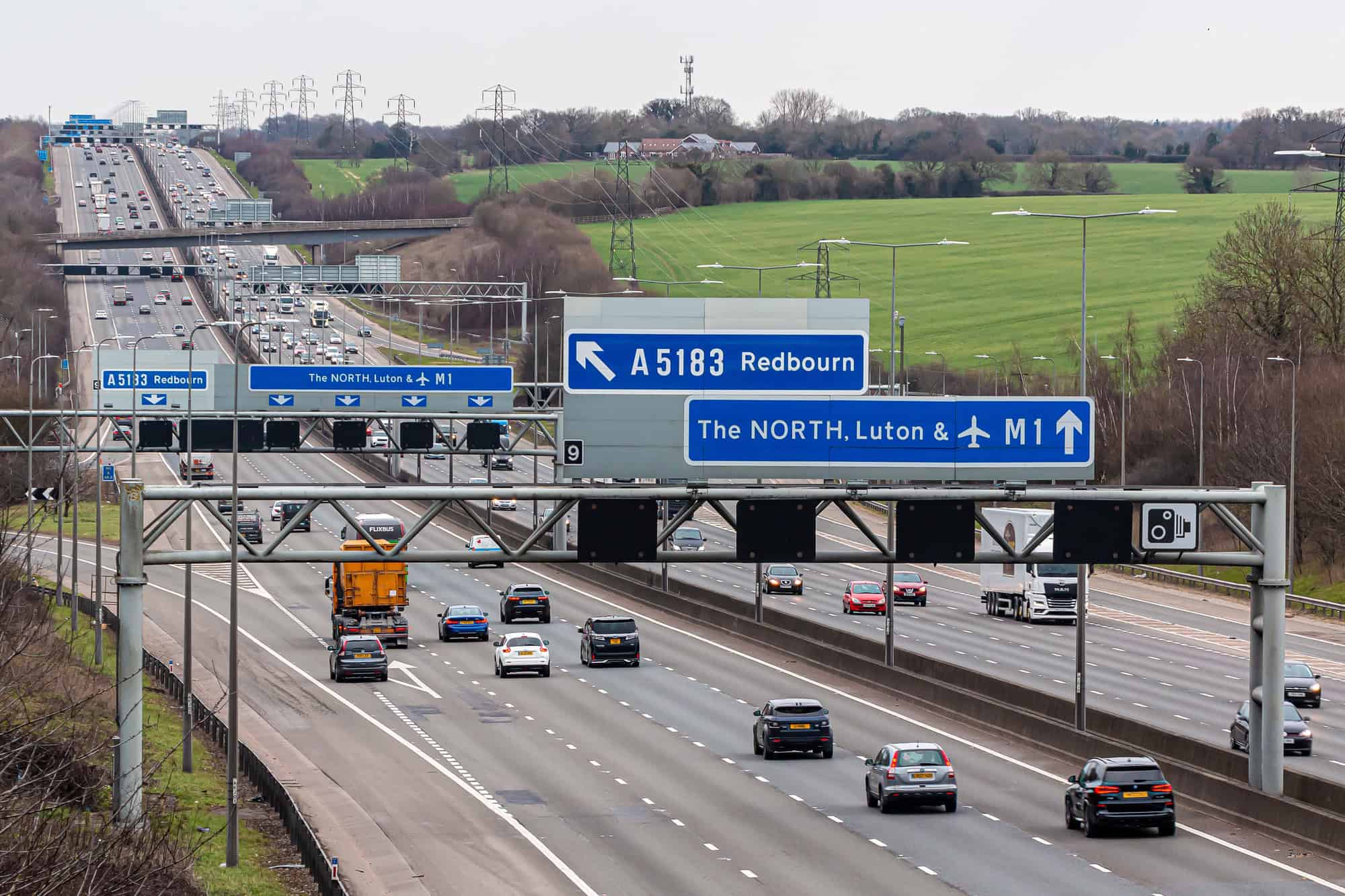
The camera gantries going up on UK motorways are not simple speed traps anymore. Hadecs 3 units, now common on smart motorways, can monitor up to five lanes at once without a visible flash, reading number plates continuously rather than waiting for a single triggered shot. A newer generation of multifunction AI cameras goes further, detecting speed, handheld phone use and seatbelt status from the same piece of road in one pass. Average speed systems, which calculate a vehicle’s pace between two fixed points rather than a single spot, are now claimed by their manufacturers to carry an error margin under 1 percent.
The practical effect is that a driver who has never had so much as a warning letter can now be caught for three separate offences on a single short journey, each carrying its own points and its own fine, without ever seeing a camera flash or knowing they had been recorded.
Why points have hit a four year high
Department for Transport data shows roughly 3.6 million penalty points were issued in the most recent year on record, the highest total in seven years. Analysis from IAM RoadSmart points to the wider rollout of average speed and multifunction cameras as the main driver, rather than a sudden change in driver behaviour. Anyone who reaches 12 points within three years faces a minimum six month disqualification under the totting up rules, and the threshold is much lower for anyone who passed their test in the last two years: six points within that window triggers automatic licence revocation and a return to learner status, regardless of how minor each individual offence was.
The tolerance rule has been unofficial for decades
The 10 percent plus 2mph figure is not written into statute anywhere. It traces back to guidance issued by the old Association of Chief Police Officers, a body that no longer exists in that form, and has simply been carried forward by force policy from that point on, updated informally and applied inconsistently. A driver stopped in Lancashire or London gets a small amount of extra headroom that a driver in a force that keeps its threshold secret does not, for reasons that have nothing to do with road safety and everything to do with individual force policy. Road safety campaigners have argued for years that a national, published standard would be fairer than a patchwork that changes at a county boundary, but no government has put one on a statutory footing.
The stakes of getting this wrong have also changed. A driver caught twice for minor Band A offences a decade ago might have taken two speed awareness courses and moved on. Today, with cameras covering far more road and catching phone use and seatbelt offences in addition to speed, the same driver is more likely to accumulate points from several separate triggers before they even realise a pattern has formed.
What you can actually do about it
Treating a force’s tolerance band as a safe margin is the single most common mistake drivers make, and it is not a defence in court. The only reliable way to know a camera’s enforcement threshold is to assume it is the legal limit itself, not the limit plus a cushion that varies by postcode. New drivers within two years of passing their test carry the most to lose from a single lapse, as the six point revocation threshold applies regardless of intent or how the offence happened.
For a Band A offence, a speed awareness course remains the cheapest outcome available and keeps points off a licence entirely, provided a driver has not already taken one in the past three years. Anyone who believes they were wrongly caught, through a faulty camera reading or a road sign that was missing or obscured, can challenge a notice through the issuing force or, if it proceeds to court, argue the point there. With nine forces unwilling to even confirm their own tolerance levels, the safest position for any driver is to stop relying on a margin they cannot verify and drive to the number on the sign, not the number they assume a camera will allow.
A written request to a force under the Freedom of Information Act will usually produce its tolerance policy within 20 working days, and a handful of local newspapers have already published the figures their own force provided after asking the same question. Until every force answers the same question the same way, the only number worth planning a journey around is the one posted on the sign at the side of the road, not a margin that changes depending on which side of a county boundary a driver happens to be on that day.
Sources:

Leave a Comment
More in News

Why a Blocked DPF Fails Your MOT and Costs £1,000 to Put Right

Why 70 Percent of Car Thefts Now Happen Without the Thief Ever Touching Your Keys

Britain’s Most Stolen Car Has Changed and Only 13 Percent Are Ever Recovered

DfT Bans Calling Cars Self-Driving From January 2027 With Two Year Prison Risk

Every Driver With a Ghost Plate Risks £1,000 as New AI Cameras Spot Them
Trending on Motoring Chronicle
The Most Dangerous Hour to Drive in Britain Has Been Revealed by New Data
Councils Risk Losing a Third of Their Road Funding Unless They Prove They Fix Potholes

2026 Kia K4 Hatchback Sets Foot in The Big Apple for Official Debut [Photo Gallery]
Traffic Penalty Tribunal Data Shows Moving Traffic Appeals Jumped 131 Percent
