A 1,065 HP V12 With Three Electric Motors, No Roof And A Top Speed Above 211 mph. This Is The Lamborghini Fenomeno Roadster


Lamborghini has unveiled the most powerful open-top car it has ever built. The Fenomeno Roadster combines a 6.5-litre naturally aspirated V12 engine with three electric motors for a combined output of 1,080 CV, which translates to 1,065 HP. It accelerates from 0 to 62 mph in 2.4 seconds, from 0 to 124 mph in 6.8 seconds, and has a top speed above 211 mph. There is no roof, no folding mechanism and no compromise. It is permanently open to the sky.
Only 15 will be built. Lamborghini has not disclosed a price, but given that the car sits at the top of the company’s Few Off programme and every previous model in this lineage has sold for seven figures, the Fenomeno Roadster will be among the most expensive cars the company has ever produced. If you are not already on the list, you will not be getting on it.
The car was presented at the second edition of the Lamborghini Arena at Imola on 9 May 2026. It is an evolution of the Fenomeno Coupe that was first shown in 2025, rebuilt from the windscreen up to function as a permanently open car while maintaining the same levels of downforce, stability and aerodynamic balance as its closed sibling.
The Name
Lamborghini has a long tradition of naming its cars after legendary bulls. Fenomeno follows that convention. In both Italian and Spanish, the word means “phenomenal,” and while naming your own car phenomenal is not exactly understated, subtlety has never been part of the Lamborghini formula. The name fits what the car is: a limited-production, hybrid-powered V12 roadster that exists at the extreme edge of what a road-legal car can do.
The Powertrain: 1,065 HP From A Hybrid V12
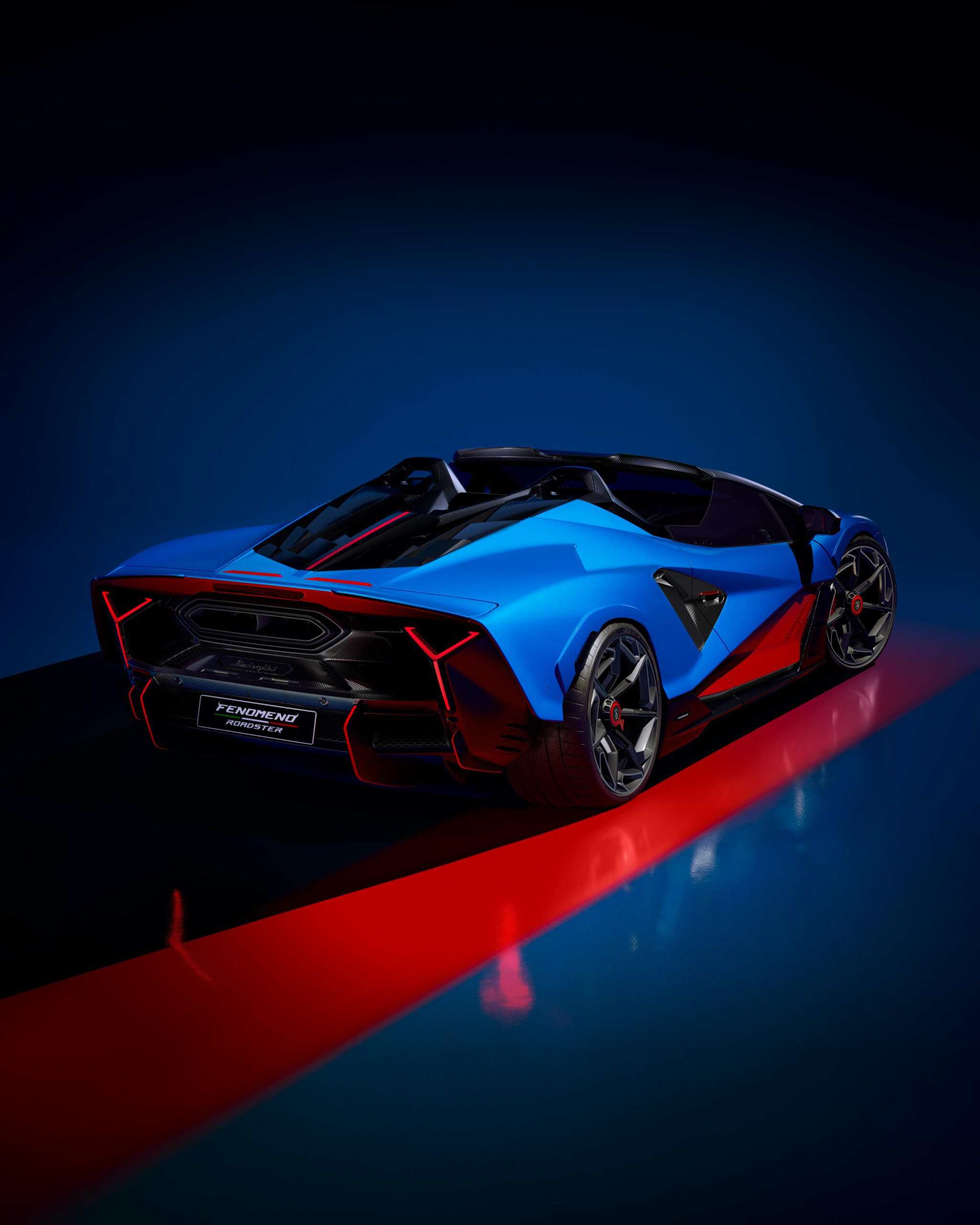
The Fenomeno Roadster is Lamborghini’s first open-top V12 hybrid High Performance Electrified Vehicle. At the centre of the powertrain is a 6.5-litre naturally aspirated V12 engine, which Lamborghini describes as the most powerful V12 it has ever built. The engine alone produces 835 CV (823 HP) at 9,250 rpm and 725 Nm of torque at 6,750 rpm. The specific power output is over 128 CV per litre, a record for the brand.
That V12 is paired with three electric motors. Two sit at the front axle, providing torque vectoring capability and allowing the car to distribute power independently to each front wheel. The third electric motor is mounted above the eight-speed dual-clutch gearbox at the rear. Together with a 7 kWh lithium-ion battery pack, the electric motors add the balance of power to bring the combined system output to 1,080 CV (1,065 HP).
The battery also enables a fully electric driving mode. Lamborghini has not quoted an electric-only range, and with a 7 kWh pack in a car of this weight and performance level, the range will be modest. The electric mode is there for low-speed manoeuvring and short distances, not for replacing the V12. The V12 is the point. The electric motors are there to make it faster, more capable and more responsive, not to replace the combustion engine.
The performance figures reflect that philosophy. The sprint from 0 to 62 mph takes 2.4 seconds. From 0 to 124 mph takes 6.8 seconds. Top speed is above 211 mph. Those are numbers that would have been considered physically implausible in a road car a decade ago. In a car with no roof, they are extraordinary.
Stephan Winkelmann, President and CEO of Automobili Lamborghini, described the car in terms that leave little room for ambiguity: “Fenomeno Roadster represents the purest expression of our brand values: visionary design, uncompromising performance, and absolute exclusivity. It is a unique interpretation of driving emotion, created for a select group of customers who seek something truly beyond convention. Each example is conceived as a collectible masterpiece, where engineering excellence meets true bespoke craftsmanship.”
Aerodynamics: Matching The Coupe Without A Roof
Removing the roof from a car that produces significant downforce at over 200 mph is not a cosmetic exercise. It fundamentally changes the airflow over the entire upper surface of the vehicle. Every aero surface that interacted with the roofline on the Coupe had to be redesigned for the Roadster.
Lamborghini says the Fenomeno Roadster achieves the same levels of downforce, stability and aerodynamic balance as the Coupe. That is a significant engineering claim, and the company has addressed it through a completely new aerodynamic package for the upper body.
The most visible addition is an extra spoiler mounted on the trailing edge of the windscreen. This element directs airflow over the open cockpit and channels it into the engine bay behind the seats. On the Coupe, the engine receives cooling air through a scoop on the roof. Without a roof, that scoop does not exist, so the windscreen spoiler and the redesigned upper surfaces take over the job of feeding air to the V12. Lamborghini says this arrangement provides efficient engine cooling in all driving conditions while minimising turbulence and vibrations inside the cockpit.
The rollover protection bars presented a particular challenge. They have to be strong enough to protect the occupants if the car inverts, but they also have to be aerodynamically efficient at speeds above 200 mph, where even small disruptions to airflow create noise and turbulence. Lamborghini has integrated the carbon fibre rollover structures as flat as possible behind the seats, flowing them into the Speedster-style humps that define the rear profile of the car. The result is a pair of structural elements that are both a safety requirement and a design feature.
At the rear, a wide and deep diffuser works with the optimised underbody and an active rear wing system to maximise downforce. The active wing adjusts its angle depending on speed and driving conditions, balancing downforce against drag. Cooling for the engine and brakes is managed through large air intakes behind the doors and along the flanks of the car.
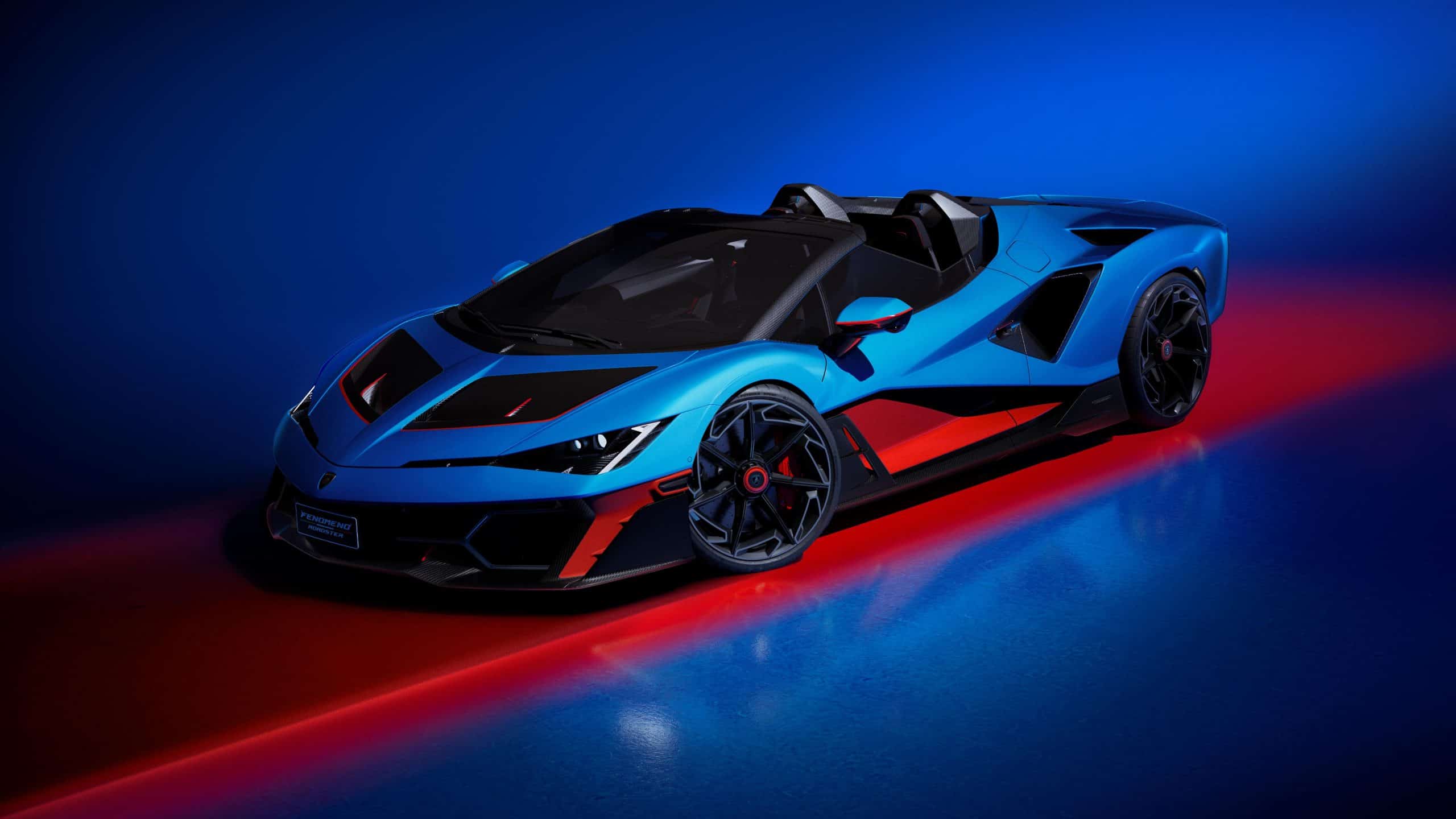
The front end features wide air intakes and sharp, angular lines built around what Lamborghini calls its hexagonal design language. The hexagonal motif appears across the entire car, from the headlights and air intakes to the side skirts, wheel arches and exhaust outlet.
Design: Feel Like A Pilot
The Fenomeno Roadster was designed by Lamborghini Centro Stile, the in-house design studio that has shaped every Lamborghini for over 20 years. Design Director Mitja Borkert described the philosophy behind the car as one built around the driver’s experience of being exposed to the elements at extreme speed.
“With the Fenomeno Roadster, we are continuing the dream of many Lamborghini enthusiasts. It’s an exclusive and precious looking design; the Fenomeno Roadster represents the ‘feel like a pilot’ philosophy. At the same time, we are showcasing the relentless creativity of our Centro Stile, which has been actively creating Lamborghini designs for more than 20 years,” Borkert said.
The silhouette is ultra-flat. A clear centre line runs the length of the car, and the side windows are chopped low to emphasise the open cockpit and the width of the body. The rear design takes inspiration from the Essenza SCV12 and 1970s racing prototypes, giving the car a long, tapered profile that also references the Lamborghini Manifesto concept created to celebrate the 20th anniversary of Centro Stile.
One of the most distinctive design decisions is the treatment of the engine bay. The V12 is visible through a new transparent engine cover featuring hexagonal air intakes. Borkert explained the thinking: “For the Fenomeno Roadster, we worked intensively on the creative inclusion of the engine area, which has the visual illusion for the driver that it is floating. That illusion helps to integrate and celebrate the driver as much as possible. Once again, we have placed the powertrain as the center of attention. Our unique V12 hybrid powertrain must always be the main proportional aspect of visualization.”
The engine sits behind the occupants, framed by a hexagonal surround, visible and celebrated rather than hidden beneath a solid cover. In a car with no roof, the driver can hear it, feel it and, through the rear-view mirror and the transparent cover, see it. That is a deliberate choice and one that distinguishes the Fenomeno Roadster from the current trend of hiding powertrains beneath featureless panels.
From the rear, the high-mounted hexagonal exhaust is the focal point. It sits within a purposeful rear end that combines the diffuser, the active wing system and the Speedster humps into a cohesive design that looks both futuristic and aggressive.
The launch colour is Blu Cepheus, a shade chosen as a deliberate reference to the first Lamborghini roadster ever built: the 1968 Miura Roadster. The lower section of the body is finished in Rosso Mars as a contrasting accent. The blue and red combination is also a tribute to the colours of the city of Bologna, the capital of the Emilia-Romagna region where Lamborghini is based.
The Cockpit
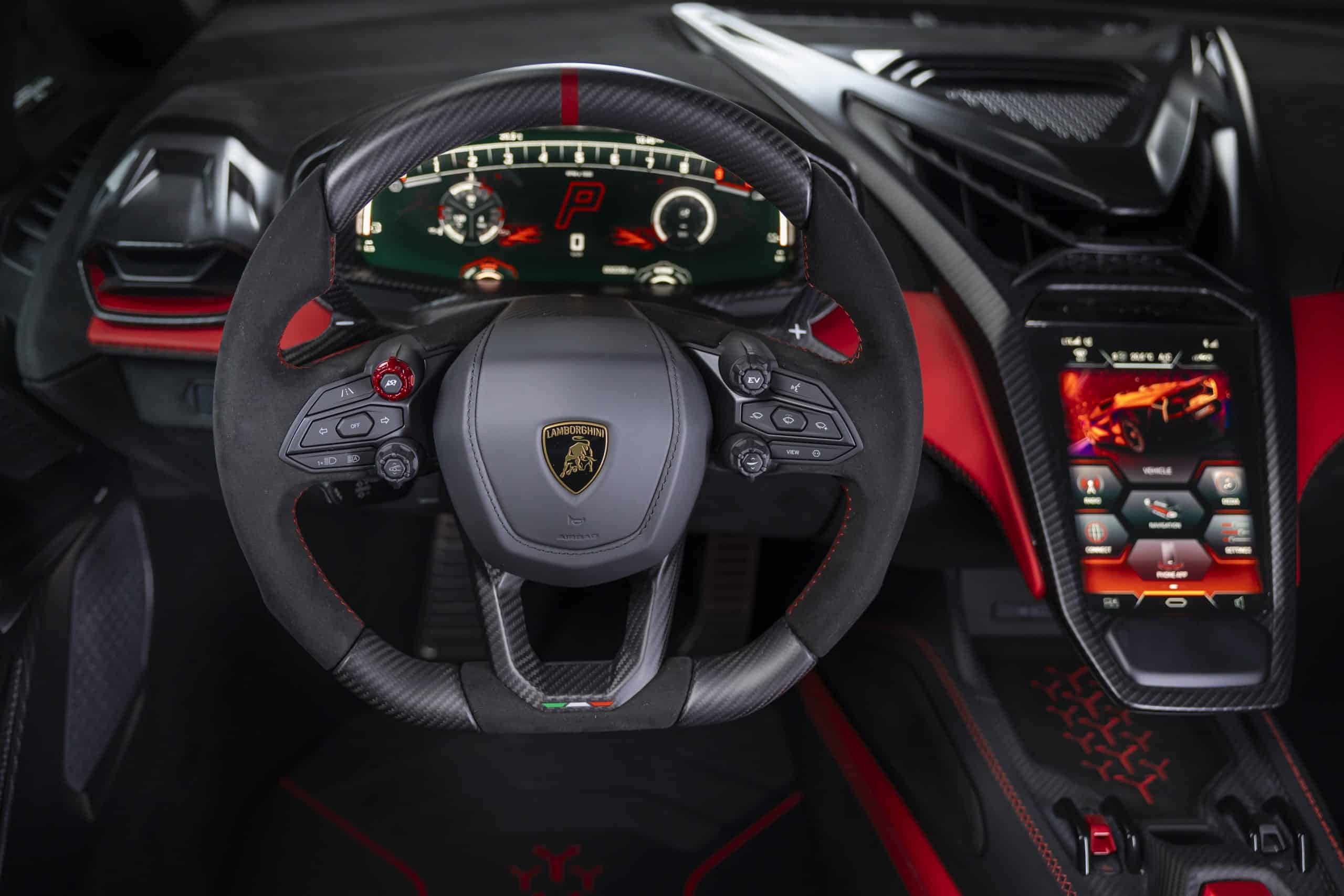
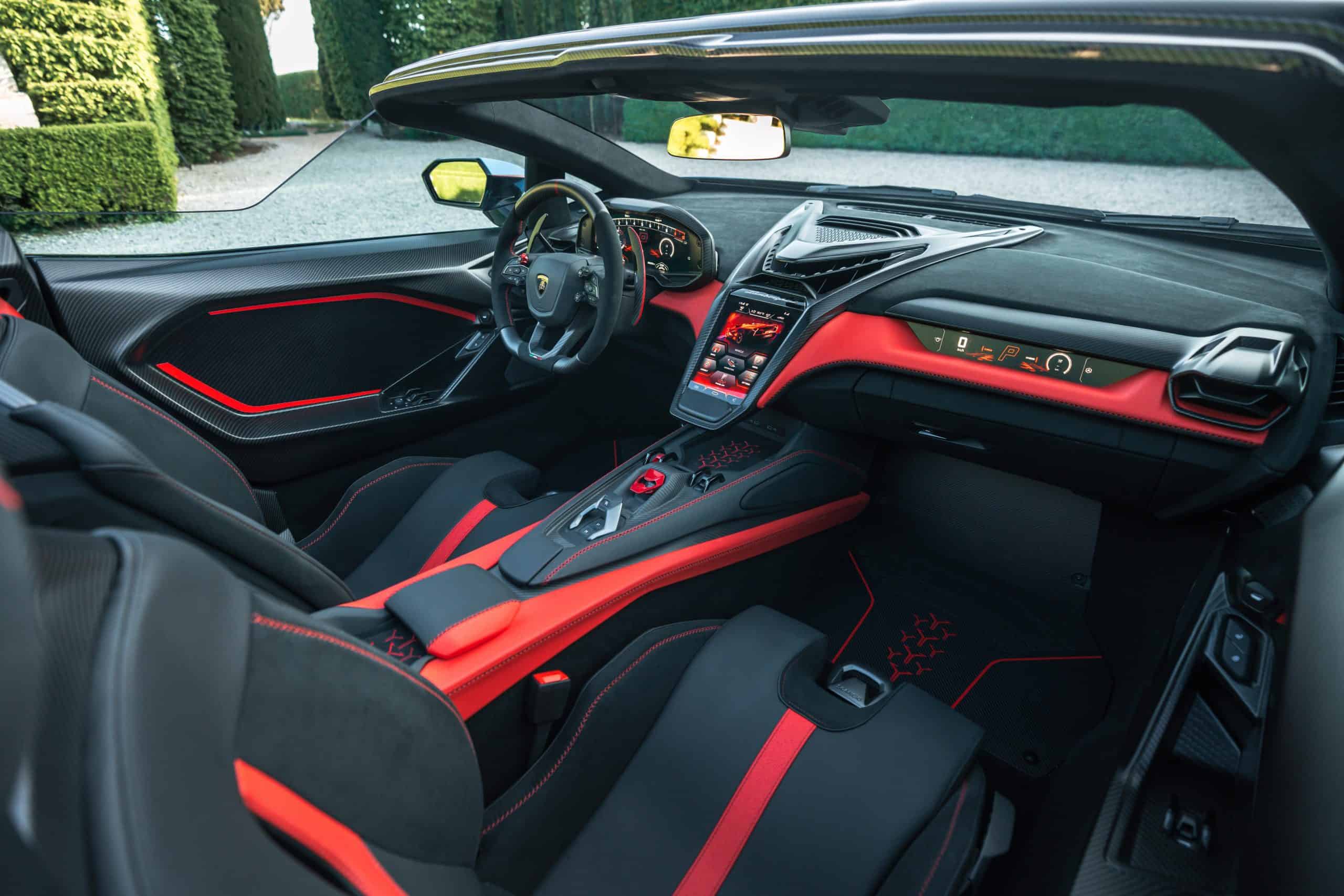
Inside, the Fenomeno Roadster follows the same pilot-inspired philosophy. The cockpit is finished in carbon fibre, Corsatex by Dinamica (a sustainable microfibre material) and Lamborghini’s patented Carbon Skin material. The contoured seats are trimmed with contrasting red stitching and are designed to hold the occupants firmly during extreme cornering loads.
The driver interface is built around what Lamborghini calls the Pilot Interaction concept. Three digital displays present driving data through hexagonal graphics, and the physical controls use haptic buttons and aviation-inspired toggle switches. The intention is to keep the driver’s attention on the road or circuit rather than on navigating menus. In a car capable of 211 mph with no roof between the driver and the atmosphere, that focus is not a luxury. It is a necessity.
The hexagonal design language continues inside through the air vents and instrument display surrounds, tying the interior to the exterior in a way that makes the design feel cohesive rather than assembled from separate themes.
Chassis And Suspension
The Fenomeno Roadster is built on the same monofuselage chassis architecture used in the Revuelto, Lamborghini’s V12 hybrid production car. The structure is a monocoque made entirely from multi-technology carbon fibre, with a front structure made from Forged Composite, Lamborghini’s patented material that combines long and short carbon fibres in a fluid mixture to create components that are extremely light and extremely strong.
The monofuselage integrates the front crash structures, front frame, windscreen frame, rear bulkhead and side skirts into a single structural element. Lamborghini says the Roadster achieves a similar level of stiffness and rigidity to the Coupe with only a few kilograms of additional weight. For a car without a fixed roof, matching the torsional rigidity of the closed version is a significant achievement and one that directly affects how the car handles at speed.
The suspension uses manually adjustable racing shock absorbers rather than electronically controlled adaptive dampers. This is a deliberate choice that prioritises precision and driver engagement over comfort and convenience. The shocks can be set for road or track use, with different ride heights and damping rates available depending on the intended driving conditions.
Braking is handled by the CCM-R Plus carbon-ceramic system. These are not standard carbon-ceramic discs. The CCM-R Plus system uses a three-dimensional structure of long carbon fibres embedded in a carbon matrix, with a special coating that increases durability for both discs and pads. The system is designed to work with organic racing brake pads and includes a dedicated ventilation system that manages disc and pad temperatures under sustained high-speed use. On a car that weighs over two tonnes with its hybrid system and can exceed 200 mph, brake fade resistance is not optional.
Vehicle Dynamics
The Fenomeno Roadster uses a 6D sensor mounted near the vehicle’s centre of gravity to feed real-time data to the integrated vehicle dynamics control system. The sensor measures acceleration on all three axes (lateral, longitudinal and vertical) and angular velocity on all three rotational axes (pitch, roll and yaw). This data allows the system to estimate vehicle speed, side-slip angle and the instantaneous coefficient of friction between the tyres and the road surface.
That information is fed to the Integrated Power Brake control unit and used to manage the torque vectoring system, the stability control, the regenerative braking and the power distribution between the front and rear axles. The two front electric motors provide independent torque control to each front wheel, allowing the car to adjust its behaviour mid-corner in ways that a purely mechanical system cannot.
Tyres
Bridgestone, Lamborghini’s exclusive tyre supplier for its super sports car range, has developed bespoke Potenza tyres for the Fenomeno Roadster. Two sets are available.
The road-focused Potenza Sport tyres come in 265/30 ZRF21 at the front and 355/25 ZRF22 at the rear. These are available with Bridgestone’s Run-Flat Technology, allowing the driver to continue at reduced speed after a puncture without needing an immediate tyre change. On a car with no spare wheel and no space for one, run-flat capability is a practical consideration as much as a performance one.
For track use, Bridgestone has developed a bespoke semi-slick tyre in 20-inch and 21-inch sizes. This next-generation compound is engineered for maximum grip on circuit surfaces while remaining road-legal. It draws on Bridgestone’s motorsport experience and is designed to unlock the full performance potential of the chassis and powertrain on track.
Both tyre sets carry Lamborghini-specific sidewall markings and were developed and manufactured in Italy using Bridgestone’s Virtual Tyre Development technology, which the company says reduces raw material consumption and CO2 emissions during the development phase by up to 60 per cent.
Lamborghini’s Few Off Lineage
The Fenomeno Roadster is the latest in a line of ultra-limited V12 models that Lamborghini has produced since 2007. The programme began with the Reventon, the first Few Off model developed entirely by Centro Stile in Sant’Agata Bolognese. A Roadster version followed in 2009.
Since then, the lineage has included the Veneno in 2013, the Centenario in 2016 and the Sian in 2019, each of which was also offered in Roadster form. Every one of these cars was produced in extremely small numbers, sold out before or at the point of announcement, and has appreciated significantly in value on the secondary market.
Beyond their collectibility, these models have served as a testing ground for design and technical solutions that later appear on Lamborghini’s production cars. The Reventon introduced design elements that influenced the Aventador. The Sian debuted supercapacitor technology. The Fenomeno Roadster’s hybrid V12 powertrain and carbon fibre monofuselage chassis are shared with the Revuelto, the production car that will carry Lamborghini’s V12 tradition into the hybrid era.
For the 15 people who will own one, the Fenomeno Roadster is the most extreme expression of that tradition: a naturally aspirated V12 with electric assistance, no roof, over 1,000 HP, and a production run so small that encountering another one on the road is essentially impossible.

Leave a Comment
More in News

300,000 Uninsured Cars Are Driven in Britain Every Day and Honest Drivers Pick Up the Bill

DVSA Survey Finds a Third of Learners Paid Up to £500 for a £62 Test

2027 Kia Telluride Earns IIHS Top Safety Pick+ Rating for 2026

Florida Orders Removal of License Plate Reader Cameras From State Roads

Annapolis Speed Cameras Go 24/7 Starting September 8, With Fines Up to $425
Trending on Motoring Chronicle
Why Driving Test Fraud Rose 47 Percent as Learners Turn to Impersonators and Bluetooth Cheats

NHTSA Closes Its Four Year Tesla Phantom Braking Probe of 695,000 Cars

How to remove moisture from a car headlight

What Every Learner Must Know About the Theory Test Changes Coming in June 2026