
Why Most Drivers Are Holding the Steering Wheel Wrong


Most drivers learned steering wheel grip from outdated advice. The traditional 10-and-2 position (ten o’clock and two o’clock with your hands) actually puts you at risk during airbag deployment and reduces control in emergency situations. Modern driving research shows that the 9-and-3 position is safer, improves your reaction time by up to 200 milliseconds, and reduces arm fatigue on longer journeys. Your hand position matters far more than most drivers realise, and changing this one habit can make you a safer, more controlled driver.
The Problem with 10-and-2: Why Driving Instructors Got It Wrong
The 10-and-2 position dates back decades when steering wheels were larger, power steering didn’t exist, and cars lacked airbags. Your driving instructor probably taught you this position, and you’ve likely stuck with it ever since. But modern vehicles have changed everything about how you should hold the wheel.
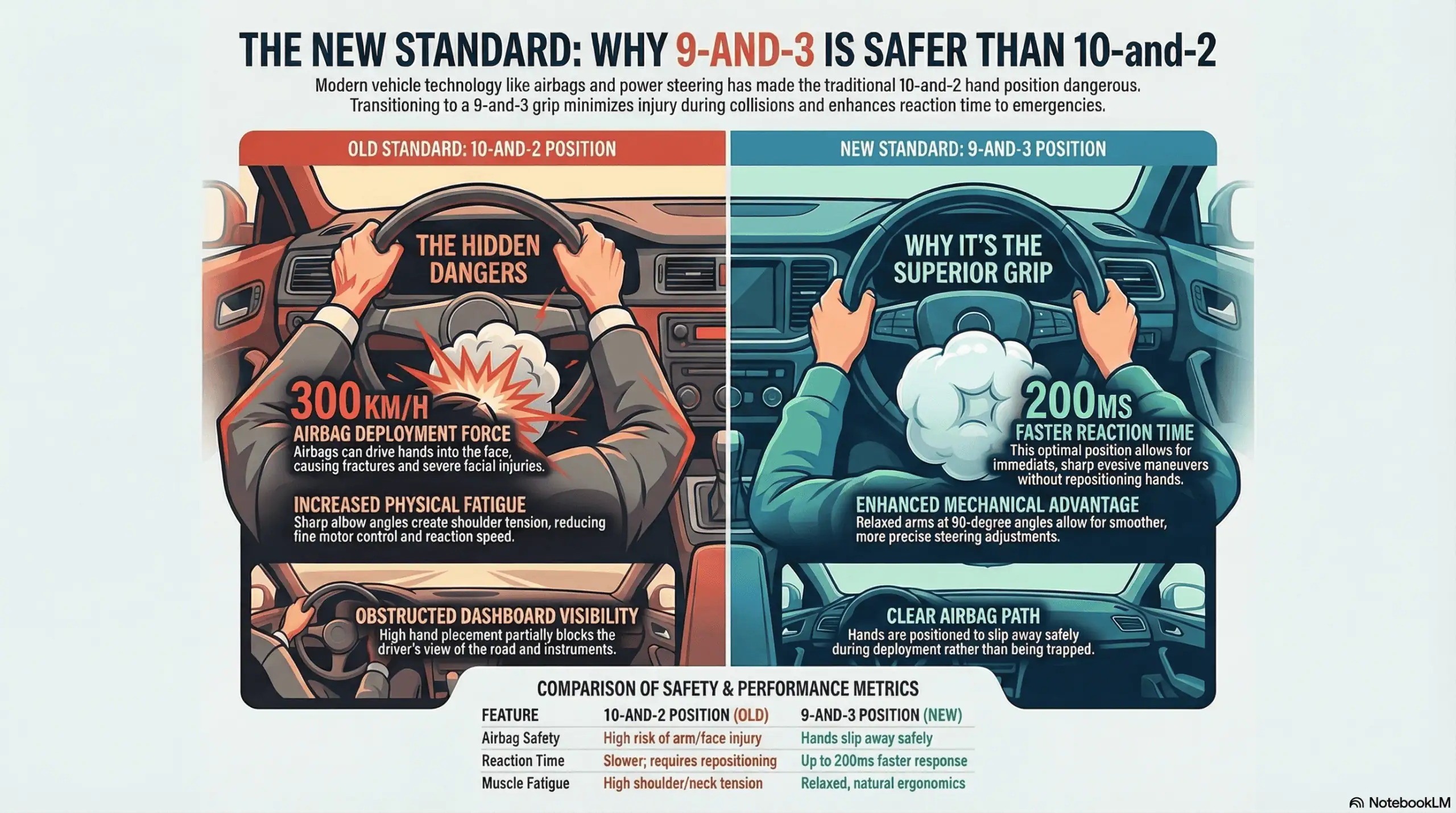
When an airbag deploys, it does so at speeds exceeding 300 kilometres per hour. If your hands are positioned at 10-and-2, they’re directly in the path of the expanding airbag. This creates a brutal physics problem: the airbag can drive your hands into your face, causing wrist fractures, broken arms, facial injuries, or worse. It sounds dramatic, but it’s a well-documented risk that safety engineers have been addressing for years.
Beyond the airbag issue, the 10-and-2 position creates unnecessary strain on your shoulders and arms. Your arms are bent sharply at the elbows, forcing tension into your shoulders during long drives. This tension doesn’t just cause fatigue; it actually reduces your fine motor control and reaction speed. A tense driver is a slower driver. Your nervous system functions best when your muscles are relaxed but engaged, not locked into an uncomfortable position.
There’s also a visibility problem. When your hands are up at 10-and-2, your arms partially block your view of the dashboard and the road directly ahead. This might seem minor until you realise you’re missing crucial information in your peripheral vision during critical moments.
The 9-and-3 Position: The Modern Standard for Control and Safety
Safety experts across Europe and North America now recommend the 9-and-3 position. This means your left hand sits at the 9 o’clock position and your right hand at the 3 o’clock position. Your hands are lower, your arms are relaxed at roughly a 90-degree angle, and you have maximum control with minimum risk.
The safety benefits are clear. Your hands are below the steering wheel’s rim level, which places them well away from the direct deployment path of an airbag. Even in a frontal collision, your hands are positioned to slip away from danger rather than be driven upward into your face. This positioning has been crash-tested and validated by automotive safety organisations worldwide.
But safety isn’t the only advantage. The 9-and-3 position gives you better mechanical advantage for steering. Your arms form a more natural angle, allowing for smoother, more intuitive adjustments. On a tight bend, you’ll find you can make smaller, more precise movements as you’re not starting from a locked position. This precision matters during winter weather, motorway lane changes, or any situation where the margin for error is small.
The 9-and-3 position also reduces fatigue dramatically. Your shoulders sit naturally over the wheel rather than being pulled upward. After four or five hours of motorway driving, the difference becomes immediately obvious. A relaxed driver is a safer driver, and a driver who isn’t fighting muscle fatigue makes better decisions.
How Hand Position Affects Your Reaction Time and Emergency Control
Research from driving safety organisations shows that hand position directly impacts reaction time in emergency situations. When you need to steer hard in either direction, the position of your hands determines how quickly your body can respond.
From the 9-and-3 position, your hands and arms are already in the optimal position to execute a sharp evasive manoeuvre. Both hands are equally positioned for either left or right steering input. You don’t have to reposition yourself; you simply respond. At speeds of 100 kilometres per hour or more, those milliseconds translate into metres. Studies suggest that proper hand positioning can reduce your reaction time by 150 to 200 milliseconds compared to other grip styles.
This is why advanced driving instructors and professional drivers use 9-and-3. It’s not about tradition or looking correct; it’s about physics and neuromuscular response. Your hands are already where they need to be, and your brain doesn’t have to waste time calculating how to move from an awkward position into an emergency manoeuvre.
The 10-and-2 position actually works against you in emergencies. Your hands start from a position of maximum steering angle. To steer hard left or right, your hands have to move further, and your body has to overcome more tension. It’s a slower, less efficient system. If you’ve never tested this yourself, the difference is surprising.
What Happens to Your Hands When an Airbag Deploys at 10-and-2
Understanding the mechanics of airbag deployment makes the safety argument undeniable. A modern frontal airbag expands in approximately 40 to 60 milliseconds. In that split second, it’s moving at speeds that would rival a speeding bullet. The force involved is enormous: roughly 10,000 newtons of force in the first millisecond.
If your hands are at 10-and-2, they’re positioned directly in front of the airbag as it deploys. Several things can happen, none of them good. First, your hands can be struck by the airbag itself and driven backward into your face with tremendous force. Second, the airbag can trap your hands against your face, preventing you from controlling your head position. Third, your wrists can be bent forcefully backward, potentially causing fractures.
At 9-and-3, your hands are lower and slightly further back from the steering wheel’s rim. When the airbag deploys, your hands naturally slip away downward and backward. Instead of being trapped and driven forward, they have a clear path to escape the force. Your wrists remain in a neutral position rather than being bent backward at an angle.
This isn’t theoretical. Crash test data from vehicles equipped with modern airbags shows clear patterns. Injuries to hands, wrists, and arms are significantly more common at 10-and-2. Insurance companies and vehicle safety ratings organisations have taken note. The liability issues from the old position are real, which is why newer driving instruction standards have shifted.
Common Bad Habits: One-Handed Driving, Bottom-of-Wheel Grip, and Crossed Arms
Beyond the 10-and-2 versus 9-and-3 debate, many drivers have developed genuinely dangerous habits that make their steering control unpredictable. Identifying these habits in yourself is the first step to fixing them.
One-Handed Driving
Driving with one hand on the wheel is common, especially on motorways or in light traffic. It feels relaxed and natural. It’s also significantly more dangerous than it appears. With one hand, you’ve eliminated your ability to respond quickly in either direction. If you need to execute a sharp correction, you’re already at a disadvantage as you only have one hand to work with.
One-handed driving also compromises your stability. Two hands provide redundancy. If one hand slips or loses grip, the other is there to maintain control. With one hand, you have no margin for error. Add a pothole, a sudden swerve from another vehicle, or a momentary loss of attention, and you’re now in a situation where you can’t recover as quickly.
The habit tends to escalate. Drivers who start with one hand on the wheel often progress to resting with no hands briefly, steering with their knee, or other increasingly risky behaviours. It’s not that these behaviours are always immediately dangerous, but they’re training your nervous system to be less engaged with the driving task. That’s a slippery slope.
Bottom-of-Wheel Grip
Some drivers grip the bottom of the steering wheel, around the 6 o’clock position. This creates multiple problems. First, your hands are completely out of position for quick steering input in either direction. Second, you have to rotate your hands significantly further to make any steering adjustment. Third, in a collision, your hands are positioned to be driven upward directly into your torso, which is its own safety hazard.
Bottom-of-wheel grip often develops in drivers who spend a lot of time on straight motorways and have become complacent about their hand position. It’s an invitation for a loss of control when you do encounter a situation that demands quick steering input.
Crossed Arms
Crossing your arms while steering is a habit some drivers develop, especially on long straight roads. It might feel comfortable in the moment, but it’s severely limiting. When your arms are crossed, any emergency steering input requires you to uncross them first. That’s an extra step your brain and body have to manage in a situation where every millisecond counts.
Crossed-arm steering also reduces your mechanical control. You can’t push or pull with full force when your arms are in a crossed position. Your control becomes shallow and less responsive. Professional drivers never cross their arms at the wheel, and there’s a good reason for that.
How Your Seating Position Affects Your Grip and Control
Hand position can’t be properly discussed without addressing seating position, as the two work together. If you’re sitting too far back from the wheel, too far forward, or at the wrong height, even a correct 9-and-3 hand position won’t give you optimal control.
Your seat should be positioned so that when your arms are extended with hands at 9-and-3, your wrists are slightly higher than your elbows. Your shoulders should be relaxed against the seat back but not leaning heavily. Your hips should be pushed firmly into the seat, and your back should maintain the curve of the seatback support.
Too many drivers sit too close to the wheel, compressing their arms and reducing their range of motion. Others sit too far back, which stretches their arms and reduces fine control. Finding the right distance is personal, but the general rule is that your wrists should be able to rest on the wheel rim with your shoulders relaxed and your arms at roughly 90 degrees.
The seat height matters as well. You should be able to see over the top of the steering wheel to the road beyond. If you’re looking through the wheel, you’re too low. If you’re looking at the top of the wheel at eye level, you’re too high. This affects not just comfort but your ability to see the road clearly and spot hazards early.
Advanced Techniques: Push-Pull versus Hand-Over-Hand Steering
Once you’ve established a proper 9-and-3 grip position, you can explore different steering techniques for different situations. The two most common methods are push-pull steering and hand-over-hand steering, and each has its place.
Push-Pull Steering
Push-pull steering is the standard method for everyday driving. From 9-and-3, you push the wheel forward with one hand while pulling it back with the other, alternating smoothly. This method keeps both hands on the wheel at all times, maintaining constant contact and control. For normal bends, roundabouts, and gradual direction changes, push-pull is ideal.
Push-pull steering is safer as you never lose contact with the wheel. Even if you’re executing a fairly sharp turn, both hands remain in control. Your reaction time to unexpected inputs is minimized as you’re not repositioning your hands. If another vehicle suddenly cuts across your path mid-turn, you’re already in position to respond further.
Hand-Over-Hand Steering
Hand-over-hand steering involves crossing your hands over each other as you turn, like the motion of turning a ship’s wheel. It allows you to execute sharper turns as your hands can move through a larger range of motion. Professional drivers and advanced motorists use this technique for tight manoeuvres, emergency evasive actions, or driving in challenging conditions.
Hand-over-hand steering should not be your default technique. It’s a skilled manoeuvre that requires practice and situational awareness. When you’re crossing your hands, there’s a brief moment where you have less control, and your reaction time to unexpected inputs increases slightly. For normal driving, push-pull is superior.
Where hand-over-hand becomes valuable is in situations where you need maximum steering angle quickly: avoiding a pedestrian, executing a sharp lane change at high speed, or recovering from a skid. In these moments, the extra steering range that hand-over-hand provides can be the difference between a successful manoeuvre and a collision.
When Grip and Hand Position Matter Most: High-Speed Manoeuvres and Emergency Situations
Understanding that proper grip matters is one thing. Recognizing when it matters most is another. There are specific driving situations where your hand position can directly impact your safety and the safety of everyone around you.
Emergency Braking and Evasive Action
When you need to brake hard and steer simultaneously, your hand position determines how effectively you can manage both inputs. With hands at 9-and-3, you can brake firmly while maintaining steering control. Your hands aren’t fighting each other or compromising your ability to grip. This is why understanding how your vehicle’s braking systems respond works best when you’re in an optimal position to take manual control if needed.
Motorway Lane Changes
On a motorway, lane changes at high speed require smooth, confident steering input. A poorly positioned hand on the wheel can result in overcorrection, which leads to swerving. Proper 9-and-3 positioning allows you to make a lane change that’s smooth, controlled, and confident. You’re not fighting the wheel; you’re gliding through the manoeuvre.
Cornering at the Limit
When cornering at higher speeds, your grip on the wheel directly affects how much feedback you’re receiving from the road surface. A firm grip from 9-and-3 keeps you connected to the steering input and the road’s surface changes. This connection is crucial for maintaining control on challenging roads or when driving a sporty vehicle.
Weather-Related Hazards
In rain, snow, or icy conditions, your hands on the wheel become your primary feedback system. Water, ice, and loose surfaces all transmit information through the steering system. A firm grip at 9-and-3 keeps you connected to that feedback. A loose grip at 10-and-2 or other compromised positions isolates you from the information you need to stay safe.
The Role of Vehicle Design and Modern Power Steering in Hand Grip
Modern vehicles have dramatically altered the physical demands of steering. Power steering has made the actual force required to turn the wheel minimal. This is good for comfort but has created a new problem: drivers can grip the wheel loosely and still control the vehicle, which leads to reduced feedback and slower reaction times.
Modern steering wheels are also smaller than they used to be. A smaller wheel requires less hand movement to achieve the same steering angle. This is efficient, but it means that an incorrect hand position is less forgiving. On an older, larger steering wheel, a driver could get away with slightly poor positioning as there was more wheel to work with. On modern wheels, positioning is more critical.
Electronic steering in some luxury vehicles has introduced a new consideration. When steering input is being interpreted by a computer before being translated to the wheels, feedback becomes even more important. Your hands need to be in position to feel what the vehicle is doing, even if the actual force required to steer is minimal.
Developing the Habit: How to Train Yourself into a Proper Grip
Changing a driving habit that you’ve had for years isn’t instantaneous, but it’s entirely possible. The key is to approach it deliberately and with awareness.
Start with your seating position. Adjust your seat forward or backward so that when your arms are extended, your wrists are slightly higher than your elbows. Adjust the height so you’re looking over the wheel, not through it. Then grip the wheel at 9-and-3. Sit with that position for a few minutes without driving, just getting your body used to it.
On your next drive, focus exclusively on maintaining the 9-and-3 position. Don’t worry about anything else. Your driving might feel slightly awkward as your muscles aren’t used to this position, but that passes within a few days. After about a week of deliberate practice, the new position will start to feel natural.
Be patient with yourself. You’ve probably been gripping the wheel at 10-and-2 or some other position for years. Your muscle memory is strong. It will take roughly 21 to 30 days of consistent practice before the new position truly feels automatic. But once it does, you’ll notice the improvement immediately.
The improvement you’ll feel is less fatigue, better control, and more responsiveness. Your body will confirm that the new position is genuinely better, which helps reinforce the habit change.
If you enjoyed this article, be sure to follow us on Microsoft Start.
Steering Wheel FAQs
Why is the 10-and-2 grip position dangerous?
When an airbag deploys, it expands at speeds over 300 km/h. Hands positioned at 10-and-2 are directly in the path of the airbag, which can cause wrist fractures, arm injuries, or drive your hands into your face with serious force. Beyond airbag safety, 10-and-2 also causes unnecessary shoulder tension, reduces visibility, and limits your reaction time in emergency manoeuvres.
Is 9-and-3 better than 10-and-2?
Yes, significantly. The 9-and-3 position places your hands lower and further from the airbag deployment path. It also provides better steering control, clearer visibility, reduces arm fatigue on longer journeys, and improves your reaction time in emergency situations by up to 200 milliseconds. Safety organisations across Europe and North America now recommend 9-and-3 as the standard.
Should I use hand-over-hand or push-pull steering?
Push-pull steering is safer for everyday driving as both hands stay on the wheel at all times, maintaining consistent contact and control. Hand-over-hand is a skilled technique for tight manoeuvres or emergency situations but shouldn’t be your default method. Most of your driving should use push-pull steering from a 9-and-3 position.
Does hand position really affect reaction time?
Yes, measurably. Studies by driving safety organisations show that proper hand positioning reduces reaction time by up to 200 milliseconds in emergency manoeuvres. At motorway speeds of 100 km/h, this difference translates to several metres. Those metres can be the difference between avoiding a hazard completely and being unable to avoid a collision.
Can I drive with one hand on the wheel?
It’s legal in most cases but not recommended. One-handed driving reduces your control options and limits your ability to respond to unexpected situations quickly. It also eliminates the redundancy that two hands provide. If something goes wrong, you’re already at a disadvantage as you only have one hand to work with.
Sources
- IAM RoadSmart – Advanced Driving Instruction and Road Safety
- Royal Society for the Prevention of Accidents – Vehicle Safety and Driving Techniques
- NHTSA – National Highway Traffic Safety Administration
- AAA Foundation for Traffic Safety – Driving Research and Safety Studies
- Driving Instructors Association – Professional Driving Standards

Leave a Comment
More in News
Which Side Is the Accelerator and Brake?

VW Emergency Assist Plus Can Now Steer an Unresponsive Driver to the Shoulder

How to Tell if a Car Was Written Off Before You Buy It

2027 Jeep Wrangler JL-2A Special Edition Adds Retro Style for Just $115 More
What Actually Happens If You Ignore an MOT Advisory
Trending on Motoring Chronicle

Rolls-Royce Phantom Arabesque: World’s first laser-engraved bonnet honours Middle East’s architectural heritage

Mercedes-AMG A 45 S Final Edition Priced From £67,965 as Send-Off Special

120,000 Citroen Owners Face A Year Long Recall Queue
How California’s New Move Over Law Covers Every Car With Hazard Lights
