8 Reasons Why Your Engine Oil Turns Black So Fast


Engine oil turns black from a combination of combustion byproducts, heat oxidation, and detergent additives suspending carbon particles in the fluid. Black oil is not automatically a sign of a problem; it frequently indicates the oil is performing its cleaning function correctly. The concern is oil that darkens abnormally fast, within 1,000 to 2,000 miles, or oil that has turned black with an accompanying burnt smell, gritty texture, or visible particles.
What the Color Change Actually Means
Why Oil is Designed to Absorb Contaminants
Modern engine oil is formulated with detergent additives that suspend carbon particles and combustion residues instead of allowing them to settle as sludge on engine components. This is intentional. The oil is the engine’s cleaning agent as much as it is a lubricant. As the oil circulates through the engine, it encounters fuel vapors, soot particles, water vapor, and unburned hydrocarbon fragments. These contaminants are drawn into the oil, where the detergent additives coat them with a molecular layer that keeps them dispersed throughout the oil rather than allowing them to stick to piston rings, valve seats, or bearing surfaces.
This suspension of contaminants is what causes the color darkening. Clean oil is amber or pale yellow. As the oil collects soot and combustion residues, it takes on a brown tint. As the concentration of suspended particles increases over the next thousand or two thousand miles, the oil progresses from brown to dark brown to black. The black color is not oil degenerating; it is detergent additives working. The particles suspended in the black oil are kept in solution from the detergent, preventing them from forming deposits in the engine.
This is why experienced mechanics and engine builders do not panic when an oil sample extracted from a running engine appears dark. They look for evidence of the oil’s true condition: viscosity, acid number, wear metal content, and water content. An oil sample test from a reputable laboratory will reveal if the oil has deteriorated or if the darkening is simply evidence of normal operation and effective additive performance.
The Difference Between Normal Darkening and Abnormal Darkening
Normal oil darkening follows a predictable pattern. Fresh synthetic oil or high-quality conventional oil begins light in color. Within the first 500 to 1,000 miles of operation, detergents begin capturing soot and combustion residues, and the oil noticeably darkens to dark brown or nearly black. This rapid initial darkening occurs in most engines and is normal. The oil’s viscosity remains stable, the smell is normal exhaust odor rather than burnt or chemical, and the oil level does not drop more than normal consumption predicts.
Abnormal darkening happens when oil becomes very dark within 500 miles of a fresh change, accompanied by a strong burnt smell, a gritty or thin texture, or visible black particles that do not disappear when the oil is held to light. The oil smells of coolant (sweet or fruity odor) or gasoline, indicating contamination. In these cases, the darkening is not evidence of normal detergent function; it is evidence of a deeper problem in the engine. A contamination source is introducing excessive soot, coolant, or fuel into the oil faster than the detergents can handle it.
The best way to distinguish normal from abnormal is to perform an oil analysis after the oil has been in service for 1,500 to 2,000 miles. A professional lab will measure oxidation, acid number, soot concentration, water content, and wear metals. If the numbers are within normal ranges for the oil brand and the engine type, the darkening is normal. If the acid number is elevated, oxidation is excessive, or water content is abnormally high, a problem exists that requires investigation.
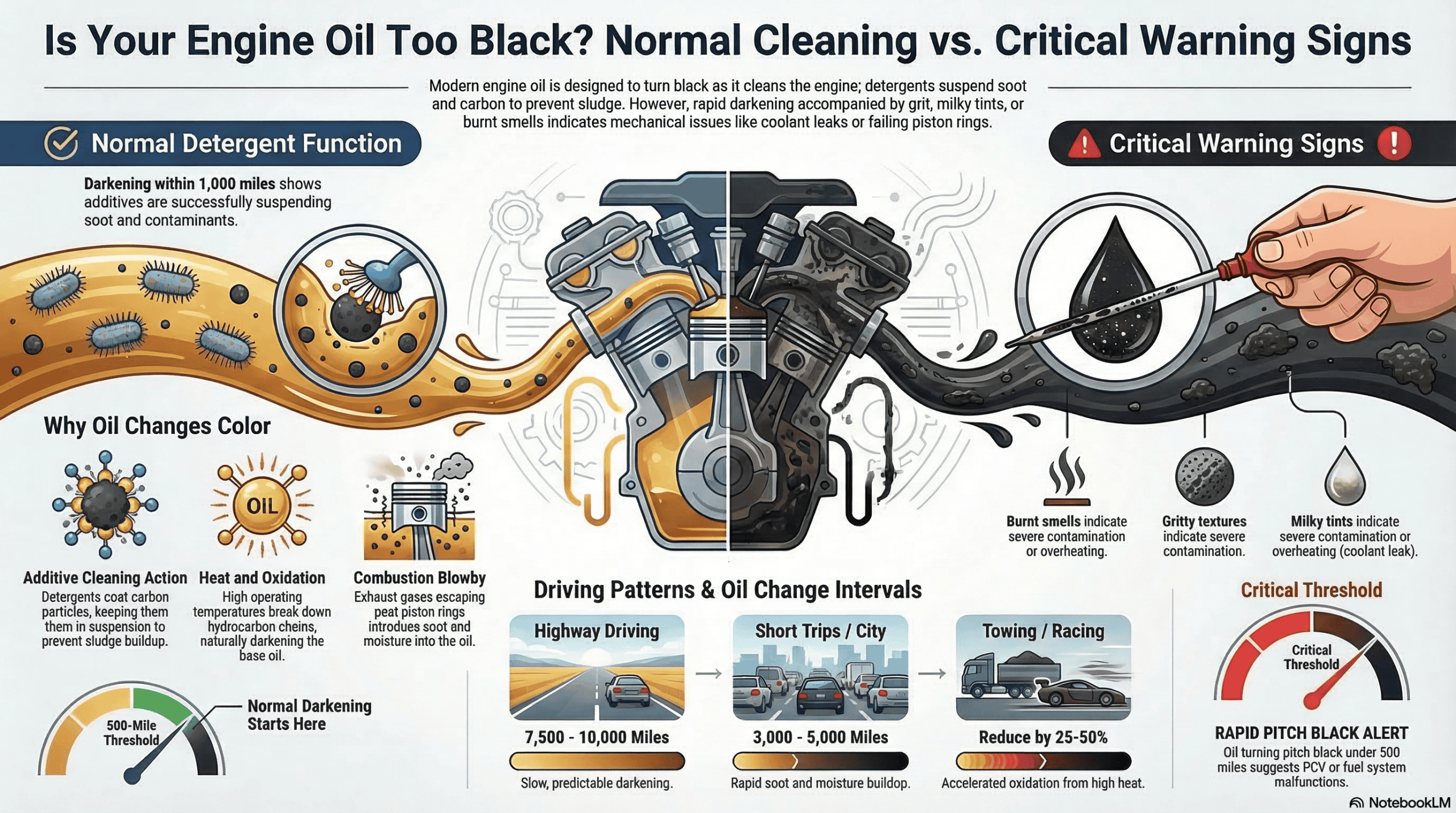
The 8 Reasons Your Oil Turns Black
1. Combustion Blowby Gases Entering the Crankcase
During the compression and power strokes of the internal combustion cycle, high-pressure gases in the cylinder push past the piston rings into the crankcase. This is normal and is called blowby. The amount of blowby depends on engine load, throttle position, and the wear condition of the piston ring seals. On a new engine with tight tolerance rings, blowby is minimal. On an engine with 100,000 or more miles, wear on the rings and cylinder wall increases blowby flow significantly.
Blowby gases are a mixture of unburned fuel vapor, water vapor, nitrogen oxides, and carbon monoxide. These gases enter the crankcase above the oil level and are circulated back to the intake manifold through a positive crankcase ventilation (PCV) valve so they can be re-burned in the engine. Some of the gaseous residues condense into the oil itself, forming carbon deposits and organic acid compounds. The more blowby entering the crankcase, the more soot and carbon particles accumulate in the oil.
A properly functioning PCV system minimizes the time gases spend in the crankcase before being returned to the engine. A blocked or stuck PCV valve allows blowby gases to accumulate, increasing pressure in the crankcase and accelerating oil contamination. Checking that the PCV system is functioning correctly, that the valve moves freely, and that the PCV hose is not cracked or collapsed is a basic maintenance task that reduces the rate of oil darkening.
2. Detergent Additives Working as Designed
Premium engine oils contain zinc dithiophosphates, ashless dispersants, and other detergent compounds that are specifically engineered to suspend contaminants. The performance of these additives is reflected directly in the oil’s color. Oil with weak or low concentrations of detergent remains cleaner in color for longer, yet this is actually a sign of weakness, not strength. The contaminants are not disappearing; they are settling as sludge on engine parts rather than being suspended in the oil.
Full synthetic oils, most notably those formulated for extended drain intervals, contain strong detergent packages that are highly effective at suspending soot and combustion residues. These premium oils darken faster than conventional mineral oils, not from degrading faster, yet from containing more active detergent chemistry. An oil that remains light in color after 3,000 miles of driving a normal engine is either a lightweight mineral oil with minimal detergent, or the engine is not producing normal levels of soot, which suggests a different problem such as rich combustion or partial cylinder misfiring.
The relationship between detergent strength and oil color is important for drivers to understand. A darker oil from a premium synthetic oil producer is often a sign that the product is doing its job well, holding soot and combustion residues in solution where they cannot form deposits. Switching to a lesser oil to keep the color lighter would be counterproductive. Monitoring oil color trend is useful, yet obsessing over a specific shade or changing oil from visible darkening misses the point of modern additive chemistry.
3. Heat Oxidation Breaking Down the Base Oil
Engine oil is subject to repeated heating and cooling cycles. Oil temperature can climb from room temperature to 200 degrees Fahrenheit or higher during normal driving, and sustained track driving or towing can push oil temperature even higher. At elevated temperature, the hydrocarbon base stock of the oil undergoes oxidation reactions. Oxygen molecules break bonds within the hydrocarbon chains, creating smaller fragments and organic compounds. Some of these reaction products are acidic and can contribute to oil degradation.
Oxidation reactions progress slowly at low temperatures yet accelerate exponentially as temperature increases. A 20-degree increase in oil temperature can double the oxidation rate. A 40-degree increase can quadruple it. Synthetic oils are engineered from chemically uniform base stocks that are more resistant to oxidation than conventional mineral oils, which is one reason synthetics can tolerate extended drain intervals. A conventional oil exposed to sustained high temperatures will show significantly faster darkening and viscosity loss than a synthetic oil subjected to the same temperature regime.
Drivers in hot climates or those who tow regularly expose their oil to higher average temperatures, and this accelerates oil darkening. The oil does not necessarily fail faster, yet it does change color faster. Racing or track driving generates even higher oil temperatures as the engine is at wide-open throttle and the cooling system is working at its limit. A car that spends a day at the track will show noticeably darker oil than a car that spends a day commuting in city traffic, and this is entirely normal.
4. Extended Drain Intervals Past the Fluid’s Service Life
If an oil change is overdue, the oil in the crankcase is older, has encountered more blowby and combustion residues, and has absorbed more water and acid. As time passes beyond the recommended drain interval, the cumulative contamination in the oil increases steadily. By the time the scheduled service date arrives, the oil is significantly darker than expected simply from working longer than intended.
Modern vehicles with extended oil change intervals, especially those using synthetic oil, are designed to go 7,500 to 10,000 miles or 6 to 12 months between services. An oil change that is overdue from 1,000 or 2,000 miles will show significantly darker coloration than fresh oil of the same type and brand. The darkening is accelerated contamination accumulation, which is why adhering to the manufacturer’s recommended intervals is important. Exceeding the interval from 50 percent or more can result in oil that looks nearly black, even if it is still technically within acceptable parameters for acid number and oxidation.
The trend is worsening with extended intervals. Drivers who rely on oil change reminder lights or manufacturer intervals rather than checking the oil themselves are operating engines on oil that has exceeded its design service life. If a vehicle is due for an oil change or overdue, changing it immediately is the proper action, regardless of how dark the oil appears. Do not drive an engine on oil past its scheduled service interval to avoid the embarrassment of dark-colored oil; the oil has already served its time, and leaving it in longer serves no purpose.
5. Short-Trip Driving and Incomplete Combustion
Short trips, such as a two-mile drive to the grocery store and back, do not allow the engine to reach full operating temperature. In a cold-start condition, the fuel mixture is richer (more fuel, less air) to aid engine starting and warm-up. This rich mixture means fuel that does not combust completely, and these unburned hydrocarbons enter the crankcase via blowby. A cold engine produces more soot from incomplete combustion at lower temperatures.
Water vapor from combustion condenses in the crankcase when the engine is cold, and the oil absorbs this moisture. Over time, short-trip driving accumulates unburned fuel, water, and excessive soot in the oil at a faster rate than highway driving. An engine that makes five 2-mile trips per week experiences much more contamination accumulation than an engine that makes one 10-mile trip per week, even though both traveled 10 miles. The frequent cold-starts and incomplete combustion cycles in the short-trip car produce more soot and moisture per mile driven.
Drivers in urban environments who make frequent short trips should select more frequent oil changes than the manufacturer recommends, most clearly if they also live in a cold climate. The combination of short trips and cold ambient temperature creates the worst-case scenario for oil contamination. Many manufacturers provide two maintenance schedules, one for “normal” driving and one for “severe” driving conditions, and short-trip driving typically falls into the severe category.
6. Engine Wear Particles Accumulating in the Oil
As engine components wear, fine metallic particles from pistons, piston rings, cylinder walls, bearings, and cam lobes enter the oil. The oil filter traps large particles, yet very fine wear metals pass through the filter media and remain in the oil. These particles are typically iron, aluminum, copper, or lead, depending on what surface is wearing. The particles are suspended in the oil, and they contribute to visual darkening, in those cases in engines with higher wear rates.
A new or recently rebuilt engine produces minimal wear particles as internal surfaces are in fresh condition and fit tightly. An engine with 150,000 or more miles produces substantially more wear particles from rings wearing, piston-to-wall clearances opening, and bearing surfaces showing micro-spalling. The oil in a high-mileage engine will always be darker than oil in a new engine of the same model, partly from detergent additive activity and partly from accumulated wear particles.
Excessive wear metal content revealed in an oil analysis indicates accelerated wear and potential engine problems. If wear metals are normal for the engine age and mileage, the particle presence is simply a sign of normal aging. The oil filter is designed to capture particles, and the full-flow oil circulation path includes the filter, which regularly removes the largest particles. Between oil changes, the smaller wear metals remain in suspension, contributing to oil color and requiring attention during oil sampling and analysis to distinguish normal wear from abnormal wear conditions.
7. A Failing or Worn Piston Ring Seal
A piston ring that is no longer sealing properly allows excessive blowby to enter the crankcase. As combustion pressure increases above a leaking ring, a jet of high-pressure, high-temperature gas containing fuel vapor, soot, and combustion products sprays into the crankcase and directly into the oil. This is different from normal blowby, which is a slower accumulation. A severely leaking ring introduces a large volume of contaminated gas into the oil in a very short time.
The result is rapid oil darkening, often within 500 to 1,500 miles of an oil change. The oil develops a burnt smell from the high-temperature gas heating the oil to abnormal temperatures in localized areas. Fuel odor is present from unburned fuel entering the crankcase. If an oil analysis is performed on oil from an engine with a leaking ring, wear metal content will typically be abnormally high, and the acid number will be elevated from unburned fuel and combustion residues.
A leaking piston ring must be repaired; the ring itself can usually be replaced without removing the block. The rings do not fail suddenly in most cases; they wear gradually over tens of thousands of miles. If a vehicle shows a sudden increase in oil consumption and rapid oil darkening, a ring failure should be suspected, and a professional engine inspection is warranted. Ignoring the symptom and simply adding more oil delays proper diagnosis and can allow other engine damage to occur.
8. Oil and Coolant Contamination
The most serious cause of abnormally rapid oil darkening is contamination of the oil with another fluid. A failed head gasket or a crack in the engine block can allow engine coolant to leak into the oil passages. Coolant contains water, glycol, and corrosion inhibitor additives. When coolant mixes with oil, the oil becomes cloudy or milky white initially, then darkens rapidly as the contaminants oxidize. A coolant-contaminated oil has a sweet, fruity smell distinctly different from normal burnt oil smell.
Transmission fluid contamination can occur if the transmission cooler, which is often located inside the radiator or as a separate component, leaks. Transmission fluid is a thinner, lighter-colored product than engine oil, and small amounts can leak past gaskets into the engine oil passages. This is rare in modern vehicles yet is possible on older cars or after engine or transmission service if cooler lines are not properly reconnected.
Oil contamination with another fluid is a serious condition that requires professional diagnosis. An oil analysis will reveal the presence of glycol from coolant or the specific gravity profile of transmission fluid. Do not continue driving an engine with contaminated oil; the mixture will cause varnish deposits and accelerate bearing wear. The source of the contamination must be identified and repaired, the oil must be drained, the engine must be flushed with a flushing oil to remove residual contamination, and a complete fresh fill of the correct oil must be installed.
When Black Oil Signals a Serious Problem
Oil That Blackens Within the First 1,000 Miles of a Change
If oil becomes very dark (nearly black) within 500 to 1,000 miles of a fresh change, and the smell is burnt or acrid rather than normal exhaust-like, a problem exists. This is especially concerning if the vehicle has low mileage and a healthy engine. A new car or an engine that was recently rebuilt should not produce enough soot to darken oil this rapidly.
Rapid darkening in a fresh oil change suggests one of several problems. A stuck PCV valve or blocked PCV line is creating excessive crankcase pressure and forcing contaminated gases directly into the oil. A fuel injector is leaking raw fuel into the cylinder, which enters the crankcase via blowby, or a malfunctioning oxygen sensor is causing the engine to run rich. The engine can have an ignition timing problem that is causing incomplete combustion and excessive soot production.
The solution is to have the vehicle scanned with a diagnostic code reader to check for any stored or pending faults. Even if no check engine light is illuminated, the scanner can reveal issues with fuel injection, oxygen sensors, or ignition timing. A visual inspection of the PCV system should be performed. If no obvious issues are found, an oil analysis from a professional laboratory will provide specific data on soot concentration, oxidation, and acid number, which can help pinpoint the cause of the rapid darkening.
Sludge, Gelling, or Metallic Particulate
If the oil has become thick, gelled, or contains visible sludge that does not flow freely when the oil is warm, the oil has reached the end of its service life or has become contaminated with an incompatible substance. Sludge is not suspended particles; it is solid or semi-solid deposits that have settled out of solution. Gelling is when the oil loses its fluidity and becomes pasty or thick, indicating severe oxidation or the presence of incompatible additives from mixing different oil brands or types.
Visible metallic particles, such as shiny flecks visible when the oil is swirled in a container, indicate excessive wear of internal engine components. If these particles are iron filings or large enough to be visible to the naked eye, bearing wear or piston ring failure is occurring. The oil filter is not capturing particles this large, which means they are circulating through the engine and damaging additional surfaces.
Any of these conditions requires immediate oil change and professional engine inspection. Continued driving on sludgy, gelled, or metallic-laden oil will result in bearing failure, piston seizing, or camshaft damage. The engine will produce noise, lose power, and eventually suffer catastrophic failure. Do not delay; schedule service immediately.
Milky or Grey-Tinted Black Oil
If the oil is black yet also has a milky, white, or grey tint, water contamination is present. This indicates that the oil contains suspended water droplets that have not yet fully separated from the oil phase. Coolant leak, water ingestion through the air intake, or driving through deep water can introduce water into the oil. Water in oil dramatically reduces the lubricating properties and accelerates corrosion of engine components.
A milky appearance can also result from a failed head gasket allowing coolant to drip slowly into the oil. The oil will be milky, have a sweet smell, and an oil analysis will show abnormally high water content and coolant additives. This is a serious condition from the coolant and oil mixture attacking both the engine and the transmission if the vehicle has an automatic transmission that shares cooling circuits with the engine.
If the oil appears milky or has a milky sheen visible when a drop is observed on a paper towel, drain the oil immediately and do not run the engine further. Identify and repair the source of water ingestion. Flush the engine with a light flushing oil, then refill with fresh motor oil. If the condition was severe or the engine ran for long periods with water-contaminated oil, have the engine and its internal surfaces inspected for corrosion damage. Professional help is needed in these cases.
What the Right Drain Interval Looks Like
Matching the Interval to Your Driving Pattern
The manufacturer’s oil change interval is a baseline recommendation that assumes average driving conditions. Most modern vehicles recommend 5,000 to 7,500 miles or 6 months for conventional oil, and 7,500 to 10,000 miles or 12 months for synthetic oil. The actual optimal interval for your vehicle depends on your specific driving habits.
A vehicle that spends most of its time on the highway at steady speeds and load should be able to meet or exceed the manufacturer’s interval. The oil reaches full operating temperature quickly and spends most of its time in a stable thermal condition. A vehicle that spends most of its time in stop-and-go city traffic, or a car that is driven primarily in short trips under 10 miles, should have its oil changed at the more aggressive interval, often every 3,000 to 5,000 miles regardless of oil type.
Towing, performance driving, or operation in very hot climates pushes the oil harder and generates more contamination per mile. In these cases, the oil change interval should be reduced from 25 to 50 percent from the manufacturer’s recommendation. A vehicle that tows a trailer regularly or that is driven hard on a track should have its oil change interval determined from oil analysis performed every 1,000 to 1,500 miles to establish a safe service interval for that specific vehicle and duty cycle.
How Synthetic Oil Handles Darkening Differently
Synthetic oil darkens faster than conventional mineral oil in the first 1,000 to 3,000 miles from containing more aggressive detergent packages that capture soot and combustion residues more effectively. This rapid initial darkening is normal and is not a sign of synthetic oil weakness. After the initial darkening phase, the oil maintains a stable color throughout the rest of its service life, whereas mineral oil continues to darken gradually.
Synthetic oils are engineered from uniform base stock molecules that resist oxidation and shearing. An oil analysis of synthetic oil after 5,000 or 7,500 miles typically shows lower oxidation numbers, lower acid numbers, and similar or lower wear metal content compared to a conventional oil at the same mileage. The dark color is detergent doing its job, not oil breaking down. A driver using full synthetic oil can feel confident that the oil is protecting the engine even if the color is very dark.
The relationship between oil color and oil condition is different for synthetic oil than for conventional oil. A darkened synthetic oil is often in better condition than a lighter-colored conventional oil at the same mileage. This is why performing oil analysis is far more reliable than relying on color observation. An oil that looks perfectly clean yet has been in service for twice the recommended interval without change is suffering from severe oxidation and additive depletion. Conversely, an oil that looks nearly black yet has been in service for only 2,000 miles of synthetic operation retains excellent protective properties. Matching the interval to your driving pattern and consulting routine fluid checks is the way to determine the engine receives protection that aligns with how you operate the vehicle.
If you enjoyed this article, be sure to follow us on Microsoft Start.

Leave a Comment
More in News

How Can You Maximize Fuel Economy When Accelerating?

When to Use Your Hazard Lights (And When They’re Making Things Worse)

BRB: Lincoln Takes You to the Tropics with New Tropical Paradise Rejuvenate Theme

Vanquish at 25 – three generations of flagship performance and engineering excellence

7 Interior Maintenance Habits That Keep Your Car Looking New
Trending on Motoring Chronicle

Pioneering technology meets pure driving pleasure: testing BMW iX3 prototypes [Photo Gallery]

Winter thrills on Ice: Lamborghini Esperienza Neve debuts in Inner Mongolia [Photo Gallery]

Rolls-Royce Spectre Bailey: a joyful tribute to a beloved dog

Hyundai Motor Named “Top Three in the World” Finalist for Three 2026 World Car Awards