When to Use Your Hazard Lights (And When They’re Making Things Worse)


Hazard lights are emergency warning devices designed to alert other drivers to a stationary obstruction, breakdown, or accident. UK law permits them only during genuine emergencies like breakdowns or accidents, while US regulations vary by state but generally follow the same principle. Using hazard lights in heavy rain, while double-parked, or during slow driving actually disables your directional indicators and confuses other drivers about your intentions, making roads less safe.
What Hazard Lights Are Actually For
Hazard lights exist for one core purpose: warning other road users about a stationary hazard or emergency. This is not an opinion or a suggestion. It is the legal definition across virtually every jurisdiction.
Hazard lights use all four corner lights (front and rear indicators) flashing simultaneously. This creates a distinctive pattern that cuts through visual clutter on busy roads. When you activate hazard lights, you are broadcasting a single, universal message: something is wrong and you are stopped, or about to be stopped, in a way that poses a risk to traffic.
The key word is “stopped” or “stopped and stationary.” Not slow. Not cautious. Not “I am driving carefully through fog.” Stopped, or broken down, or obstructed, or in genuine danger.
When You Should Use Hazard Lights
Breakdown or Vehicle Failure
This is the clearest case. If your car stops working and you must stop on the roadside or hard shoulder, hazard lights should be activated immediately. They warn approaching traffic that you are stationary and not part of normal traffic flow. According to the UK Highway Code, you should also turn on side lights if visibility is poor and maintain a safe distance from your vehicle.
This guidance is consistent across most jurisdictions. Hazard lights exist for exactly this scenario: telling other drivers your vehicle has stopped and cannot be driven safely.
Emergency Stop on Motorway or Dual Carriageway
If you must stop suddenly from an obstruction ahead, accident, or debris in the road, hazard lights communicate your stationary status to drivers behind you. This is especially critical on high-speed roads where drivers have less time to react. Activate hazards, then move off the road if safe to do so.
Accident or Collision
If you are involved in a collision or accident and must remain at the scene, hazard lights warn other traffic of the obstruction. This is especially important on busy roads or in poor visibility.
Towing or Being Towed
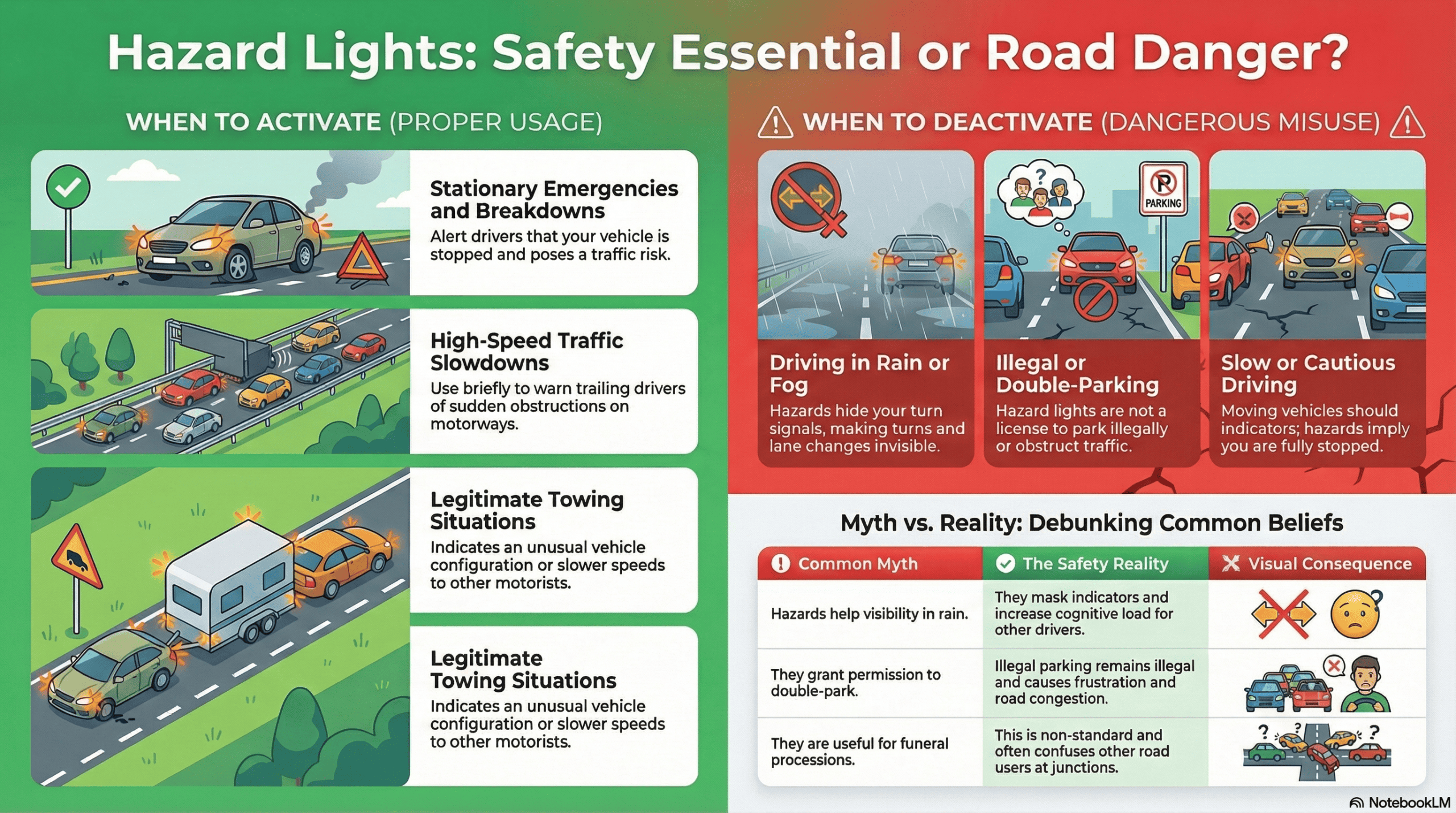
In many jurisdictions, a towing vehicle can activate hazards to indicate it is towing another vehicle, especially on motorways or dual carriageways. The towed vehicle should also display hazard lights if it is not being towed safely. This alerts other drivers to the slower speed and the unusual road configuration.
Slow-Moving or Stationary Traffic Warning (Specific Situations)
In some regions, hazard lights are permitted when warning other drivers of a sudden traffic slowdown on motorways. This is context-dependent and should only be used briefly to alert traffic behind you, then switched off once you are certain drivers are aware of the hazard. This is not a license to drive slowly in hazards.
When Hazard Lights Make Things Worse
Driving in Heavy Rain or Fog
This is perhaps the most common misuse of hazard lights, and it actively reduces safety. When you drive in poor visibility and activate hazard lights, other drivers cannot distinguish your turn signals from your hazard lights. Your directional indicators become invisible, leaving other drivers guessing about your intentions at junctions, roundabouts, and lane changes.
Consider this scenario: you are approaching a roundabout in heavy rain with your hazards on. You signal left to take the second exit. Other drivers cannot see this signal as your hazards are flashing all four corners at the same time. They might think you are about to stop suddenly, or they might assume you are in a breakdown state and drive unpredictably to avoid you. This creates confusion and risk.
In poor visibility, rain, or fog, your best approach is to reduce speed, switch on dipped headlights (even during the day), and use your normal indicators to signal turns and lane changes. This tells other drivers exactly what you intend to do.
Double-Parking or Illegal Parking
Hazard lights are not a license to park illegally. Activating hazards while double-parked sends a false signal that you have a legitimate reason to obstruct traffic. You do not. This is an easy habit to fall into on busy urban streets when you “just need to pop into” a shop, but it is neither legal nor safe.
When hazard lights are on, other drivers assume your car is empty and you are in an emergency situation. If you are in the car waiting, the message becomes garbled. If traffic needs to move and you are simply parked illegally, you are obstructing the flow and confusing other road users.
Park legally, or do not stop. There is no middle ground where hazard lights justify illegal parking.
Slow Driving or Cautious Driving in Normal Conditions
Some drivers activate hazard lights when driving slowly in fog, or when pulling out into traffic carefully, or when reversing into a difficult space. This is wrong. Hazard lights are not a “caution” indicator for other drivers. They mean something is broken or stopped, not something is slow.
If you are driving slowly as you are lost, navigating a tricky road, or concentrating hard, you do not need hazard lights. Use your normal indicators and adjust your speed. If you are moving at all, hazard lights are not the appropriate signal.
Funeral Processions or Convoys
Funeral processions sometimes use hazard lights, but this varies by region and is not standard practice in most places. It can actually confuse other drivers. Check local guidance if you are part of a funeral convoy.
School Runs or Slow-Speed Parking Situations
Hazard lights are not appropriate when dropping off children at school, even if traffic is heavy or you are blocking others briefly. Again, hazard lights signal an emergency or breakdown, not a temporary stop for loading or unloading. This habit creates confusion and normalizes misuse of hazard lights.
Why Hazard Lights in Rain Are Genuinely Dangerous
The danger of using hazard lights in rain goes beyond simple confusion. When hazard lights are on, they override your turn signals in the perception of other drivers. This is not a minor inconvenience; it is a safety failure.
Imagine you are on a dual carriageway in heavy rain. The car ahead activates hazard lights. You see flashing lights all around that vehicle. Your brain processes this as a warning signal. Then the car moves left. Was that a turn, or is the car breaking down? Are they changing lanes, or is there a hazard ahead? Your decision-making is compromised.
Now multiply this across a whole road of drivers, each making micro-decisions based on incomplete information. Hazard light misuse increases the cognitive load on every driver around you.
If your vehicle’s lights are faulty or damaged, hazard lights can be your only option to warn others. But if hazard light use becomes normalized for rain or slow driving, the signal loses its power. When a driver truly in danger needs that warning system, other drivers can dismiss it as casual use.
The Legal Position: UK and US
United Kingdom
The UK Highway Code is explicit on hazard lights. Rule 116 states: “You can use hazard lights when parked to warn of an obstruction.” Rule 112 adds that hazard lights can be used when there is an obstruction ahead and traffic needs to slow suddenly. This is the extent of permitted use.
Using hazard lights in rain, while driving in normal conditions, or for any purpose other than emergency warning is not permitted and could result in a driving offense. Practically speaking, police enforcement is inconsistent, but the legal position is clear: hazard lights are for emergencies and obstructions only.
The Highway Code does not forbid hazard use in rain explicitly, but it does not permit it either, and the guidance from IAM RoadSmart and RoSPA (Royal Society for the Prevention of Accidents) is that hazard lights should not be used in rain as they disable directional indicators and confuse other drivers.
United States
In the US, hazard light regulations are set by individual states, creating a patchwork of rules. Most state DMV guidance follows a similar principle: hazard lights are for emergencies, breakdowns, and disabled vehicles.
Some states explicitly forbid the use of hazard lights while the vehicle is moving, except in very specific circumstances like towing. Other states are less prescriptive but still recommend hazard lights only for genuine emergencies.
The National Highway Traffic Safety Administration (NHTSA) does not mandate hazard light use in rain, and several states have explicitly discouraged it as turn signals become obscured.
If you are driving across multiple US states, the safest approach is to follow the most conservative rule: use hazards only when stopped, broken down, or in a genuine emergency.
What Other Drivers Actually Think When They See Hazard Lights
Understanding driver perception is key to using hazard lights correctly. When a driver sees hazard lights, they form an instant assumption about your vehicle status.
Hazard lights activated while stopped or on the hard shoulder typically trigger the correct response: “There is a broken-down vehicle or an emergency. I need to slow down and avoid it.” This is hazard lights working as designed.
Hazard lights activated while driving in rain trigger confusion: “Is this car broken down? Are they warning me of something ahead? Why are all their lights flashing? Can I see their turn signals?” The message becomes muddled, and other drivers make conservative decisions based on incomplete information.
Hazard lights activated while double-parked trigger frustration: “This car is illegally parked and the driver is pretending it is an emergency. They are inconsiderate and breaking the rules.” Hazard lights do not give you a free pass to park illegally; they signal the opposite to other drivers.
Research from the AAA Foundation for Traffic Safety and similar bodies shows that driver confusion about hazard light use is linked to minor collisions and near-misses, especially on multi-lane roads and at junctions where directional signals are critical.
Better Alternatives to Hazard Lights in Common Situations
Heavy Rain or Poor Visibility
Use dipped headlights (low beams) and adjust your speed. This is the standard approach in most countries during rain, fog, or darkness. Dipped headlights make you visible without confusing other drivers about your direction of travel.
Temporary Stop or Parking
If you must stop briefly, find a legal parking space or pull off the road completely. Do not double-park with hazards on. If a legal space is not available, drive around the block or come back later. Hazard lights are not a solution to poor planning.
Slow Driving in Dense Traffic or While Lost
Use your normal turn signals and adjust your speed. If you are lost, pull over completely into a legal space before checking navigation. Other drivers do not need hazard lights to understand that you are moving slowly; they can see your speed and your signals.
Vehicle Breakdown or Emergency
This is the only case where hazard lights are appropriate for moving vehicles. If your vehicle is losing power or failing, activate hazards immediately, signal your intention to stop, and move off the road. This is the correct and legal use of hazard lights.
School Run or Loading Passengers
Park legally, turn off your engine, and park correctly. Do not use hazard lights as a signal that you are “temporarily” breaking parking rules. If you must stop in a busy area, accept that you need to circle back rather than create an obstruction.
Regional Variations and When to Check Local Rules
While the core principle of hazard light use is consistent across the UK and most of North America, regional variations exist. Some areas have specific rules about hazard light use on motorways, during towing, or in specific weather conditions.
If you are renting a vehicle in an unfamiliar country or state, check the local highway code or rental agreement. Rules vary by region, and the same applies for unfamiliar vehicle types like commercial vehicles or motorhomes, which can have specific requirements.
The Real Cost of Hazard Light Misuse
When drivers normalize the misuse of hazard lights, the entire safety system becomes degraded. This is not just inconvenient; it erodes a critical warning mechanism that has saved lives for decades.
Consider the statistics. Every day on UK roads, thousands of drivers misuse hazard lights in heavy rain, while double-parked, or while driving slowly. Each of these drivers believes they are being cautious or helpful. But the cumulative effect is that other drivers stop trusting hazard lights as a reliable signal. If everyone around you is flashing hazards in rain, what does a hazard light actually mean anymore?
This normalization leads to two problems. First, drivers become desensitized to the signal. When they see hazard lights, they do not immediately think “emergency ahead” as they have seen so many false positives (rain, slow driving, illegal parking). Second, and more dangerously, drivers in genuine emergencies lose the power of that signal. A motorist with a engine fire or sudden brake failure activates hazard lights, and other drivers think “probably just rain” and continue at speed.
The AAA Foundation for Traffic Safety has documented this effect in research on driver perception. When hazard lights are overused, their effectiveness diminishes. This is called signal degradation, and it applies to all warning systems. Traffic lights, sirens, and hazard lights all lose their power when abused or overused.
Hazard Lights and Insurance
From an insurance perspective, hazard light misuse can have serious consequences. If you are involved in a collision while double-parked with hazards on, your insurance company can refuse to pay or offer reduced coverage on the basis that you were parked illegally.
Similarly, if you are driving in rain with hazard lights on and you fail to clearly signal a turn, causing a collision with a vehicle that could not see your directional signal, liability can fall on you. Your insurance company can argue that you were using safety equipment incorrectly, which constitutes negligence.
This is not theoretical. Insurance claims related to hazard light misuse are becoming more common as insurers tighten their scrutiny. The lesson is simple: follow the rules for hazard light use, not just for legal reasons, but for your own financial protection.
Modern Vehicles and Hazard Light Technology
Some newer vehicles have automatic emergency braking systems and advanced driver assistance systems (ADAS) that interact with hazard lights. In some cars, a sudden emergency stop will automatically activate hazard lights even if the driver does not. This is a safety feature, but it creates a complication: other drivers can assume your vehicle has broken down when you are simply doing an emergency stop.
Always understand how your vehicle’s hazard light system works. Some cars allow hazards to activate while stationary even when the engine is off, which is useful for warning traffic about a breakdown. Other vehicles only allow hazards to activate when the engine is running. Read your vehicle’s manual to understand these details.
If your vehicle has automatic hazard light activation, you do not need to manually activate them in an emergency stop. The system is designed to handle this for you. This is one area where modern technology has actually improved hazard light use, as the system activates hazards only when truly needed, not in rain or when driving cautiously.
Hazard Lights in Extreme Weather: When the Rules Are Tested
Extreme weather creates temptation to misuse hazard lights. Heavy snow, ice, or flash flooding can make drivers feel that hazards are necessary even while driving. They are not.
In heavy snow, the best approach is to reduce speed significantly, use dipped headlights, and keep windows and mirrors clear. The fundamentals of driving safely in snow all come down to smooth inputs and good visibility, not flashing lights. Hazard lights add nothing and actually subtract directional control from your vehicle’s communication system.
In flash flooding or extreme conditions where visibility is near zero, the safest move is to stop completely in a safe location, not to drive slowly with hazards on. If the weather is that severe, your vehicle should not be moving. Park off the road and wait for conditions to improve. If you do find yourself driving through flooded roads, slow and steady progress with headlights on is far more effective than flashing hazards.
Many serious multi-vehicle collisions on motorways occur during heavy rain when drivers are driving with hazards on and cannot signal their actual intentions. The cascading effect of one driver’s hazard misuse can cause a pile-up of vehicles as following drivers cannot see directional signals and make poor braking decisions.
Hazard Lights and Towing: Getting It Right
Towing is one of the few situations where hazard light use is consistently correct. When you are towing another vehicle or being towed, hazard lights serve a legitimate purpose. They tell other drivers that your vehicle is not operating normally and that you are moving slower than traffic.
Hazard lights are only one part of a safe towing setup. You should also ensure that your towed vehicle displays tail lights and brake lights that are visible to following traffic. Some towing situations require professional towing equipment and specific lighting configurations. If you are towing a broken-down vehicle or a trailer, check the towing rules for your region and ensure all lights are functioning correctly.
The principle is consistent: hazard lights communicate to other drivers that the vehicle configuration is unusual and warrants caution. Rules on towing lights vary by region, so check your local guidance if you’re unsure.
Common Hazard Light Myths
Several myths about hazard lights persist among drivers. Let us clear them up.
Myth 1: “Hazard lights give you the right to park anywhere.” False. Hazard lights do not override parking laws. Parking illegally remains illegal, even with hazards on.
Myth 2: “Hazard lights are helpful in rain.” False. They disable directional indicators and confuse other drivers. Dipped headlights are the correct choice in rain.
Myth 3: “Using hazard lights makes you more visible in fog.” False. Hazard lights flash on and off, which can actually be harder to track in fog than steady headlights. Dipped headlights are steadier and more visible.
Myth 4: “Professional drivers use hazards more as they are experienced.” False. Professional drivers, who operate buses, lorries, and commercial vehicles under strict guidelines, use hazards only according to regulations. They use them less frequently than casual drivers as they follow the rules.
Myth 5: “Hazard lights are a substitute for brake lights.” False. Brake lights serve a different purpose and are not replaced by hazards. Both systems are needed for different situations.
Practical Tips for Hazard Light Use
If you are unsure whether a situation calls for hazard lights, ask yourself this question: “Is my vehicle stopped or stationary, or is there a genuine emergency?” If the answer is yes, hazard lights can be appropriate. If you are moving or in normal driving conditions, the answer is almost certainly no.
Before long journeys, especially in unfamiliar regions, familiarize yourself with local hazard light rules. Check the vehicle manual to ensure you know how to operate hazard lights and what to expect from your vehicle’s lighting system.
If you are driving in a country or state with unfamiliar rules, err on the side of caution. Use hazard lights only for genuine breakdowns and emergencies, and avoid using them in weather or traffic situations. This approach keeps you safe and compliant with the law.
Remember that other drivers are watching your vehicle for signals. Every time you activate hazard lights, you are making a statement about your vehicle status. Make sure that statement is true and necessary. Misusing hazard lights erodes trust in the system and makes roads less safe for everyone.
Regional Variations and When to Check Local Rules
While the core principle of hazard light use is consistent across the UK and most of North America, regional variations exist. Some areas have specific rules about hazard light use on motorways, during towing, or in specific weather conditions.
If you are renting a vehicle in an unfamiliar country or state, check the local highway code or rental agreement. Rules vary by region, and the same applies for unfamiliar vehicle types like commercial vehicles or motorhomes, which can have specific requirements.
Hazard Light FAQs
Is it legal to use hazard lights while driving in heavy rain?
In most jurisdictions, no. Hazard lights in rain disable your turn signals, confuse other drivers, and are discouraged by most motoring authorities. Using dipped headlights and reducing speed is safer and more widely accepted.
Can I use hazard lights while parked illegally?
No. Hazard lights do not give you permission to park illegally. They are specifically for traffic warnings during emergencies or breakdowns, not to excuse parking violations. Double-parking with hazards on is still illegal and still an obstruction.
What’s the difference between hazard lights and brake lights?
Hazard lights flash all four corners simultaneously to warn of a stationary hazard. Brake lights are steady lights that activate when braking, telling drivers behind you to slow down. Hazard lights do not replace proper braking signals, and they are not a substitute for normal traffic control.
When should I use hazard lights on the motorway?
Only when you have broken down or stopped from an unavoidable obstruction. Hazard lights warn other drivers of a stationary problem. Hazard lights are not for slow driving, congestion, or reduced visibility. If you are approaching a hazard ahead and need to warn traffic behind you, use hazards briefly and then switch them off once you have moved safely off the road.
What do other drivers think when they see hazard lights?
In most cases, drivers assume there is a breakdown, accident, or emergency stop ahead. If you use hazard lights while moving or in normal weather, other drivers become confused about your actual intentions and cannot read your directional signals clearly. Misuse of hazard lights erodes the effectiveness of the signal and creates safety risks.
Sources

Leave a Comment
More in News

Chase Elliott Steals Martinsville Win From Dominant Denny Hamlin

What Does O/D Off Mean?
Why Is My Fuel Economy Getting Worse?

Nobody Can Stop Alex Palou at Barber Motorsports Park

Alex Palou Back on Peak Form, Dominates Barber Qualifying
Trending on Motoring Chronicle

Why does my car make noise when I turn?
Hyundai Models Impress Car and Driver, Claim Eight 2026 Editors’ Choice Awards

The new Bugatti Tourbillon makes its debut in Doha [Photo Gallery]
Ferrari Stop Mat Armstrong From Rebuilding His 296 GTB