How Long Does Brake Fluid Actually Last?
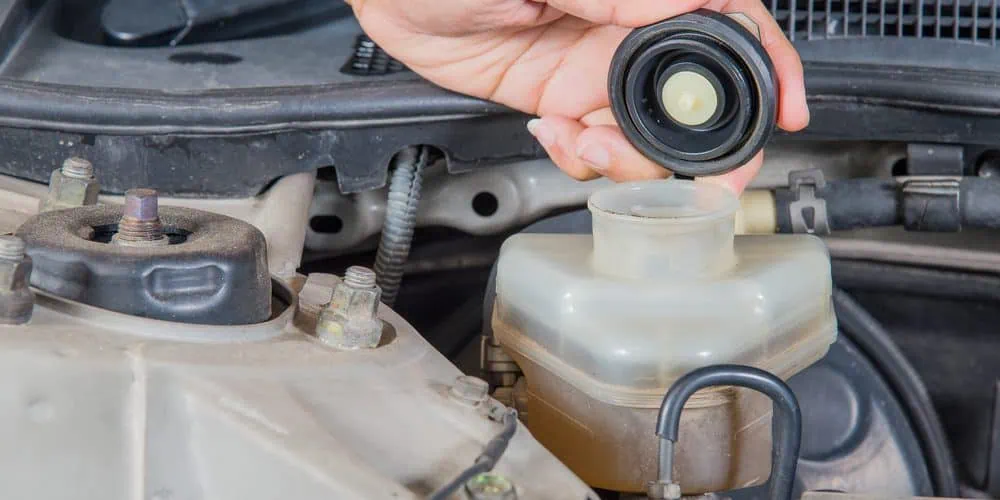

Brake fluid lasts two to three years under typical conditions regardless of mileage, as it absorbs moisture from the air continuously in both driven and parked vehicles. Most manufacturers specify a change every two years or 45,000 miles, whichever comes first. The interval is primarily time-based rather than mileage-based, with moisture absorption serving as a function of time and humidity exposure rather than driving frequency.
Why Brake Fluid Degrades Differently From Other Fluids
Hygroscopy: Why Brake Fluid Absorbs Moisture From the Air
Brake fluid operates under a unique constraint that distinguishes it from engine oil, transmission fluid, or coolant. It maintains an open relationship with the atmosphere through the master cylinder’s vent. As the brake pedal moves up and down during normal driving, the master cylinder breathing vent draws in whatever humidity exists in the surrounding air. This is not a leak or a failure; it is an inherent characteristic of the brake system’s design. Over time, this constant exposure means the fluid steadily absorbs water molecules from the environment.
The property responsible for this absorption is called hygroscopy. Brake fluid, whether DOT 3, DOT 4, or DOT 5.1, is hygroscopic by nature. The fluid’s chemical composition includes polyol compounds that have an affinity for water vapor. In a dry desert climate, the absorption rate moves slower than in a humid coastal region, yet the process never stops. Even vehicles parked in a garage with stable temperature are subject to daily humidity fluctuations, and the brake system remains open to those changes.
No sealed cap or protective device can prevent this water absorption completely. The system requires that vent to function properly; without it, pressure would build abnormally during braking, and the fluid could become superheated in the brake lines. Drivers cannot avoid moisture ingress, which is precisely why manufacturers specify a change interval based on elapsed time rather than mileage alone.
What Water Content Does to Braking Performance
As water accumulates in the brake fluid, the fluid’s boiling point declines. A new, dry DOT 3 fluid has a dry boiling point of 401 degrees Fahrenheit and a wet boiling point of 284 degrees Fahrenheit. Once the fluid absorbs even 2 to 3 percent water by volume, the wet boiling point drops below 230 degrees Fahrenheit. This is the critical threshold where brake fade becomes a real risk, in sustained braking situations or during spirited driving on mountain roads.
Water in the brake lines can also create localized boiling. When brake fluid heats up, water droplets suspended within it vaporize faster than the base fluid. This creates small pockets of vapor within the brake line, and vapor is compressible. The pedal feels soft or spongy as the driver’s foot compresses air rather than transmitting force directly to the brake calipers. In severe cases, the brake pedal sinks to the floor with little or no stopping power, a condition known as brake fade.
The moisture content also accelerates corrosion inside the brake system. Steel brake lines, cast iron calipers, and aluminum components all corrode when exposed to water-contaminated fluid. Corrosion products accumulate and can restrict fluid flow or cause wheel cylinders to stick. On vehicles with ABS systems, the rapid valve cycling becomes erratic when fluid quality declines, and the system’s ability to modulate brake pressure suffers.
How the Boiling Point Drops as Moisture Accumulates
The relationship between water content and boiling point is not linear; it is dramatic. A DOT 4 fluid starts with a dry boiling point of 446 degrees Fahrenheit. At just 3.7 percent water absorption, the wet boiling point plummets to 248 degrees Fahrenheit. By the time a brake fluid has reached 4 to 5 percent water content, it has become a liability rather than an asset, and the risk of brake fade under hard braking is substantial.
This is why the two-year interval exists. In most climates, brake fluid reaches the saturation point where water content begins to approach 3 percent at around 24 months of service. Some manufacturers recommend one-year intervals for vehicles operated in very humid climates, such as coastal regions or areas with high rainfall. Commercial vehicles, police cars, and performance-oriented drivers who brake hard frequently should select annual fluid changes as the thermal cycling of the fluid (heating and cooling) accelerates degradation and water absorption.
Testing can reveal when a fluid has absorbed too much water. A wet boiling point test, performed with proper equipment, shows if the fluid has fallen below acceptable limits. Many technicians use a simple refractometer or hygrometer to measure moisture content directly. Once the fluid shows 3 percent or higher water content, it should be replaced immediately, regardless of how recently the last change was performed.
How Long Brake Fluid Actually Lasts
The Two-Year Service Interval Explained
The two-year service interval for brake fluid is not arbitrary. It is based on decades of field data and laboratory testing under controlled humidity conditions. Manufacturers test how long it takes for a sealed container of brake fluid in a typical climate to accumulate 3 percent water by mass. The result, across DOT 3, DOT 4, and DOT 5.1 specifications, consistently points to approximately 24 months as the threshold where action becomes necessary.
This interval applies whether the vehicle is driven daily or sits unused for months. A car that travels 5,000 miles per year and one that travels 30,000 miles per year experience roughly the same brake fluid degradation over 24 months. The mileage-based portion of the specification (45,000 miles) is largely a convenience for vehicles with very high annual mileage; those cars will reach the 45,000-mile mark before two years elapse and should change their fluid at that time. For most drivers, the calendar date matters far more than odometer reading.
Some manufacturers have begun offering extended intervals, especially for synthetic brake fluids. Certain OEM specifications now allow 3-year intervals on vehicles using premium DOT 4 synthetic fluids. These fluids are formulated to resist water absorption more effectively than conventional fluids. This extension does not mean the fluid will never degrade; it simply means the manufacturer has tested the fluid and determined that under normal conditions, the water content will remain within acceptable limits for 36 months.
DOT 3 vs DOT 4 vs DOT 5.1: How Type Affects Lifespan
DOT 3 fluid is polyol-ether based and remains the cheapest and most commonly used brake fluid globally. It has adequate boiling points for normal passenger car applications. DOT 3 begins to absorb water quickly and is the first to reach saturation. A typical DOT 3 fluid will accumulate 3 percent water content between 18 and 24 months in a temperate climate, making it the brake fluid with the shortest practical lifespan.
DOT 4 fluid is also polyol-ether based, with enhanced additives that raise boiling points and provide improved water absorption resistance. DOT 4 has a higher dry and wet boiling point than DOT 3, making it more suitable for performance driving and heavier vehicles where sustained braking generates more heat. DOT 4 will absorb water at a rate comparable to DOT 3, reaching saturation around 24 months, yet the higher boiling points mean the fluid can tolerate a higher water content before brake fade becomes a practical concern. Many modern vehicles come from the factory with DOT 4.
DOT 5.1 is a newer formulation that combines the polyol-ether chemistry of DOT 3 and DOT 4 with additives that offer even higher boiling points and superior moisture absorption resistance. A quality DOT 5.1 fluid can resist reaching the 3 percent saturation threshold for 30 to 36 months. DOT 5.1 is significantly more expensive and is typically found only in sport cars, track cars, and premium European vehicles. The cost premium is offset by the extended service interval, making it economical only for drivers who prioritize performance or who intend to keep a vehicle long-term.
DOT 5, a silicone-based fluid, exists in some specialty applications and military vehicles, yet it is not miscible with polyol-ether fluids and is rarely encountered in civilian automotive use. Mixing DOT 5 with DOT 3 or DOT 4 will cause the fluid to separate and fail catastrophically, so it is not a practical option for most drivers.
Factors That Shorten the Interval (Climate, Driving Style, Vehicle Age)
Climate exerts one of the strongest influences on brake fluid lifespan. A vehicle operated in humid, tropical climates will absorb water faster than one in an arid desert, even if both are stored indoors. Coastal vehicles experience salt-laden humidity that increases corrosion risk and can accelerate degradation of brake system seals. Vehicles in areas with significant rainfall and high relative humidity reach the saturation threshold in 12 to 18 months rather than 24.
Driving style matters significantly. Track drivers, towing enthusiasts, and drivers in mountainous terrain who brake hard and frequently heat the fluid to near its boiling point accelerate degradation. The thermal cycling of brake fluid, involving repeated heating and cooling, causes micro-structural changes that make the fluid more susceptible to water absorption and oxidation. A weekend track warrior who uses brakes intensely should select annual brake fluid changes regardless of the OEM specification. A delivery driver who spends 10 hours per day in stop-and-go urban traffic also subjects the brakes to extreme cycling and would benefit from more frequent fluid changes.
Vehicle age is another factor. Older brake systems with worn seals in the master cylinder, wheel cylinders, and calipers can leak small amounts of fluid, which the driver compensates for by topping off with fresh fluid. This means the average age of the fluid in the system is younger than the time elapsed from the last full change. Conversely, if a 15-year-old vehicle has never had a brake fluid change, the fluid is almost certainly 15 years old, far exceeding safe limits. Worn seals also allow more air and moisture to enter the system. At some point, the corrosion in the system becomes so extensive that brake pedal feel degrades and a full system flush becomes necessary, not just a fluid change.
Warning Signs the Fluid Has Gone Past Its Service Life
Color Change in the Reservoir
Brake fluid in a new container or immediately after a fresh change is clear to pale yellow, depending on the DOT rating. As the fluid ages and absorbs water, it begins to darken. The color progression moves from clear to pale amber to medium brown. If you look through the translucent plastic brake fluid reservoir and see dark brown or black fluid, the fluid has almost certainly exceeded safe limits and should be changed immediately.
Discoloration occurs as water in the fluid catalyzes oxidation reactions and promotes the formation of organic acids and degradation byproducts. Moisture also allows corrosion products from internal brake lines and components to suspend in the fluid, adding to the visual discoloration. Some aftermarket brake fluids contain dyes to make the darkening more visible to technicians, so the color change is not just cosmetic; it is a visual indicator that chemistry has changed.
If the fluid in the reservoir appears black or contains visible particles or sediment, the system has serious contamination. The fluid should be replaced, and the entire brake system should be flushed to remove accumulated corrosion products. Continuing to drive with visibly degraded fluid risks brake failure, in particular if the vehicle encounters a demanding braking situation.
Spongy or Inconsistent Pedal Feel
A brake pedal that feels soft, spongy, or that sinks gradually toward the floor when pressure is applied is the most common symptom of water-contaminated brake fluid. The phenomenon occurs as water vapor forms bubbles in the fluid, and gas compresses more easily than liquid. The driver applies force to the pedal, yet instead of all that force being transmitted through incompressible fluid to the brake calipers, some of it compresses the gas bubbles. The pedal travels further than normal, and braking force arrives late or incompletely.
This symptom is most pronounced after the brakes have been used repeatedly, such as descending a long mountain road or after a series of hard stops. The fluid temperature rises, and more water vapor forms. After the vehicle cools down and is parked, the pedal feels nearly normal again until the next hard braking event, at which point the sponginess returns. This intermittent nature makes the condition easy for drivers to dismiss, yet it is a clear warning that fluid replacement is overdue.
In extreme cases, the pedal sinks to the floor with almost no braking force. This is an emergency condition. If the brake pedal becomes unresponsive during driving, pump the pedal repeatedly to try to re-pressurize the system, and slowly decelerate to the side of the road. Call for roadside assistance and do not attempt to drive further. This represents a catastrophic failure of the brake system and is a safety-critical condition.
Brake Fade Under Repeated Hard Stops
Brake fade is a gradual reduction in stopping power that occurs during sustained or repeated braking, such as when descending a long downhill grade or when braking repeatedly in heavy traffic. As the brakes are applied, friction converts kinetic energy into heat, and that heat is transferred to the fluid. If the fluid contains water and has absorbed moisture to the point that its boiling point has dropped significantly, the water in the fluid vaporizes first, expanding into gas bubbles. These bubbles interrupt the fluid’s ability to transmit pressure, and stopping power decreases.
Drivers experience brake fade as a progressive softening of the pedal as the descent or braking session continues. The first few hard brakes work normally, yet by the fifth or tenth brake application, the pedal has moved further and the stopping distance has increased. Releasing the brakes and allowing the fluid to cool for a few minutes restores normal pedal feel temporarily, yet this is a symptom that the fluid quality has deteriorated to unacceptable levels.
Brake fade from fluid degradation differs from mechanical brake fade from overheated friction material. Mechanical brake fade recovers completely once the brakes cool down. Fluid-related fade is a sign of immediate action needed; the fluid must be changed before attempting any more sustained braking. Operating in this condition increases the risk of brake failure or collision, most notably in emergency situations where the driver relies on maximum braking force.
Checking and Changing Brake Fluid
How to Read the Reservoir Correctly
Most modern vehicles have a translucent plastic brake fluid reservoir mounted on or near the master cylinder in the engine bay. The reservoir has MIN and MAX marks stamped into the side. The MIN mark indicates the lowest safe level before the fluid runs low enough to draw air into the master cylinder. The MAX mark indicates the level when the fluid is full and the brake pads are not yet worn and do not need compensation.
Brake fluid level will drop slightly over months as brake pads wear down. The fluid itself does not leak away; instead, as pads thin from use, the brake caliper pistons extend slightly further to maintain contact with the rotors, and this increased piston travel requires more fluid in the system. A slow, steady drop in level is normal and is not a sign of fluid degradation. A sudden drop in level over a few days or weeks indicates a leak in the brake lines or a failing seal in the master cylinder, wheel cylinders, or calipers. Any significant leak should be inspected and repaired.
To check the fluid level, look through the translucent reservoir from the side. The fluid should be between the MIN and MAX marks. If it is below MIN, the system is drawing in air, and braking function is compromised. Add the correct DOT rating fluid (check the vehicle’s owner’s manual) to bring the level to MAX. Simply topping off the fluid is not a substitute for changing the entire fluid if the existing fluid is old. The new fluid will quickly become contaminated from mixing with degraded fluid in the system. When checking and changing brake fluid, remember that engine oil, coolant, and trans
mission fluid on the same maintenance schedule all benefit from the same attentive care. You can find a comprehensive guide at checking these fluids regularly to stay ahead of degradation in all systems.
Wet and Dry Boiling Point Testing
Professional technicians use boiling point testing to determine if brake fluid has reached the end of its service life. A dry boiling point test measures the temperature at which the fluid vaporizes in a sealed, moisture-free environment. A wet boiling point test measures the temperature at which the fluid vaporizes after absorbing water. The wet boiling point is the more relevant number as it reflects the real-world condition of the fluid in the vehicle.
DOT 3 fluid must have a minimum wet boiling point of 284 degrees Fahrenheit when new. DOT 4 must be at least 311 degrees Fahrenheit. DOT 5.1 must be at least 356 degrees Fahrenheit. Once the fluid’s tested wet boiling point falls below these minimums, it should be changed immediately. A dedicated boiling point tester is expensive laboratory equipment, so most technicians instead use a simple refractometer or electronic hygrometer to measure water content directly. Fluid with more than 3 to 3.5 percent water content is considered unacceptable and requires replacement.
Many shops offer brake fluid testing as part of a routine inspection. Some even offer visual testing kits that use a color-change indicator; when a small amount of fluid is exposed to a moisture-sensitive chemical, the color reveals if water content is excessive. These kits are not as precise as laboratory testing yet are sufficient for a roadside indication of whether fluid change is needed urgently. If testing reveals unacceptable moisture content, a complete brake system flush should be scheduled immediately.
Flush vs. Top-Up: Which Approach to Use and When
A brake fluid top-up means adding fresh fluid to bring the level back to the MAX mark without removing the old fluid. This approach is acceptable if the existing fluid is young (less than one year old) and testing shows acceptable moisture content. A top-up does not address the contamination in the system; the new fluid will immediately begin mixing with the old fluid, and the average age of the fluid in the system increases only slightly.
A complete brake system flush is the proper maintenance procedure when fluid change is due. A flush involves opening the brake lines at the wheel cylinders or calipers and bleeding out the old fluid while introducing new fluid, repeating the process until the discharged fluid matches the color and clarity of the new fluid being introduced. A flush removes not just old fluid yet also accumulated corrosion products, moisture, and trapped air. On vehicles with ABS, the flush process can require a specialized machine that cycles the ABS solenoids to purge fluid from those lines.
A flush should be the default approach every two years at the scheduled interval, before fluid testing shows it to be in poor condition. Waiting until the fluid is visibly degraded, the pedal feels spongy, or testing confirms excessive moisture means the system has already experienced corrosion and contamination that a flush cannot fully undo. In severe cases, the brake system will require component replacement in addition to fluid change. Engine oil, coolant, and transmission fluid also require scheduled replacements to maintain system health, and brake fluid deserves the same attentive regular maintenance. Scheduling a brake fluid flush as part of routine maintenance, alongside other periodic services, is the best way to preserve consistent braking performance and system longevity.
If you enjoyed this article, be sure to follow us on Microsoft Start.

Leave a Comment
More in News
Presenting Rolls-Royce Cullinan Yachting: a bespoke celebration of marine craft and design

Steering Wheels: The 9 and 3 Paradigm

New Study Shows Strong, Compounding Safety Benefits of Mazda’s Advanced Driver Assistance Systems
2027 Chevrolet Corvette Grand Sport, Grand Sport X debut with new 6.7L V8

How Can You Maximize Fuel Economy When Accelerating?
Trending on Motoring Chronicle
Alfa Romeo Unveils the 2026 Tonale: The Most Expressive and Dynamic Yet

Audi brings greater presence, performance, and class-above premium content to the all-new 2026 Audi Q3

Automobili Lamborghini talks about industry through art: the Museum hosts “The Industrial Perspective” [Photo Gallery]
World’s oldest Bentley T-Series returns home [Photo Gallery]