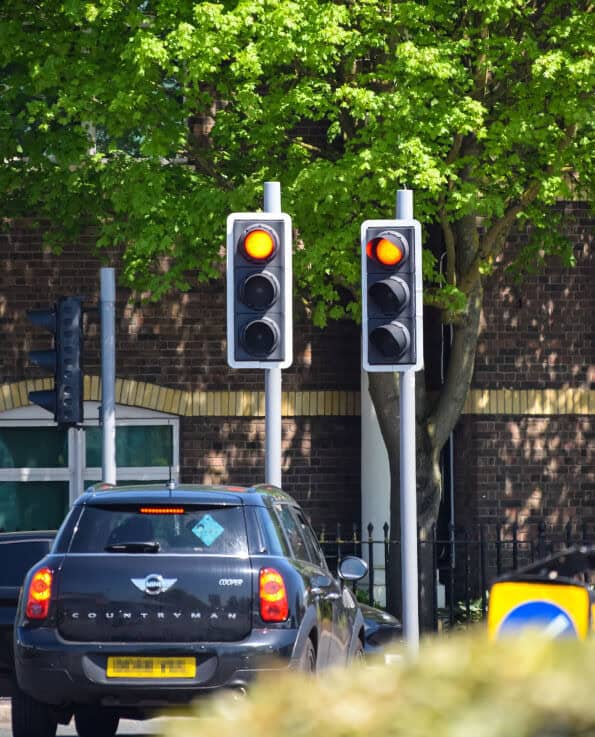
How Kentucky’s New School Bus Law Now Requires Stops in Both Directions


- Kentucky’s House Bill 7 now forces drivers on multi-lane roads to stop for a school bus in both directions, closing a gap that let opposite-side traffic roll past a stopped bus for years.
- School districts can install cameras on bus stop arms for the first time, with fines set at $300 for a first offense and $500 for a second within five years.
- A camera-issued ticket goes to the vehicle’s registered owner even when someone else was behind the wheel, unless that owner can prove another driver was responsible.
A Rule That Used to Stop at the Median Now Covers the Whole Road
For years, Kentucky drivers on a divided highway could legally keep driving past a school bus stopped on the other side of the road, as long as a median or turn lane separated the lanes. House Bill 7, which took effect July 15, closes that gap. Drivers on multi-lane roads must now stop for a bus’s flashing red lights and extended stop arm regardless of which direction they are traveling. The only exceptions are roads split by a concrete wall or a grass median wide enough to count as a physical barrier under the new statute.
The change targets one of the most common and dangerous gaps in school bus law nationwide: drivers assuming that oncoming traffic rules do not apply to them. Kentucky joins a growing list of states tightening stop-arm requirements as school districts report thousands of illegal passes every year, often within feet of children stepping off a bus.
Cameras Are Rolling Out District by District, Not Statewide
House Bill 7 also gives Kentucky school districts permission, for the first time, to mount camera monitoring systems on bus stop arms to catch violators automatically. The law does not include state funding for the equipment, so installation depends entirely on individual district budgets. Jessamine, Bath, and Knox counties are among the districts that already have cameras running. Many others, including large portions of Fayette County and its neighbors, do not yet have a single bus equipped.
That patchwork makes a real difference for drivers. A bus without a camera still requires a full stop under state law, and a state trooper or local officer who witnesses a violation can issue a citation on the spot. A camera simply adds a second layer of enforcement that does not depend on an officer being present at the exact moment a car blows past. Districts that install cameras are expected to see citation numbers climb quickly once the systems go live, based on patterns seen in other states after similar rollouts.
Funding remains the biggest obstacle to statewide coverage. A single stop-arm camera system can cost a district several thousand dollars per bus once installation, data storage, and staff time to review footage are factored in. Larger districts with bigger transportation budgets, or those willing to enter revenue-sharing agreements with camera vendors, tend to move first. Smaller and rural districts often wait to see how the economics play out elsewhere before committing scarce dollars to the technology, which means a child crossing the street in one county is protected by camera enforcement while a child in the next county over is not.
What a Violation Actually Costs
Under House Bill 7, a first stop-arm violation carries a $300 civil fine. A second violation within five years jumps to $500. Most of that money stays with the school district that issued the citation, while local law enforcement agencies receive a flat $25 per penalty processed through the civil citation system.
The citations are processed civilly rather than as criminal traffic offenses, so they work differently than a typical speeding ticket. When a camera captures a violation, the notice goes to whoever the vehicle is registered to, not necessarily the person driving at the time. A parent who lends a car to a teenager, or a company with a fleet vehicle, can be held responsible unless they can identify and document who was actually driving. Kentucky’s law allows an affidavit process for registered owners to name the actual driver and shift liability, but the burden of proof sits with the owner. A driver-only citation issued by a stop, unlike the camera-based civil penalty, is a criminal moving violation that a court can add to a driving record.
That distinction has practical value for anyone worried about insurance. The camera-issued fine is a civil penalty rather than a moving violation, so it typically does not add points to a driver’s license or trigger an automatic rate increase from an insurer, the way a criminal traffic conviction would. A citation written by an officer who personally witnesses a stop-arm violation works differently, and that conviction can carry both points and an insurance consequence in addition to the fine.
Kentucky’s Fines Sit in the Middle of a Wide National Range
States that allow stop-arm cameras have settled on very different penalty amounts. Georgia issues a $1,000 citation for illegally passing a stopped school bus with its red lights flashing, more than three times Kentucky’s first-offense fine. Florida’s Duval County set its camera-issued fine at $225. Pennsylvania fines the registered owner $300 for a first stop-arm camera violation, matching Kentucky’s starting point almost exactly. The variation reflects how much discretion individual states give to legislatures and, in some cases, to local school boards over how aggressively to price the risk of a moving vehicle near children.
The National Conference of State Legislatures tracks stop-arm camera laws across dozens of states, and the trend line points in one direction: more states are authorizing camera enforcement, not fewer, as school districts push back against what many describe as a persistent and undercounted safety problem. National one-day survey counts conducted by bus drivers in past years have found tens of thousands of illegal passes reported across participating states in a single morning and afternoon of driving, a figure researchers say represents only a fraction of the true daily total.
The Real-World Stakes Behind the Paperwork
The urgency behind Kentucky’s new rules showed up in Georgetown this month, when a child was struck near a school bus that did not have a stop-arm camera installed and was taken to the hospital. Local police have not released additional details of the incident, and the case remains under investigation. The circumstance illustrates the exact scenario lawmakers cited when writing House Bill 7: children boarding or exiting buses are most vulnerable in the seconds when a driver misjudges whether a stop applies to them, especially on roads with a median or turn lane that can create confusion about which lanes must stop.
Federal transportation safety researchers have long identified the ten-foot zone around a school bus, sometimes called the danger zone, as the area where a driver has the least visibility of a child and the least time to react. Kentucky’s expanded both-directions stop requirement is designed to shrink the number of vehicles moving through that zone while children are present, regardless of which side of the road they approach from.
What Kentucky Drivers Should Do Now
Drivers on any Kentucky multi-lane road should now stop for a school bus with its red lights flashing and stop arm extended, no matter which direction they are traveling, unless a concrete wall or grass median physically separates the lanes. On undivided two-lane roads, the requirement to stop in both directions was already the law and has not changed.
Drivers who receive a camera-issued citation and believe someone else was driving their vehicle at the time should contact their school district’s civil citation office right away to learn what documentation is required to redirect the fine. Kentucky’s Department of Education and individual district transportation offices can confirm whether a specific bus route currently uses stop-arm cameras. Districts considering the technology are watching early adopters like Jessamine and Bath counties for data on how much citation revenue offsets camera and maintenance costs before committing their own budgets.
Parents can also play a direct role in reducing the number of close calls their own children face. Standing at least three giant steps back from the curb while waiting for the bus, making eye contact with the driver before stepping into the street, and never crossing behind a bus give children the clearest sightline to oncoming traffic in both directions. School transportation officials say most stop-arm incidents involve a driver who spots the flashing lights but misjudges how quickly to slow down, not a driver who fails to see the bus at all, a margin of error House Bill 7 is designed to shrink.
Sources:
- https://www.wkyt.com/2026/08/20/factcheck-new-kentucky-law-lets-districts-use-cameras-catch-school-bus-stop-arm-violators/
- https://www.wkyt.com/2026/08/11/kentucky-law-requires-drivers-stop-school-bus-arms-both-directions/
- https://www.ncsl.org/transportation/state-school-bus-stop-arm-camera-laws

Leave a Comment
More in News
How Massachusetts Speed Cameras Could Start Fining Drivers This Fall

McMurtry Speirling PURE Track Car Debuts in the US With 1,000bhp for $1.3 Million
Honda Passport TrailSport Gains More Ground Clearance and Off-Road Tech for 2027
How to Claim Up to $4,500 From the New Kia and Hyundai Theft Settlement

Why a Connecticut Nissan Dealer Just Had to Pay Customers Back $4 Million
Trending on Motoring Chronicle

Urban Automotive redefines the Mercedes-Benz G-Wagon W465 with next-generation Widetrack and Aero Kit styling programmes [Photo Gallery]

Why EV Drivers Face a New $130 Federal Fee on Top of State Charges

Ferrari’s Four-Door V12 SUV Just Got A Track-Focused Upgrade And It Still Seats Four

Aston Martin debuts Apple CarPlay Ultra for iPhone users [Photo Gallery]