Two Million Electric Cars Are Now On UK Roads But Sales Are Still Falling Short Of What The Government Demands


The UK reached a landmark in April when the two millionth battery electric car was registered. It is a figure that would have seemed unthinkable five years ago. In the same month, EVs accounted for 26.2% of all new car registrations, more than one in four. The market is growing, the cars are selling, and electrification is clearly happening.
But it is not happening fast enough. The Zero Emission Vehicle Mandate requires that 33% of all new cars sold in 2026 are battery electric. Year to date, the actual figure sits at 23.1%. That is a gap of almost ten percentage points, and it is costing manufacturers billions in discounts and incentives to try to close it.
The figures come from the Society of Motor Manufacturers and Traders, which published its April 2026 registrations data today alongside an updated industry outlook that tells a story of cautious optimism on overall volumes but growing concern about the pace of the EV transition.
April’s Numbers In Context
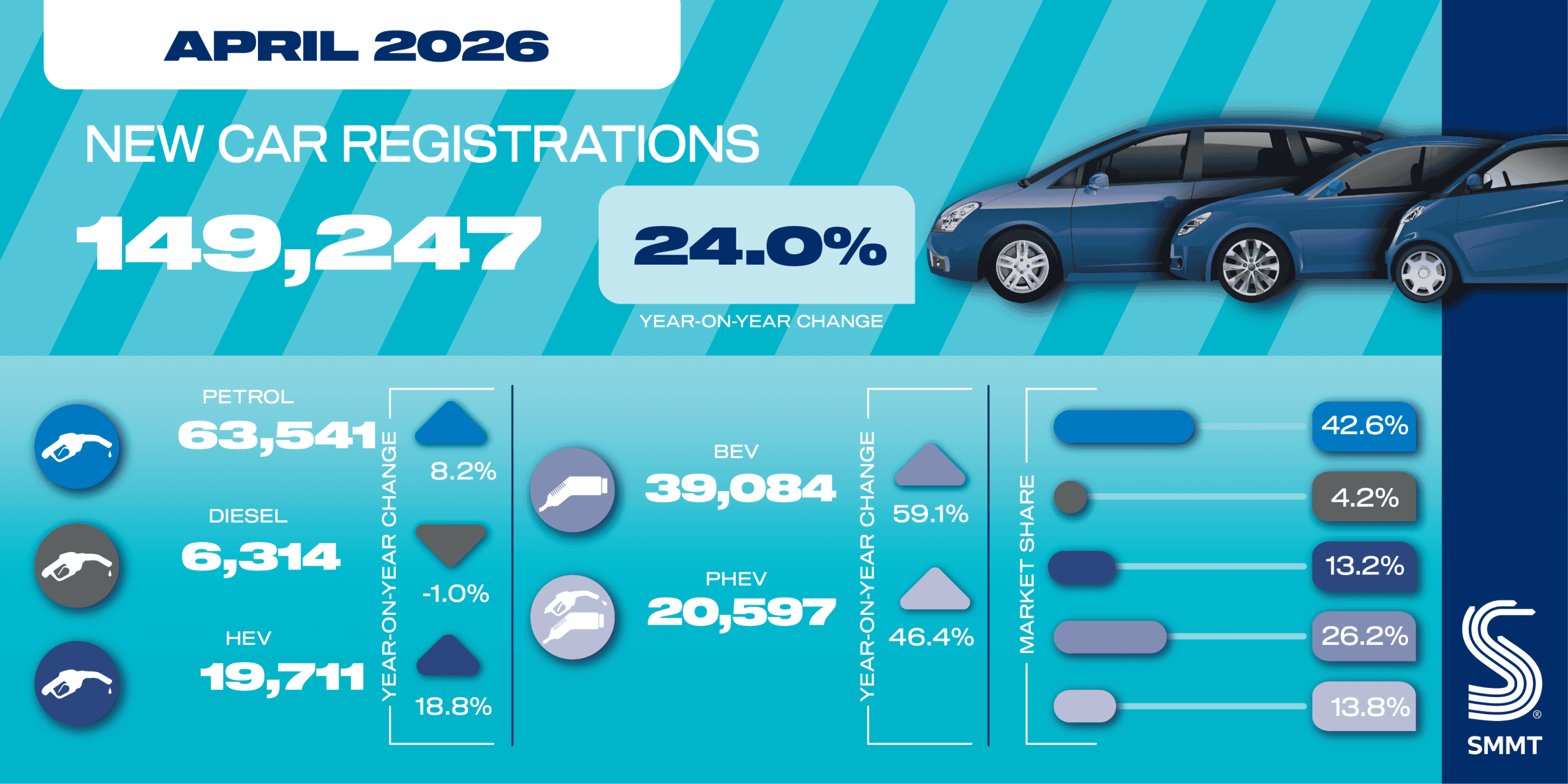
The UK new car market grew 24% in April to reach 149,247 registrations, the best April since 2019. That headline figure needs context. Last April was unusually weak because buyers pulled purchases forward into March 2025 to beat incoming VED changes, including the application of road tax and the expensive car supplement on electric vehicles for the first time. The 24% growth is largely a correction from that artificial low point rather than a sign of exceptional demand.
Growth came from all sectors. Fleet registrations led the way, up 26.8% to 90,462 units. Private retail deliveries grew 20.2% to 56,116. The smaller business sector rose 15% to 2,669.
Electrified cars of all types accounted for more than half of the market for the second month running. Plug-in hybrids grew 46.4% to take 13.8% market share. Conventional hybrids rose 18.8% to 13.2%. Battery electric vehicles grew 59.1% compared to last April’s tax-depressed figures, reaching 26.2% of registrations.
Petrol car demand rose 8.2%. Diesel fell 1%.
The Mandate Problem
The two million milestone and the 26.2% April share are both strong numbers in isolation. The problem is that the regulation demands more than the market is delivering naturally.
The ZEV Mandate requires manufacturers to sell an increasing proportion of zero-emission vehicles each year or face fines. For 2026, the target is 33%. The industry is tracking at 23.1% year to date, despite billions of pounds in manufacturer discounts and the introduction of the Electric Car Grant last year. That gap of almost ten percentage points represents a serious compliance challenge.
The SMMT’s updated outlook, also published today, has downgraded its forecast for BEV market share in 2026 from 28.5% to 26.8%, reflecting weaker-than-expected first quarter demand. For 2027, the industry expects 32% of registrations to be battery electric, still around six percentage points below what the mandate will require.
The reasons for the shortfall are not mysterious. Energy costs remain high, pushing up the cost of charging relative to what was forecast when the mandate was designed. Production costs for EVs have not fallen as quickly as expected. The public charging network, while expanding, still has gaps that deter drivers without home charging. And electric cars remain, on average, several thousand pounds more expensive than their petrol equivalents even after manufacturer discounts and government grants.
What This Means For Buyers
For consumers, the mandate gap is creating an unusual market dynamic. Manufacturers need to shift more EVs to avoid fines, which means discounts, incentives and favourable finance deals on electric cars are likely to continue and potentially improve through the rest of 2026. Buyers looking at EVs right now are in a strong negotiating position because the pressure to sell is on the manufacturer’s side.
At the same time, the SMMT is calling for a “rapid review” of the transition timeline to align policy with what the market can actually deliver. If that review happens and targets are relaxed, the urgency to discount could ease. For anyone considering an electric car, the current combination of manufacturer incentives, the £3,750 Electric Car Grant and competitive finance rates may represent a window that does not stay open indefinitely.
Mike Hawes, SMMT Chief Executive, said the milestone should be celebrated but the underlying challenge remains.
“April’s rebound is welcome, but underlines just how significantly fiscal changes can influence the market,” Hawes said. “Two million electric car registrations is a considerable milestone to celebrate, although natural demand is still well below the level demanded by the mandate. The mounting cost of compliance threatens to limit consumer choice, overall decarbonisation and the sector’s competitiveness so the need for a rapid review of the transition to align policy with market realities is unchanged, else Britain’s attractiveness as a vehicle market and manufacturing hub will be put at risk.”
The Broader Outlook
The SMMT has upgraded its overall market forecast for 2026 to 2.093 million registrations, up from the 2.048 million predicted in January. That represents a 3.6% increase on 2025. For 2027, the forecast rises slightly further to 2.121 million units.
The Iran conflict adds an additional layer of uncertainty. Rising interest in EVs as an alternative to volatile fuel prices is being tempered by concerns about inflation, higher energy costs and the wider impact on the cost of living. The full effect of that geopolitical pressure on buying decisions is not yet clear.
What is clear is that two million electric cars on UK roads represents a point of no return. The infrastructure is being built around them, the used EV market is growing, and familiarity with the technology is spreading. The debate is no longer about whether the transition will happen. It is about how fast, at what cost, and who bears the financial pressure of getting there on a timeline that may have been set too aggressively for the market to follow.
Sources:

Leave a Comment
More in News
Teenage Drivers in London Now Pay £2,928 for Car Insurance, Quotezone Reveals

What Your Tyre Pressure Warning Light Actually Means (and How to Reset It)
How to Fix a Windscreen Chip Before It Fails Your MOT

Millions of Older Drivers Could Now Pay Doctors £62.50 for a DVLA Medical Letter
What Every UK Driver Needs to Know Now the Digital Driving Licence Is Live
Trending on Motoring Chronicle

What Does Sport Mode Do on a Car?

Ten EV Charging Stations Worth Building Your Next US Road Trip Around

Leaving Your Dog in a Hot Car Could Bring an Unlimited Fine This Summer

Honda Passport Joins Used Civic and Accord on 2026 IIHS Best Vehicles for Teen Drivers List