The New BMW 7 Series Has 452 Miles Of Range, A Cinema Screen And Hands-Free Driving At 81mph. Here Is Everything We Know


BMW has revealed the new 7 Series and it is, by any measure, the most ambitious update the company has ever attempted on a single model. This is not a facelift. It is a wholesale transformation that brings the Neue Klasse design language, Gen6 battery technology, a full-width windscreen projection system, the first ever BMW Passenger Screen, an 8K rear cinema display with video conferencing, hands-free motorway driving at up to 81mph, and a paint option that takes 75 hours to apply. The car launches in the UK from September 2026 in three all-electric variants, with two plug-in hybrids following in November.
The headline number is range. The BMW i7 50 xDrive delivers up to 452 miles on the WLTP cycle, an increase of approximately 73 miles over the outgoing rear-wheel-drive i7 eDrive50. If that figure translates to anything close to real-world numbers, it puts the i7 ahead of virtually every luxury EV on sale, including the Mercedes EQS.
But range is only part of the story. What BMW has done here is use the 7 Series as the vehicle to prove that Neue Klasse technology can be integrated into the existing model range, not just into new-platform cars. Every major system in the car has been updated, from the powertrain and chassis to the displays, driver assistance and even the way the doors open and close. This is BMW making a statement about where its entire lineup is heading.
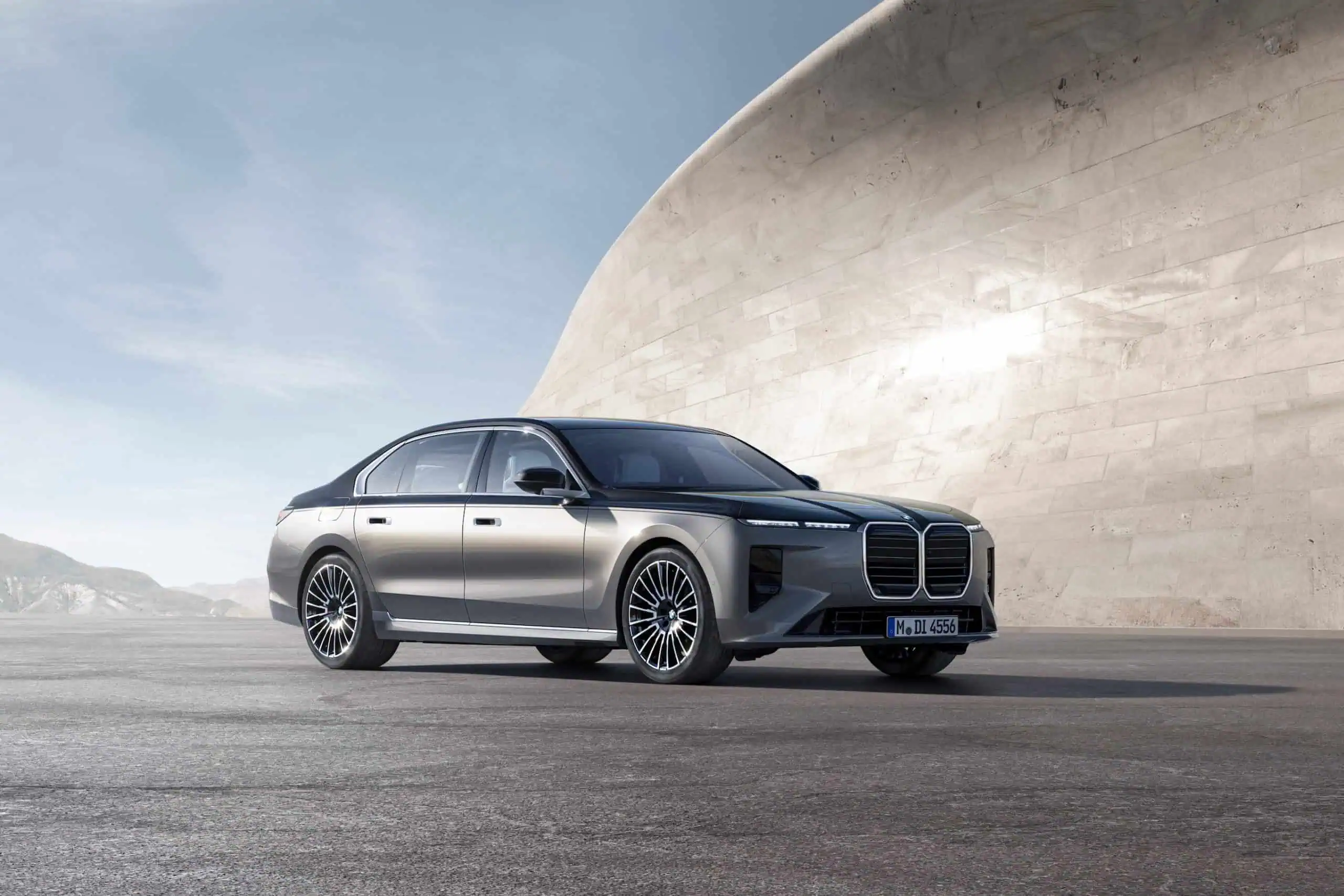
Three Electric Variants With Gen6 Battery Cells
The new i7 launches in three configurations, all with standard all-wheel drive and dual electric motors.
The i7 50 xDrive sits as the entry point with 455 hp and 660 Nm of torque. It reaches 62mph in 5.5 seconds, tops out at 130mph, and delivers combined power consumption of 21.8 to 18.1 kWh per 62 miles on the WLTP cycle. That efficiency is what enables the 452-mile range claim from the new battery pack.
The i7 60 xDrive steps up to 544 hp and 745 Nm, cutting the 0-62mph time to 4.8 seconds with a top speed of 149mph. Range is virtually identical to the 50 at up to 451 miles, with consumption of 21.9 to 18.2 kWh per 62 miles. The near-identical range despite the higher output speaks to how much of the efficiency gain comes from the new cells rather than the motors.
At the top sits the i7 M70 xDrive, BMW’s M Performance flagship. Two electric motors produce a combined 680 hp and 1,015 Nm of torque in Sport mode, rising to 1,100 Nm with Launch Control or Sport Boost activated. It covers 0-62mph in 3.8 seconds and is electronically limited to 155mph. Range drops to 426 miles, which is still remarkable for a car producing this level of output from a body this size. Consumption sits at 22.9 to 19.7 kWh per 62 miles.
All three variants use electrically excited synchronous motors rather than permanent magnet units. The distinction is significant. Electrically excited motors use a controlled electrical feed to set the rotor in motion, eliminating the need for rare earth metals that are typically required for the magnets in conventional EV motors. It is a technology choice that reduces reliance on critical and often controversially sourced materials without compromising performance.
Gen6 Cylindrical Cells Change The Equation
The range improvements across the i7 lineup come primarily from BMW’s new Gen6 cylindrical battery cells. These cells offer higher energy content and greater energy density than the prismatic cells used in the outgoing model. The result is more stored energy in a similar physical footprint, which directly translates to more miles per charge.
The 73-mile range increase in the i7 50 xDrive over its predecessor is not the result of a bigger battery squeezed into the floor. It comes from cells that store more energy per unit of volume and weight, combined with efficiency improvements in the drive system and thermal management. BMW says the Gen6 cells are produced largely using renewable electricity, including for anode and cathode materials, and incorporate secondary lithium, cobalt and nickel. The company expects these measures to cut supply chain emissions by around 30 per cent compared to the previous generation.
Charging Gets Faster And Smarter
Maximum charging power has increased from 195kW to 250kW, with the i7 capable of accepting current at up to 630 amps, which BMW says is beyond any other model in the segment. A 10 to 80 per cent charge takes 28 minutes at a high-power station. In a ten-minute stop, the i7 50 and i7 60 can add up to 146 miles of range, while the M70 manages up to 133 miles.
AC charging runs at up to 22kW as standard, delivering a full charge from empty in six hours. At 11kW, that extends to 12 hours. For most UK owners charging at home on a 7kW wallbox, an overnight charge will comfortably cover daily use with range to spare.
The charging route planner uses artificial intelligence to draw on past charging cycles, estimate realistic charging power at specific stations, identify potential fault susceptibility and refine station location data. It factors in occupancy status, connector types and estimated costs based on stored tariffs. The car automatically pre-conditions the battery when navigating to a DC charger, bringing it to the optimal temperature before arrival to maximise charging speed from the moment the cable is connected. Battery temperature status and remaining preparation time are visible in the car and through the My BMW app.
Adaptive recuperation now takes traffic lights into account and can automatically decelerate the car to a complete standstill, feeding energy back into the battery while reducing the need for the driver to brake manually in urban driving.
Two Plug-In Hybrids Follow In November
The 750e xDrive and M760e xDrive arrive two months after the electric models, both powered by an updated straight-six petrol engine with a new turbocharger, paired with a 197 hp electric motor packaged within the eight-speed Steptronic transmission.
The 750e produces a combined 489 hp and 700 Nm, reaching 62mph in 4.8 seconds. An 18.7kWh battery provides up to 50 miles of electric-only range at speeds of up to 87mph. Combined consumption is 46.3 to 56.5 mpg with CO2 emissions of 138 to 113 g/km. AC charging at 11kW takes two hours and 15 minutes from empty.
The M760e xDrive raises the combustion engine output to 426 hp, giving a combined system total of 612 hp and 800 Nm, an increase of 41 hp over the outgoing model. It covers 0-62mph in 4.2 seconds with electric-only range of up to 49 miles. A model-specific exhaust system provides what BMW describes as an M-specific soundtrack.
Both plug-in hybrids offer a viable option for buyers who want the new 7 Series experience but are not ready to commit to a fully electric powertrain, or who need the flexibility of a combustion engine for longer journeys without charging infrastructure concerns.
Neue Klasse Design Comes To The Flagship
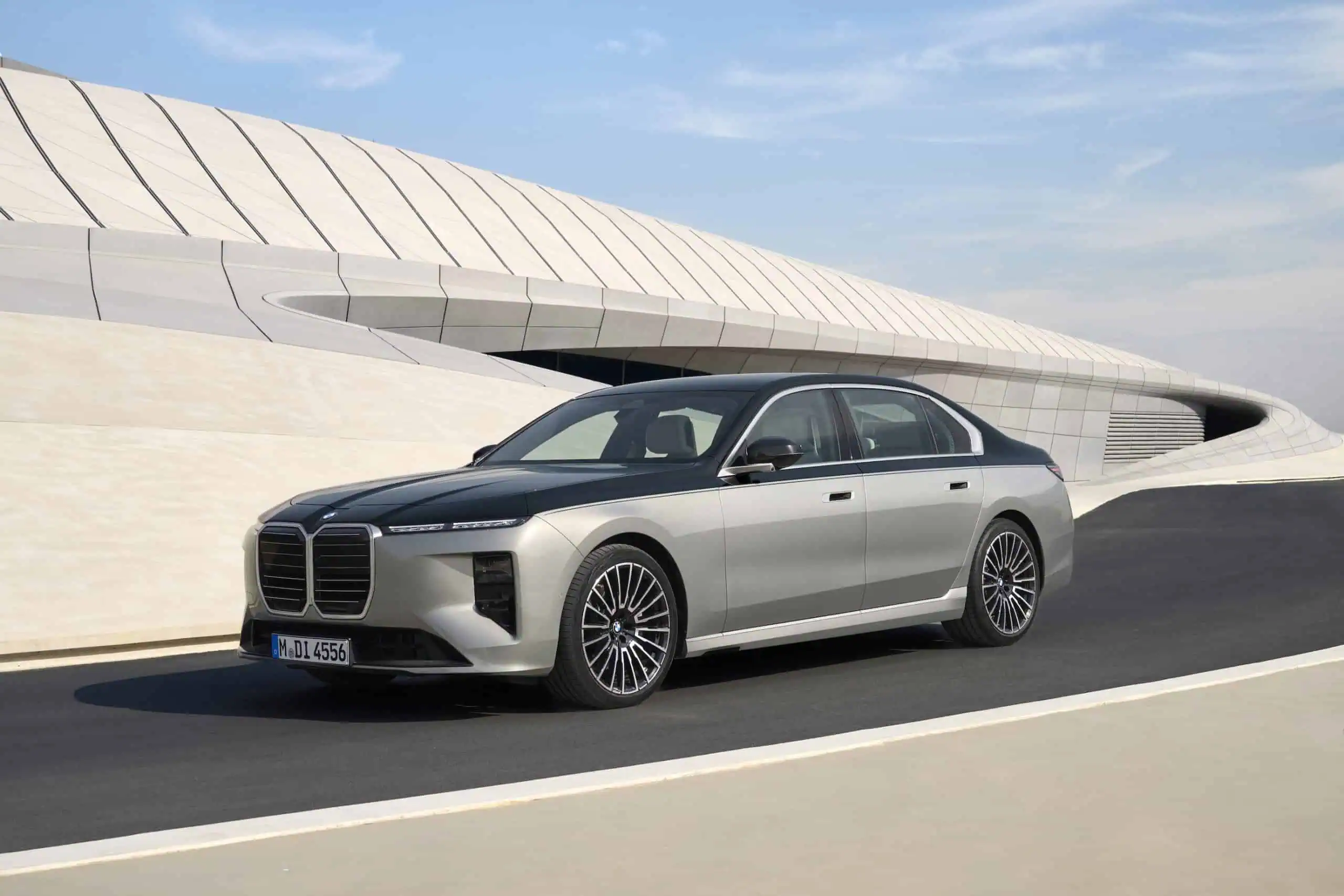
The exterior represents the first application of BMW’s Neue Klasse design language to the luxury segment. The kidney grille takes on slimmer, more vertical proportions with Iconic Glow illumination as standard. Ultra-slim daytime running lights sit in the upper section of the headlight units, with low and high beam positioned below in a vertical arrangement that is almost hidden near the air curtains. The headlights only become fully visible when activated, contributing to a minimalist front end.
At the rear, slim full-width taillights span the entire bodywork, and the BMW badge sits in a recessed, jewel-like frame. Exhaust tailpipes on the plug-in hybrid models are hidden beneath the car, giving all variants a consistent rear appearance regardless of powertrain.
M Sport and M Sport Pro trims add progressively more aggressive bumpers, larger air intakes, darkened Iconic Glow, 20 and 21-inch wheels and M Sport brakes. The M Performance models go further with exclusive grille graphics, smoke-black crystal headlight elements, M-specific mirror caps and model-specific rear diffusers.
A World-First In Paint
The most striking personalisation option is BMW Individual Dual-Finish, a paint process that pairs a matt finish on the lower body with a hand-applied metallic finish on the upper section, joined by a hand-drawn Coach Line. The transition between the two finishes is seamless despite the fundamentally different compositions of matt and metallic paint.
The process took two-and-a-half years to develop and is currently exclusive to the Dingolfing plant. Each Dual-Finish car spends more than 75 hours in the paint shop, nearly six times longer than a standard finish, with around 50 per cent of the work carried out by hand. More than 20 specially trained employees execute 12 carefully choreographed steps, including taping, sanding and manual application.
Beyond Dual-Finish, the 7 Series offers over 500 exterior colour combinations through the BMW Individual programme, including around 130 Individual paint finishes, two-tone options in solid, metallic, Frozen and mixed combinations, and a new Vancouver Green metallic. For buyers who want something truly unique, BMW Individual Manufaktur will produce bespoke one-off specifications.
BMW Panoramic iDrive And The First Passenger Screen
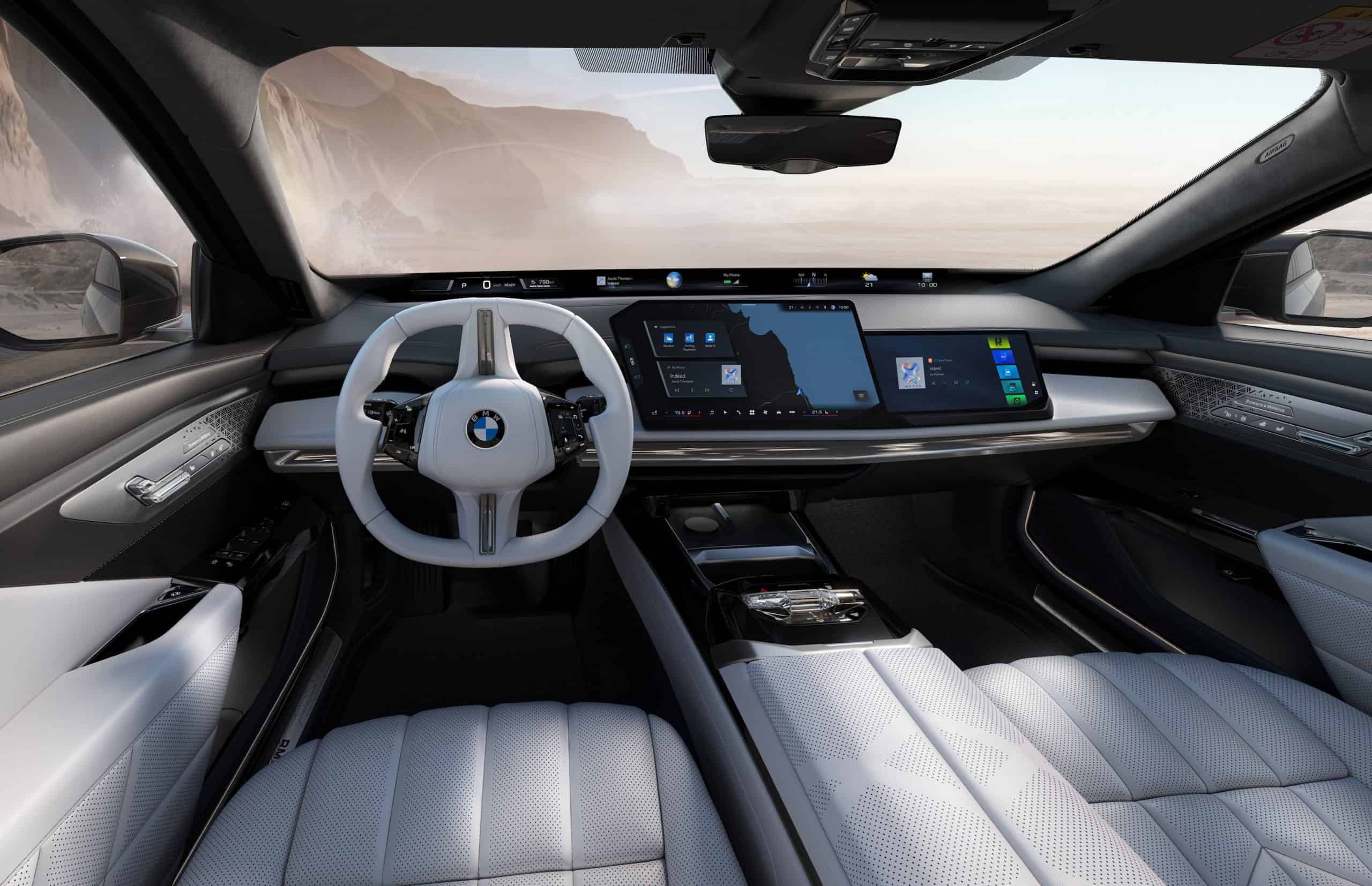
The interior technology package is where the new 7 Series makes its strongest case as the most advanced car in the segment. BMW Panoramic iDrive, powered by Operating System X, introduces a layered display concept that starts with the Panoramic Vision, a full-width projection across the lower windscreen.
The Panoramic Vision is always visible and places driving information on the right within the driver’s direct line of sight, while the central and left sections can be personalised with widgets that the driver arranges freely. Above it, the 3D Head-Up Display projects selected content directly into the driver’s field of view with spatial precision for navigation cues and assistance system information.
The 17.9-inch free-cut Central Display uses matrix backlight technology for sharp graphics in all lighting conditions. Widgets can be dragged from the Central Display onto the Panoramic Vision for quick access to frequently used functions. Up to six can be arranged simultaneously.
Making its brand debut in the 7 Series, the BMW Passenger Screen is a 14.6-inch full HD display fitted as standard on every variant. It provides the front passenger with independent access to video streaming, gaming, music and video conferencing through the interior camera. An integrated shield function uses the cabin camera to detect if the driver is being distracted by the passenger display while on the move, automatically dimming the screen if necessary. When the passenger seat is empty, the screen switches to a reduced ambient mode that blends with the interior lighting.
The system runs on BMW Operating System X, built on the Android Open Source Project, which enables over-the-air updates and a growing library of apps through the BMW ConnectedDrive Store. BMW Digital Premium, included as standard for the first four years, provides unlimited data for streaming, apps and connected services, plus security features including theft notifications, parking impact alerts and drive recorder functionality.
The 8K Theatre Screen Gets Dolby Atmos And Video Calls
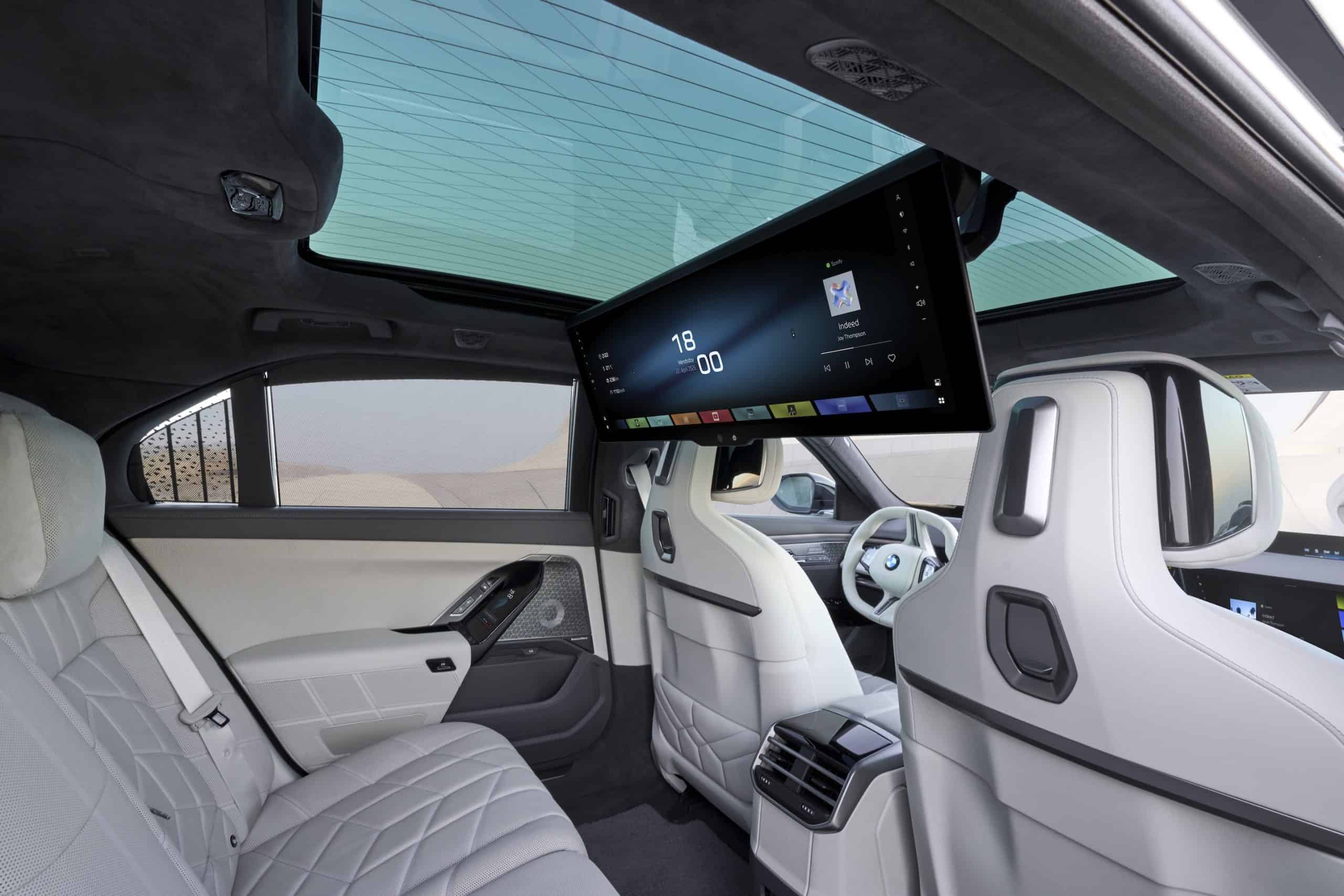
The optional rear Theatre Screen has been upgraded to an 8K resolution 31.3-inch touchscreen, paired with the optional Bowers and Wilkins Diamond Surround Sound System, which now supports Dolby Atmos. The system delivers up to 1,965 watts through 35 speakers, including units integrated into the head restraints of all four outer seats and 4D exciters in the seat backrests that intensify bass perception even at low volumes.
For the first time, the Theatre Screen includes an integrated camera for video conferencing, turning the rear of the 7 Series into a functional mobile office. An HDMI connection allows it to double as an extended computer screen. When the screen deploys, a choreographed sequence automatically closes the side, rear and panoramic roof blinds while dimming the ambient lighting, creating a dedicated viewing environment.
The Theatre Screen position can be adjusted fore and aft using the updated BMW Touch Command panels in the rear doors. For a car that is frequently chauffeur-driven, the combination of 8K resolution, Dolby Atmos sound, video conferencing and a laptop connection makes the rear cabin a genuine alternative to a first-class airport lounge.
Driver Assistance Reaches A New Level
The new 7 Series introduces BMW’s most advanced driver assistance package, built around a philosophy the company calls Symbiotic Drive. The principle is that the car’s automated functions work with the driver rather than replacing them, allowing natural steering, braking and acceleration inputs without immediately cancelling the active assistance.
Motorway Assistant enables hands-free driving at speeds of up to 81mph on motorways, using navigation data for entry-to-exit guidance. The system performs assisted lane changes when the driver confirms with an eye signal and can navigate motorway junctions autonomously. UK availability is subject to confirmation, but the system is launching across many European countries.
City Assistant is entirely new. With BMW Maps route guidance active, it supports the driver through turns, right-of-way situations, traffic light stops and starts, roundabouts and urban lane changes. It can pull away from a green light even with no vehicle ahead, negotiate filtering into traffic, and handle complex junctions. Without active route guidance, it still provides extensive urban support.
Driving Assistant Plus is standard and covers adaptive cruise control with lane centring, automatic speed adjustment to detected limits, and proactive slowing for corners, roundabouts and turns. The Emergency Brake Assistant now responds to wildlife crossing the road. An exit warning function can delay door opening if an object is detected approaching the car.
Parking Assistant uses AI and a redesigned surround-area visualisation for quicker, smoother manoeuvres. The optional Parking Assistant Professional adds remote parking and stored manoeuvres of up to 200 metres, controllable from up to six metres away through the My BMW app.
Chassis Technology Sets The Standard
Every variant of the new 7 Series comes with adaptive two-axle air suspension with automatic self-levelling and electronically controlled dampers as standard. Air supply is managed individually at each wheel, and the system adjusts body height automatically, lowering by 10mm in Sport mode and rising by 20mm for rough roads or steep ramps.
Integral Active Steering is also standard, with the rear wheels turning by up to 3.5 degrees in the same or opposite direction to the front wheels depending on speed. At low speeds, opposite-direction steering reduces the turning circle by around 0.8 metres. At higher speeds, same-direction steering increases stability during lane changes and cornering.
The optional Adaptive Chassis Control Professional package, which is standard on M Performance models, adds active roll stabilisation using a 48-volt electric motor and active anti-roll bars to counter lateral forces and reduce body roll through corners.
A segment-first digital tyre diagnosis system uses AI and cloud-based algorithms to detect pressure loss earlier than the standard tyre pressure monitor. It can also predict tyre wear and forecast remaining tread life, sending notifications and recommended actions through the My BMW app.
Interior Comfort And Materials
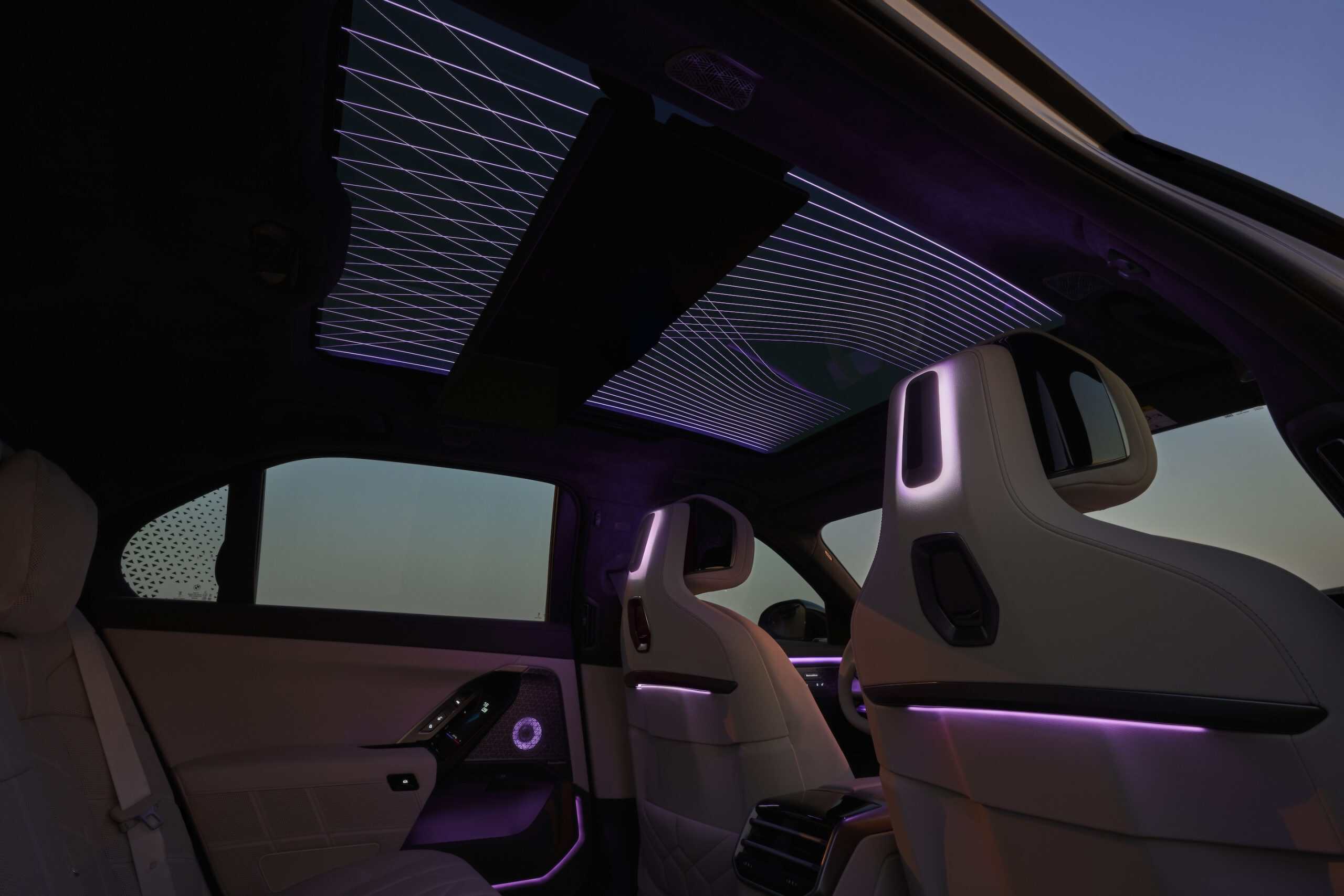
Standard seats are multifunction units with extensive electric adjustment, heating, lumbar support and a massage function with seven programmes and three intensity levels. Active ventilation is available from the options list. The optional Executive Lounge for the rear compartment adds an integrated leg rest, heated quilted armrest with glass insert, and coordinated adjustment of the backrest, seat position and angle for a reclining posture of up to 43 degrees.
Five new steering wheel designs are available in up to three colours, including a leather-free option. The M leather steering wheel, standard on M Performance and M Sport Pro models, features a red 12 o’clock marker and M-specific thumb controls for Sport Boost and M Mode.
Automatic doors have been refined with radar sensors integrated into the side skirts, front and rear of the car for faster operation and improved collision detection. A new Soft Close mechanism and servo mode allow effortless manual opening and closing. The doors can be controlled by button, voice command, the My BMW app, or through BMW Digital Key Plus using a smartphone or smartwatch.
The interior offers around 700 combinations of materials, trims and colours. Standard upholstery is Veganza, a leather-alternative material with perforated surfaces and quilted detailing, available in three colours. BMW Individual options include Merino Leather in multiple finishes and a Merino Leather combined with cashmere wool for the seat surfaces and armrests. Trim options range from open-pored Fineline Lime wood as standard through to Mirror Oak, ash and, for the first time, Alcantara strips in matching interior colours.
Four-zone automatic climate control is standard across all variants, with the i7 models featuring a model-specific unit with updated heat pump technology. A panoramic glass roof with electrically operated sliding headlining floods the cabin with natural light.
Built At Dingolfing, Launching In September
All variants of the new 7 Series, regardless of powertrain, will be produced on a single production line at BMW Group Plant Dingolfing in Lower Bavaria. The plant has received significant investment to accommodate the Neue Klasse technologies, and it retains its role as the lead facility for BMW’s luxury model portfolio.
The car celebrated its world premiere on 22 April 2026 at Auto China in Beijing. The three all-electric i7 variants arrive in the UK from September 2026, with the 750e xDrive and M760e xDrive plug-in hybrids following from November.
UK pricing and final specification have not yet been confirmed, but with this level of standard equipment, the technology package and the range figures the i7 is posting, the new 7 Series positions itself as the most complete luxury saloon BMW has ever built. Whether it can take the fight to the Mercedes S-Class on comfort and the EQS on electric range simultaneously will become clear when the first cars reach UK roads later this year. On paper, at least, there is very little it has left out.

Leave a Comment
More in News
Milton Keynes Council’s Parking Surplus Hit £12.8 Million, Up 42 Percent in Two Years

2027 Kia Sorento Hybrid Gets New X-Line Trim, Starts at $39,090

BMW F 450 RR Supersport Motorcycle Arrives in US from $7,815

One in 12 UK Sellers Would Hide a Costly Fault (and How to Spot One)

2027 Mazda CX-30 Expands to 21 Models With New Homura Plus Grade
Trending on Motoring Chronicle

New Renault Megane E-Tech Electric Gains 67kWh Battery and 310-Mile Range

Used Car Prices Jump Up to $3,600 in Six Months as Hybrids Surge
7 Interior Maintenance Habits That Keep Your Car Looking New

How DVLA Data Reveals the Nissan Juke Is Now Britain’s Most Stolen Car