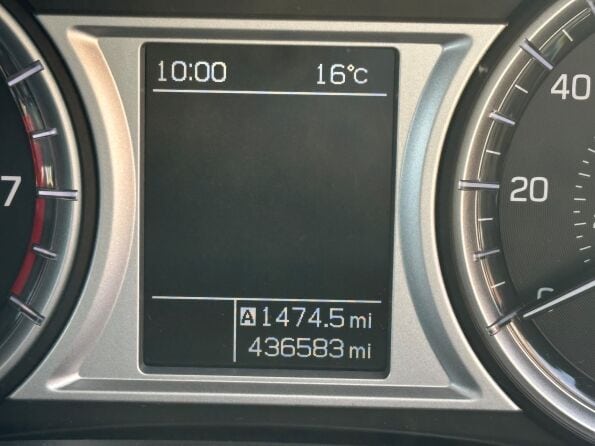
436,500 Miles On The Original Engine. This Suzuki Vitara Has Driven Around The World Seventeen Times


A Suzuki Vitara SZ-T with a 1.6-litre petrol engine has just recorded 436,500 miles on its original engine and gearbox. The car belongs to a customer of Hilton Suzuki in Bedford and has covered that distance in less than ten years. To put that in perspective, the average UK motorist drives around 7,600 miles per year. This Vitara has been doing more than 43,000 miles a year, every year, for a decade. That is the equivalent of driving around the Earth’s equator more than seventeen times.
The car is a standard production Vitara SZ-T, not a specially prepared press fleet vehicle or an engineering test mule. It has been used as a regular daily driver, racking up the kind of mileage that would typically be associated with a taxi, a courier van, or a long-distance sales representative. And it is still running on its original powertrain.
What 436,500 Miles Actually Looks Like
Most modern cars are designed to last around 150,000 to 200,000 miles before major components start requiring serious attention. Engines, gearboxes, suspension bushes, exhaust systems, and electrical components all have finite lifespans, and the further past 100,000 miles you go, the more frequently things tend to need replacing. A car that reaches 200,000 miles on its original engine is considered durable. A car that reaches 300,000 is remarkable. A car that passes 400,000 miles without a replacement engine or gearbox is in a very small club indeed.
For context, 436,500 miles at an average speed of 30 mph represents more than 14,500 hours behind the wheel. That is roughly 600 full days of continuous driving. It is the equivalent of driving from London to Edinburgh and back more than 550 times, or doing the daily commute from Bedford to central London and back every single working day for nearly forty years, compressed into less than ten.
The Vitara SZ-T in question uses the 1.6-litre naturally aspirated petrol engine that was standard in the fourth-generation Vitara when it launched in the UK. It is not a turbocharged unit, which may partly explain its longevity. Naturally aspirated engines generally have fewer components under stress compared to turbocharged alternatives, with no turbocharger bearings to wear, no intercooler to fail, and no boost pressure putting additional load on pistons, con-rods, and head gaskets. They tend to be simpler, cooler-running, and more tolerant of high mileage.
Suzuki’s Quiet Reputation For Reliability
Suzuki has never been a brand that shouts about its reliability. It does not run advertising campaigns boasting about durability records or publish press releases every time a customer crosses a mileage threshold. But within the ownership community and across independent reliability surveys, Suzuki consistently ranks among the most dependable manufacturers in the UK market.
In the most recent What Car? Reliability Survey, Suzuki placed in the top five manufacturers overall. The brand has appeared in the upper reaches of that survey for several consecutive years. Auto Express owner satisfaction surveys tell a similar story, with Suzuki owners regularly reporting low running costs, minimal unscheduled workshop visits, and high levels of satisfaction with the ownership experience.
The Vitara specifically has earned a strong reputation as a practical, affordable, and dependable small SUV. It is not the most exciting car in its class. It does not have the interior quality of a Volkswagen T-Roc or the driving dynamics of a Ford Puma. What it does have is a straightforward mechanical layout, a light kerb weight, sensible engineering, and a track record of not breaking down. For a significant number of buyers, that combination is worth more than a premium badge or a fashionable interior.
What High-Mileage Suzuki Owners Say
This Bedford Vitara is not the only high-mileage Suzuki in circulation. Online ownership forums are populated with Swifts, Vitaras, and Jimnys that have sailed past 200,000 miles with nothing more than routine servicing. The common thread among these cars is regular oil changes, adherence to the service schedule, and the use of genuine or equivalent-quality parts.
The ownership costs that matter most over high mileages are not the purchase price or the monthly finance payment. They are the items that recur: tyres, brakes, servicing, and the occasional wear-and-tear replacement. A car that can cover 436,500 miles on its original engine and gearbox has, by definition, saved its owner the cost of at least one replacement engine and one replacement gearbox compared to a less durable vehicle. That saving alone could run into several thousand pounds.
Running costs on the Vitara SZ-T are modest to begin with. Insurance groups are low, servicing intervals are reasonable, and parts availability is good. The 1.6-litre petrol engine returns combined fuel economy in the mid-40s on a gentle right foot, which at current fuel prices translates to a cost per mile that makes the car viable even for very high annual mileages.
What This Tells You If You Are Buying A Used Vitara
If you are in the market for a used small SUV and you prioritise reliability above all else, the Suzuki Vitara is worth serious consideration. Used examples from 2018 and 2019 with 40,000 to 60,000 miles are available from around £12,000 to £15,000. For a car that has been independently demonstrated to last well past 400,000 miles, that looks like strong value for money.
The key things to check on a used Vitara are the service history (look for regular oil changes at the recommended intervals), the condition of the clutch and dual-mass flywheel on manual versions, and the state of the front suspension bushes, which can wear on higher-mileage examples. Beyond that, the Vitara is a car that tends to give more than it takes, and the Bedford example with 436,500 miles on the clock is the most extreme proof of that yet.

Leave a Comment
More in News

746 Unregistered Vehicles Caught in Victoria’s Cup Blitz, $1,046 Fine

Dealer Body Links 66 Car Brands to Lower Resale Values and Slower Repairs
Missouri School Bus Passing Fines Start at $500 and Add 5 License Points
Oklahoma Turnpike Tolls Rise Jan. 5, With PikePass Cars at 8 Cents a Mile

Rapid Charging Slows Right Down in the Cold, and the Car Does It on Purpose
Trending on Motoring Chronicle

Superhero Supercar Returns: Acura NSX Roadster from Marvel’s The Avengers to Appear at Monterey Car Week

English Drivers Paid Nearly £1 Million in Yellow Box Junction Fines in a Single Year

What the CMA Scrapping Its 2000 Order Means for Every New Car Buyer

How Long Beach’s New Speed Cameras Will Fine Drivers Up to $500 Starting This Fall