
How to Drive on a Flat Tyre Long Enough to Reach Safety


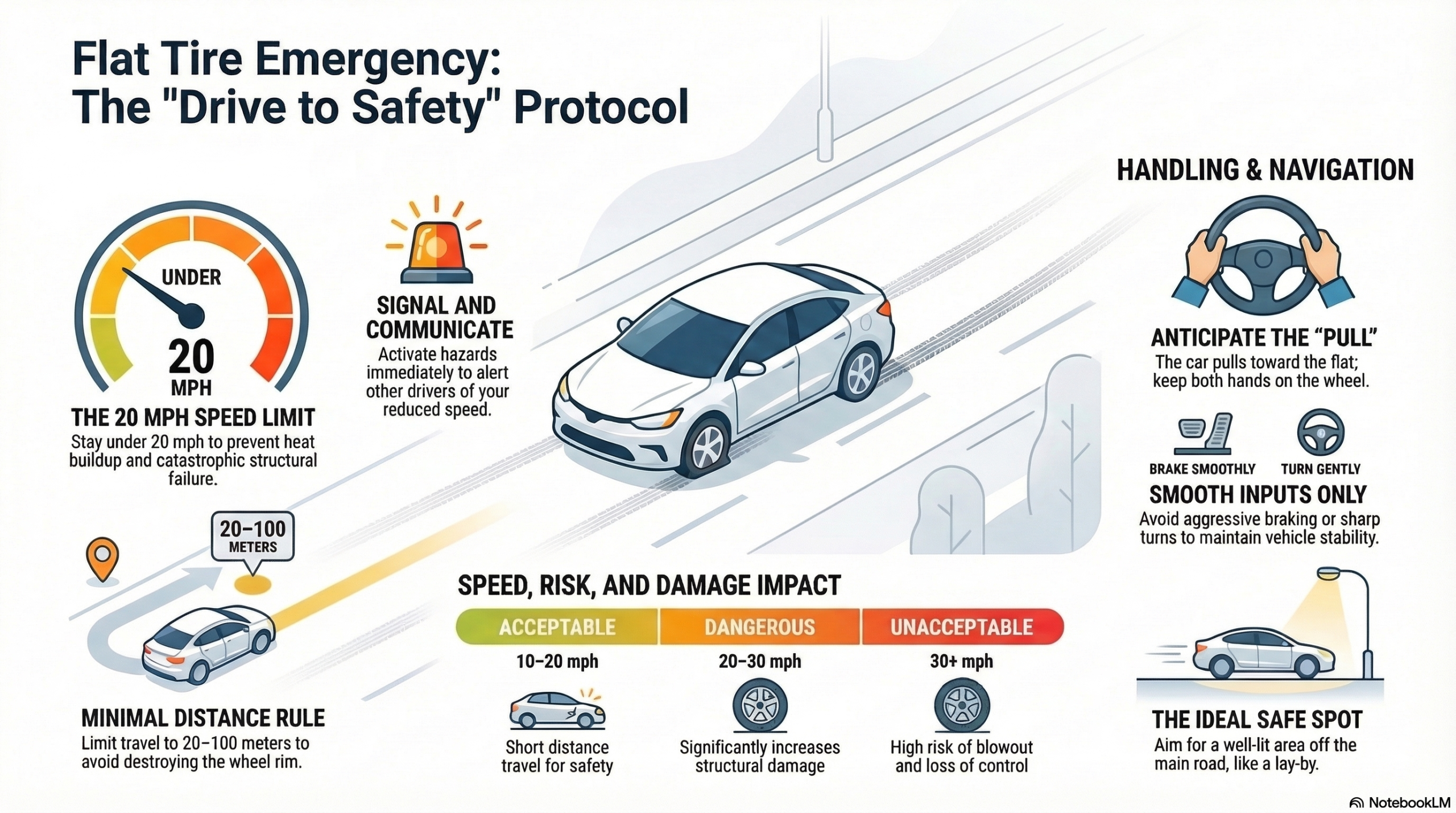
A flat tyre needs immediate action. You can drive on one at 10-20 mph for 20-100 metres to reach safety. Turn off air suspension if fitted and activate hazard lights. Head to the nearest safe location: a service station, lay-by, or parking area off the main road.
Understanding Your Immediate Situation
When you realise you have a flat tyre, your first response determines everything that follows. Whether you’re on a motorway, a highway, a quiet suburban street, or a rural road, the core principle remains the same: get to a safe place where you can stop without risk of collision.
The difference between a flat tyre on a busy high-speed road and one on a quiet side street is critical. If you’re surrounded by fast-moving traffic, driving a short distance at very low speed to reach the hard shoulder or a safer spot is sensible. If you’re already on a quiet road near a lay-by, rest area, or service station, the choice is clearer. The worst place to stop is anywhere vehicles might hit you from behind.
Before you make any decision about driving further, assess what actually happened. Did you feel a sudden bang or gradual deflation? Did you hear something, run over an object, or hit a pothole? A sudden bang suggests a blowout or severe puncture. Gradual deflation indicates a slow leak. This distinction matters: a slow leak gives you more time and possibly more distance than a catastrophic failure.
One thing most drivers get wrong is misjudging how much damage they’re causing. Many people think that if they can still drive, the tyre is fine. In reality, even 50 metres of driving on a completely flat tyre can cause severe internal damage to the tyre wall. The rubber compounds break down, the structure separates, and you might see blistering or chunking later. The rim can also suffer dents or bends that make it unusable. Understanding this helps you make a balanced decision: drive just enough to reach safety, then stop.
Assessing Whether You Can Actually Drive
Not every flat tyre situation allows for driving, and it’s important to know the difference. If your tyre is genuinely completely flat with zero pressure, the tyre wall collapses entirely. The sidewall becomes a pancake, and the rim sits much lower. In this state, you can technically move the vehicle, but you’re in the most dangerous situation for both handling and rim damage.
If your tyre is partially deflated but still holding some pressure (perhaps 10-15 psi), you have slightly more room to manoeuvre. The sidewall still has some structure. The vehicle will handle poorly, and the steering will feel heavy or numb, but you retain some control. This is the scenario where driving a short distance to safety becomes more feasible.
Here’s what to check before you attempt to drive:
- Can you identify a safe destination within 100-200 metres? This might be a service station, lay-by, quiet side street, or parking area.
- Is the road you’re on safe enough to drive on at very low speed? Motorways and busy dual carriageways are dangerous for this, but quiet roads are manageable.
- Do you have control of the steering? Test it gently. If the steering is extremely heavy or unresponsive, do not drive further.
- Is there traffic behind you that poses a risk? If you’re about to move into a path of oncoming vehicles, wait for a gap.
If the answer to any of these is no, then you should stop where you are, activate your hazard lights, and wait for roadside assistance. There’s no shame in this. Recovery services exist for exactly this situation.
The Critical Speed Rule
Speed is everything when driving on a flat tyre. The faster you go, the worse the outcome. Here’s why: at higher speeds, the flat tyre generates friction and heat. The rubber breaks down faster. The centrifugal force increases the damage to the already-compromised structure. By the time you’ve travelled 100 metres at 30 mph, you’ve done far more damage than 300 metres at 15 mph.
Both the AA and NHTSA warn that driving above 20 mph on a flat tyre risks catastrophic failure. The tyre structure simply cannot cope with the forces involved at higher speeds. Stay under 20 mph for any distance on a flat.
In practical terms, this means:
- 15-20 mph: Acceptable for very short distances (50-100 metres) if you have a specific safe destination
- 20-30 mph: Already dangerous, significantly increases damage and risk of complete failure
- Above 30 mph: Unacceptable, risks blowout and loss of control
The slower you go, the further you can travel. At 10 mph, some drivers report being able to cover 200-300 metres, though rim damage becomes a serious concern. At 5 mph (practically a crawl), you’re in the safest zone, but you’re also moving so slowly that safety becomes a different issue: vehicles behind you might not see you’re in trouble.
The balance is this: drive slowly enough to maintain control and minimise damage, but quickly enough that other road users understand something is wrong. This typically means 15-20 mph in most situations.
Steering and Handling Challenges
Driving with a flat tyre feels alarmingly different from normal driving, and understanding this is crucial for safety. The first thing you’ll notice is that the steering has become unpredictable. The tyre is no longer round, and this creates an uneven contact patch with the road. Your vehicle will pull toward the flat tyre side. The steering will feel heavier, especially if it’s power steering, and your response times will be slower.
Your car will always pull toward the flat side. If your right front tyre goes, the car drags right. If your left front goes, it drags left. A flat front tyre is easier to detect as you feel it directly through the steering wheel. A flat rear tyre is harder to spot but makes the back end feel loose and unstable, especially when braking or turning.
Here’s what to do about it:
- Keep both hands on the wheel at all times. No distractions, no checking your phone, no looking at the spare tyre.
- Make all movements smooth and gradual. No sharp turns, no aggressive braking.
- Anticipate the pull. If your right front tyre is flat, expect the vehicle to pull right and compensate by aiming slightly left.
- Brake gently and early. Braking on a flat tyre can cause the wheel to lock, leading to a skid.
- Avoid puddles and potholes. These will destabilise the vehicle further on a flat tyre.
Modern vehicles with electronic stability control help here. The system detects skidding and applies brakes to individual wheels to keep you stable. This is a genuine safety benefit when driving on a flat. That said, you shouldn’t rely on it to overcome poor decision-making. If you’re driving too fast or trying to turn too sharply, even stability control has limits.
Activating Safety Features and Signalling
The moment you realise you have a flat tyre, turn on your hazard lights. This single action tells every driver around you that something is wrong. In most jurisdictions it’s a legal requirement when you’re stationary or moving at significantly reduced speed. Hazard lights are your primary communication tool.
If your vehicle has an air suspension system (common on premium cars and some larger vehicles), you might be able to lower the suspension mode or engage a mode designed for low-speed driving with a deflated tyre. Check your owner’s manual for this feature. Some vehicles have a “tyre deflation warning” mode that’s separate from a full control system. Using this can help protect your rim by increasing ground clearance slightly.
Turn off any driver assistance features that might interfere. Adaptive cruise control should be switched off so you need full manual control. Lane-keeping assistance might fight your steering inputs when you’re compensating for the pull of the flat tyre. You want the vehicle to do exactly what you tell it, no more and no less.
If it’s dark or visibility is poor, switch your headlights to dipped beam (low beam). This helps other drivers see you more easily. Even in daylight, keeping headlights on is a sensible precaution when you’re crawling along with a flat tyre.
Choosing Your Safe Destination
Your destination matters as much as how you drive. The ideal safe place to stop is:
- Off the road entirely, on a wide verge or in a parking area
- Well-lit and visible to other road users
- Away from blind corners or crests in the road
- In an area where emergency services can reach you easily
On motorways and highways, the hard shoulder or road shoulder is designed for emergencies like this, though it’s still not ideal with traffic passing at speed. The safest approach is to drive beyond the next exit if possible and use a services area, rest stop, or quiet side road. If there’s no shoulder available, aim for the nearest lay-by or exit. On single carriageways or two-lane roads, find a straight section with good visibility where you can pull completely off the road.
In suburban or residential areas, your destination might be a side street, a car park, or a friend’s house nearby. The principle is the same: get off the main road, get away from traffic, and stop where you can safely assess the situation.
Don’t aim for a petrol station unless it’s genuinely close (within 100 metres). The misconception that you need fuel or air is common, but it’s not worth the risk. Petrol stations are often on busy roads, and the extra distance causes extra damage to your tyre and rim.
What Happens to Your Tyre and Rim
Understanding the damage that occurs is important for your post-incident decisions. When you drive on a flat tyre, two things happen simultaneously: tyre damage and potential rim damage.
The tyre damage is usually catastrophic. As you drive, the sidewall, which is designed to be flexible but supportive, bears the entire weight of the vehicle with no air pressure to help. The rubber compounds break down from heat and friction. The internal structure (belts and cords) can separate. Blistering appears as bubbles in the tyre wall. Chunking happens when pieces of rubber break away. After even a short distance, the tyre is unsalvageable. You’ll need a replacement.
The rim damage depends on how far you drive and at what speed. A few metres at walking speed might leave the rim unscathed. Driving 100 metres at 20 mph will likely dent or bend the rim. The damage often isn’t visible from a quick inspection, but a wheel specialist will identify it. Rim damage is expensive: a new alloy rim costs anything from £150 to £500 depending on the vehicle. A steel rim might be £50-150 but still represents an additional cost beyond tyre replacement.
This is why distance matters. The question isn’t “how far can I drive” but “how far do I need to drive to be safe?” The first option is always better. If you can stop safely right now, do that. If you’re in a genuinely dangerous location, drive the minimum distance necessary.
Special Considerations for Different Vehicle Types
Different vehicles behave differently with a flat tyre, and knowing your vehicle type helps you make better decisions.
Front-wheel-drive cars are slightly more stable with a flat front tyre than a rear one as the engine weight is over the front wheels. A flat rear tyre on a front-wheel-drive car is more concerning as the rear can slide or fishtail more easily.
Rear-wheel-drive vehicles are the opposite: a flat rear tyre is more dangerous as it affects traction and can cause loss of control. A flat front tyre still allows steering, though it’s heavier and less responsive.
Large SUVs and trucks present different challenges. They’re heavier, which means more load on the flat tyre and more potential for rim damage. But they also tend to have more ground clearance, which reduces the rim damage risk slightly. The steering is often heavier and response slower. Some larger vehicles have dual rear wheels, which is an advantage: if one rear tyre is flat, the other takes much of the load.
Vehicles with run-flat tyres are a special case. These are designed to continue functioning even when fully deflated, typically for 50-100 miles at reduced speed. If your vehicle has run-flats, you can drive at normal speeds for longer distances than a conventional tyre. Check your vehicle’s manual to understand the specific capability of your run-flats. The monitoring system will alert you, and you should still reach a tyre specialist as soon as practical, but you’re not facing the same urgency as with a conventional flat.
What to Do When You Stop
Once you’ve reached your safe destination, your next actions depend on several factors.
First, do a visual inspection. Look at the tyre to understand what happened. Is there an obvious puncture (a nail, a sharp object)? Is the sidewall visibly damaged or blistered? Is the tyre completely flat or just low? Is the rim visibly damaged? This information helps you explain the situation to a recovery service or tyre specialist.
If you have a spare tyre and the skills to change it, and if the situation is safe (you’re off the road, not in danger), you might consider doing it yourself. Many drivers carry a spare, though increasingly manufacturers are fitting repair kits instead. A tyre repair kit allows you to seal the puncture temporarily so you can drive to a garage. A flat tyre fix with no spare is possible if you have a repair kit, and these are increasingly common.
If you don’t have a spare or repair kit, you’ll need roadside assistance. Call your breakdown provider (AA, RAC, AAA, or whichever service you’re with). Most car insurance policies also include roadside assistance coverage. Have your phone charged and accessible.
While you wait, stay inside your vehicle with the doors locked (unless you need to set up warning triangles or cones, which are legally required in some areas). Do not attempt to fix the tyre yourself unless you have the proper tools and you’re confident in your ability. Changing a tyre is a skill, and doing it badly while standing in traffic could be dangerous.
Prevention: Avoiding Flats in the First Place
The best response to a flat tyre is to avoid having one. This is where tyre maintenance becomes critical.
Check your tyre pressure monthly. Most vehicles display the correct tyre pressure on a label inside the driver’s door or in your manual. Pressure typically ranges from 30-35 psi for sedans. Under-inflation is the leading cause of tyre failure. Low pressure causes the tyre to flex excessively, generating heat, which breaks down the rubber. It also increases your rolling resistance, wasting fuel. In winter, pressure drops naturally as the air inside cools, so regular checks are even more important.
Inspect your tyre tread. The legal minimum is 1.6mm (2/32″). You can check tyre tread properly using a simple coin test, though a dedicated gauge is more accurate. Worn tyres are more susceptible to punctures and more likely to fail in wet conditions. Most tyre professionals recommend replacing at 3mm (4/32″), well above the legal minimum, for better safety margins in rain.
Look for visible damage. Cuts, bumps, bulges, and uneven wear patterns are all warning signs. Bumps or blistering indicate internal damage and mean the tyre should be replaced immediately. Cuts that are deep or long require professional assessment. Small punctures can often be repaired, but not always. Uneven wear suggests alignment or suspension issues.
Have your wheel alignment checked regularly. Poor alignment causes tyres to wear unevenly and can lead to flat spots or excessive stress on the tyre wall. The importance of wheel alignment extends to preventing premature tyre failure as well as improving fuel economy and handling.
Avoid driving over debris when possible. Sharp objects like nails, screws, and broken glass cause punctures. Pothole avoidance is harder in busy traffic, but where possible, steer around them. Debris is especially concentrated around roadworks and rural areas with gravel or loose material.
Understanding Tyre Quality and Design
Not all tyres are equal in their resistance to punctures and flats. This is relevant to your long-term prevention strategy.
Premium tyre brands like Michelin, Continental, and Bridgestone invest heavily in tyre design and construction. Their higher-end products feature reinforced sidewalls and puncture-resistant compounds. These cost more upfront but often last longer and are less prone to failure. Budget brands can be reliable, but they tend to have thinner rubber and less advanced damage resistance.
Run-flat tyres, mentioned earlier, are specifically designed to prevent flats. They have reinforced sidewalls that support the vehicle even when the tyre is fully deflated. The trade-off is cost (typically 20-30% more than standard tyres) and slightly reduced ride comfort (they’re stiffer). For high-mileage drivers in urban areas with lots of hazards, run-flats are worth considering.
Tyre pressure monitoring systems (TPMS) are now standard in most modern vehicles. These electronic systems alert you when pressure drops significantly. A functioning TPMS gives you early warning of slow leaks, allowing you to reach a garage before the tyre becomes dangerous. If the TPMS light comes on, don’t ignore it. Check your pressures within the next few miles.
Some tyres have better wet grip and puncture resistance than others. Tyre labels and ratings give you a quick comparison of wet grip, fuel efficiency, and noise levels. Reading these before you buy helps ensure you get a tyre that matches your driving conditions. A higher wet grip rating is worth prioritising if you drive in areas with heavy rainfall.
Handling Different Road Conditions While On A Flat
Road conditions change what happens when you’re driving on a flat tyre, and you need to adapt accordingly.
On wet roads, your risk of skidding increases dramatically. A wet surface reduces friction even for normal tyres. A flat tyre has an uneven contact patch, which makes aquaplaning (hydroplaning) more likely. Your stopping distance increases. If it’s raining and you have a flat, your priority is even more urgent: get to a safe location at the lowest possible speed. If you’re in heavy rain, consider stopping and waiting for assistance rather than attempting to drive.
On gravel or loose surfaces, a flat tyre gives you even less control. The tyre sinks into the gravel, and steering becomes unpredictable. If you get a flat on a gravel road, stop immediately. Driving on gravel with a flat is genuinely unsafe as you cannot steer reliably.
In snow or ice, the situation is even more critical. A flat tyre on ice is nearly unmanageable. You have minimal steering response, and the risk of sliding is extreme. If you get a flat on an icy road, stop immediately in the safest location possible. Do not attempt to drive to a distant destination. Call for assistance and stay inside your vehicle with the heating on.
On motorways and highways with high-speed traffic, the risks escalate from the speed differential between you and other vehicles. Drive at the absolute minimum speed necessary (10-15 mph) to reach safety. The risk of being hit from behind is real, so hazard lights are non-negotiable.
In urban areas with congested traffic, a flat tyre is less immediately dangerous as traffic is already moving slowly. You have more time to find a safe location. Pull over to the side of the road and wait for assistance if you’re on a major road. If you’re on a quieter street, you have more flexibility.
Common Mistakes to Avoid
Most drivers make predictable mistakes when they get a flat tyre. Knowing these helps you avoid them.
Mistake 1: Driving too fast. The most common error is continuing at normal speed with the tyre still rolling. You feel like the car is still drivable, so you keep going at 30-40 mph. This causes catastrophic damage. Slow down immediately to 15-20 mph or less.
Mistake 2: Ignoring the pull. Many drivers compensate for the pull of the flat by gripping the wheel harder but not adjusting speed or destination. You might think you’re handling it fine, but you’re actually struggling. Lower your speed further and focus entirely on the road.
Mistake 3: Driving to the wrong location. Aiming for a petrol station that’s far away, or a friend’s house several miles off, turns an immediate problem into a dangerous situation. The safest destination is the nearest one, not the most convenient one.
Mistake 4: Not activating hazards. Some drivers don’t turn on their hazard lights from embarrassment or thinking the vehicle is still fine. This is dangerous. Other drivers need to know you’re in trouble. Hazards on immediately.
Mistake 5: Assuming a slow leak isn’t serious. If your tyre pressure is dropping gradually, you might think you can limp to the garage tomorrow. Slow leaks can become rapid ones, especially after driving generates heat. Have it checked today, not tomorrow.
Mistake 6: Attempting repairs in dangerous locations. Changing a tyre on the hard shoulder of a motorway is genuinely dangerous. Let a professional recovery service do it. Your safety is worth more than the call-out fee.
When to Call For Professional Help
Knowing when to stop trying to fix it yourself and call for professional help is important.
If you reach your safe destination and the tyre is flat but no object is visibly puncturing it, you have a few options. A tyre specialist can inspect it. If there’s a small puncture that can be repaired (less than 6mm in the centre, away from the sidewall), you can often get a repair for £10-20. If the tyre is damaged beyond repair or if the sidewall is compromised, you need a replacement, which costs £50-200 depending on the tyre quality.
If you have a spare, changing it yourself saves money and time if you’re confident in your ability. A step-by-step guide on how to change a tyre covers the tools, techniques, and safety considerations.
If you don’t have a spare, don’t have the confidence to change it, or if the wheel is damaged as well as the tyre, you need roadside assistance. This is what recovery services exist for. It’s worth checking your car insurance policy: many include roadside assistance as standard or as an optional add-on.
Recovery services typically tow you to a garage or take you home, depending on the situation. They’re professional, insured, and equipped to handle almost any situation. Using them is the sensible choice if you’re not confident or if the situation is dangerous.
Flat Tyre FAQs
How far can you drive on a flat tyre?
You can typically drive 20-100 metres on a fully flat tyre at low speeds, depending on road conditions and your vehicle. Speed is critical: driving faster than 20 mph significantly reduces this distance. Always prioritise reaching a safe location over distance.
What speed should I drive at with a flat tyre?
Drive at 10-20 mph maximum with a flat tyre. This protects the tyre wall, reduces heat buildup, and gives you better control. The slower you go, the safer you are and the further you can travel before additional damage occurs.
Can I drive on a flat tyre to a petrol station?
Only if the petrol station is very close (within a few hundred metres) and you can maintain speeds below 20 mph. If it’s further away, drive to the nearest safe location like a service station or lay-by first. Don’t risk tyre wall damage for fuel.
Will driving on a flat tyre damage my rim?
Yes, driving on a fully flat tyre will damage your rim if you travel any significant distance. The tyre wall collapses and offers no cushioning, allowing the metal rim to contact the road. This causes dents, bends, or cracks that require expensive replacement.
Is it safe to drive on a partially flat tyre?
A partially flat tyre is safer than a fully flat one, but you should still drive carefully to a safe location. Check your tyre pressure immediately using a gauge. If pressure is below 15 psi (for most vehicles), treat it like a flat and proceed cautiously at low speed.
Sources

Leave a Comment
More in News

The Real Cost of Owning a Honda Civic for 5 Years: $41,930 (2026 Breakdown)

BMW iX3 review: Long range family-sized EV is classy game-changer

MG4 EV Urban review: Budget electric family hatchback is surprisingly spacious

BYD Sealion 5 DM-i review: Bargain plug-in hybrid family SUV with a big range

Kia EV4 review: The family-friendly EV that dares to be different
Trending on Motoring Chronicle

Do Electric Cars Need Less Maintenance?

Pushing the limits of design: fusing speed and elegance with the Bugatti Tourbillon

Genesis GV60 Magma Deep Dive: Ride and Handling

Lamborghini Day China ignites Shanghai
