Automotive Couture: The Art of Color, Material and Finish for the Bugatti Tourbillon


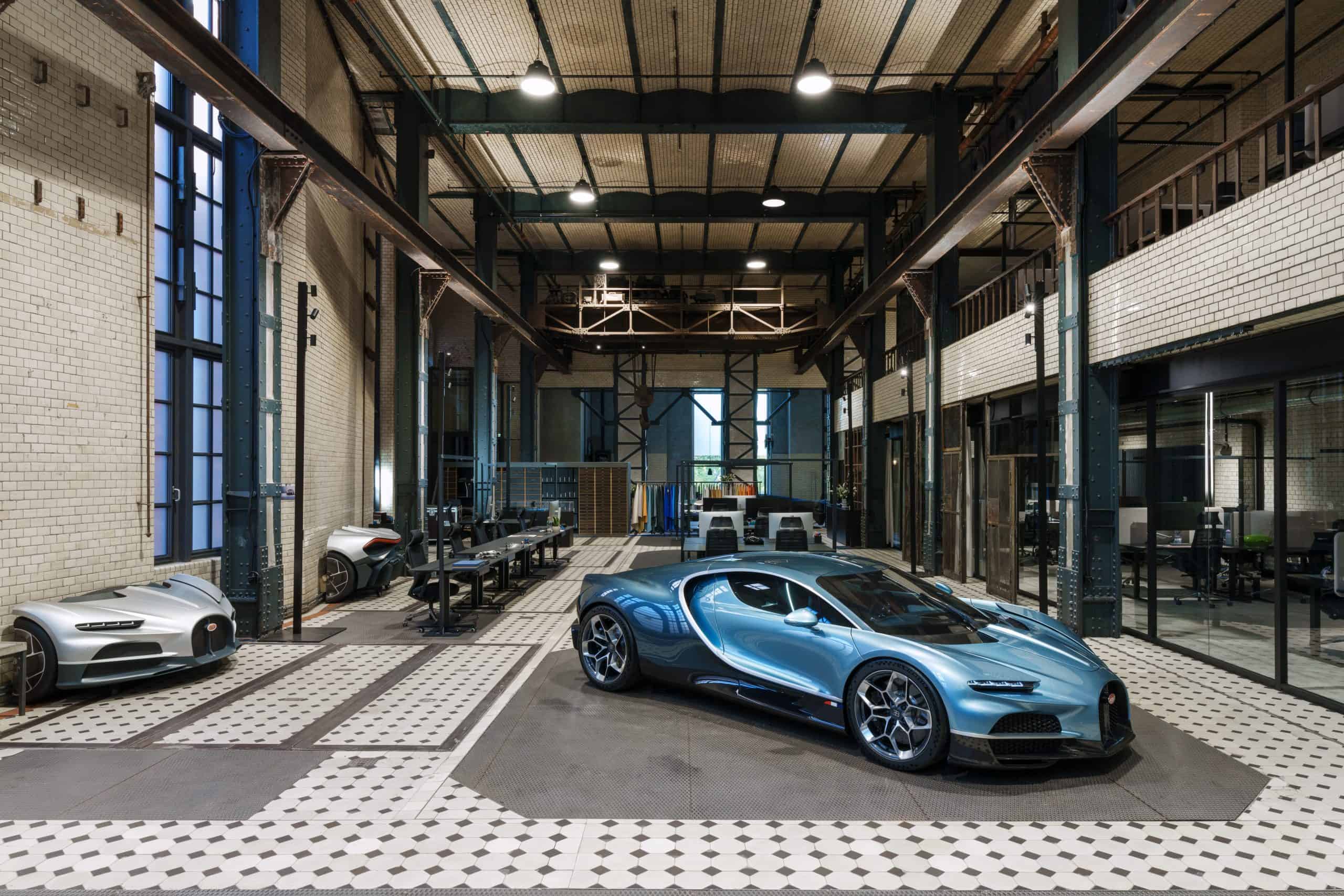
Inside Bugatti’s Atelier in Molsheim and its Design Studio in Berlin, a team of material specialists is building what may be the most individually crafted car interior ever offered in series production. The Tourbillon, Bugatti’s successor to the Chiron, is not just a new hypercar. It is a test case for how far automotive personalization can go when there are no constraints on budget, time or ambition.
The discipline at the center of this process is Color, Material and Finish, known in the industry as CMF. It covers every surface a driver or passenger can see or touch, from the paint on the body panels to the texture of the leather on the steering wheel to the finish on each metal control surface. At most manufacturers, CMF means choosing from a menu. At Bugatti, it means creating the menu from scratch for each customer.

Leading the CMF program is Sabine Consolini, Head of CMF at Bugatti, who oversees all material development from standard production configurations to one-off commissions. The Tourbillon has given her team a wider canvas than any previous Bugatti.
“The fabrics we are introducing have never before been used in Bugatti’s history, something we are now able to offer with the Tourbillon. We conducted extensive research, working with companies that typically create textiles for the fashion industry. By adapting their unique characteristics for automotive application, we are proud to bring these materials to our customers.”
The introduction of fabric to a Bugatti interior is a significant departure. Previous models relied almost exclusively on leather and carbon fiber. For the Tourbillon, the CMF team sourced materials from fashion textile houses and then re-engineered them to survive the demands of an automotive environment: UV exposure, temperature extremes, abrasion, and the strict flammability standards that every production car must meet.
One of the most striking results is a hand-woven textile produced in Kyoto, Japan. It incorporates metallic yarn and strips of washi paper, a traditional Japanese material, brought together in a weave that produces both visual depth and a soft hand feel that has no equivalent in any other production car. Alongside it, the team developed a knitted fabric threaded with metallic yarn that catches light from different angles, creating a three-dimensional, shimmering effect across the surface.
These are not catalog options. Each fabric can be personalized on demand, with the customer defining their own color combinations and patterns.

“Customers can personalize these materials entirely on demand, with the freedom to select and define their own patterns. Each version is developed exclusively for a single client, making every piece truly unique. This is the very essence of haute couture, taken to the level of Bugatti Sur Mesure.”
A signature Bugatti fabric has also been developed in four colorways, with the EB monogram woven subtly into the pattern, for use across the Tourbillon’s interior surfaces.
The leather program has been reworked from the ground up. Bugatti developed a new tanning process specifically for the Tourbillon that produces a measurably softer hide than any previous model. The goal was leather that feels broken in from the first moment a customer sits in the car, without sacrificing durability or the ability to hold its color and texture over years of use.
Aluminum is present throughout the cabin in a way that goes beyond decorative trim. It forms the center console controls, the switchgear and, most notably, the instrument cluster. That cluster draws directly from the world of haute horlogerie, with interchangeable back plates finished using techniques developed alongside the same Swiss manufacturer responsible for the Tourbillon’s celebrated analog clock dials. The result is an instrument panel that looks and feels like a mechanical timepiece rather than a digital screen.
Glass has been introduced to the interior in a way that presented one of the most difficult engineering challenges of the entire CMF program. The center console features a single formed glass piece, available in multiple shades of color. Forming glass into a shape that fits precisely into a car interior, maintaining optical clarity and structural integrity while also offering color variation, required extensive collaboration between Bugatti’s team and specialist glass suppliers.
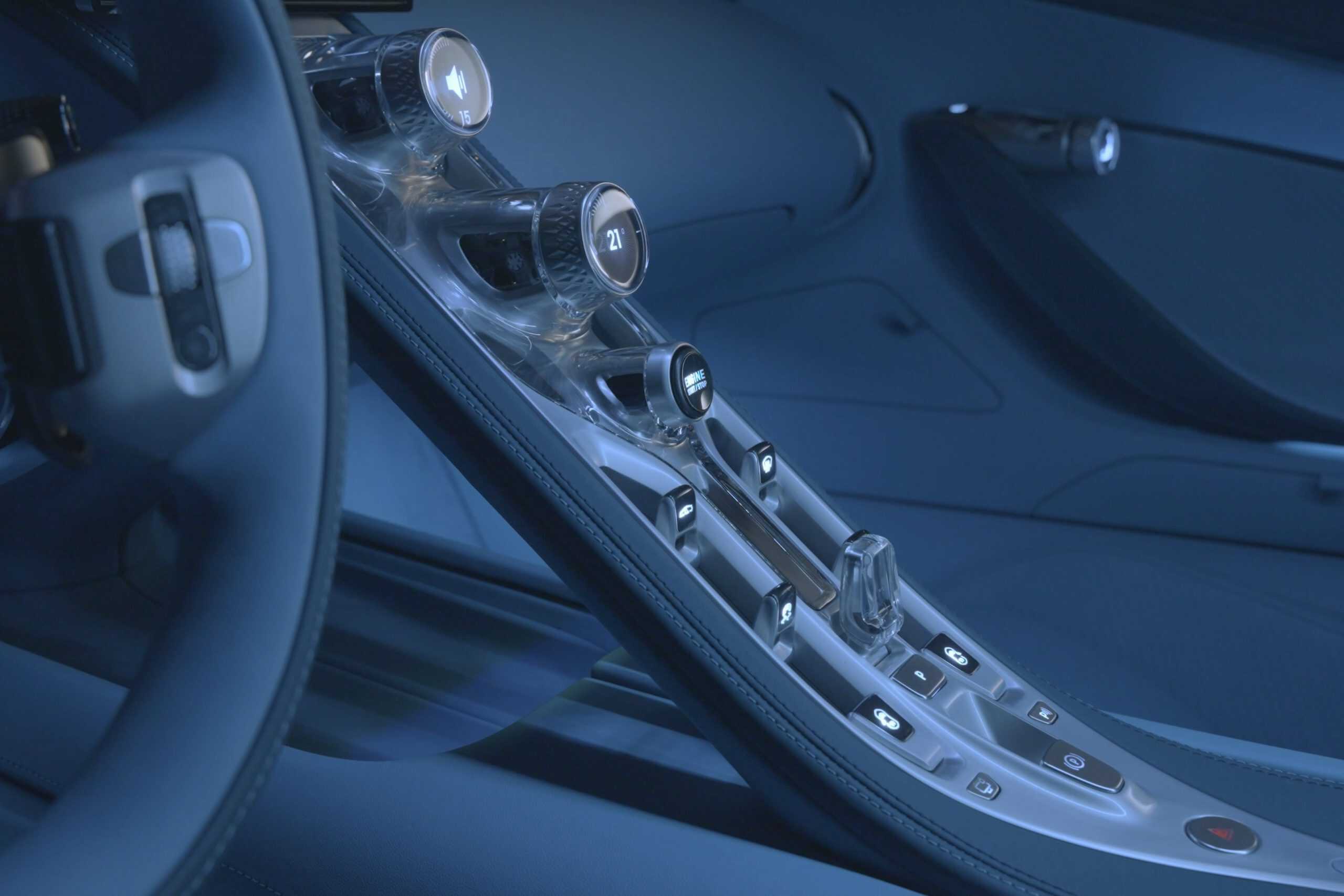
“Bringing this to life was a significant challenge, as the glass is crafted from a single piece. Through close collaboration with our experts and specialist suppliers, we succeeded in developing it not only in a transparent finish, but also in a variety of colored shades.”
The paint program pushes into territory that most manufacturers would consider impractical. Bugatti offers the option of adding metallic sparkle particles and even diamonds into the Tourbillon’s exterior finish, creating a surface that shifts and catches light in ways that a conventional metallic or pearlescent paint simply cannot replicate. Each exterior color is developed to complement the interior specification, with the CMF team working to ensure that the relationship between outside and inside reads as a single, coherent composition rather than two separate choices.
The overall color philosophy for the Tourbillon moves away from the high-contrast, aggressive palettes that have defined much of the hypercar segment. Instead, the palette is built around nuanced tones with depth and subtlety, colors that reveal their character gradually in different lighting conditions rather than shouting from across a car park.
For customers who want something beyond even the expanded standard palette, Bugatti’s Design Studio in Berlin hosts private configuration sessions. These are not the kind of configurator appointments offered by mainstream luxury brands, where a customer picks from swatches on a screen. At Bugatti, the session can result in an entirely new material or color being developed from scratch, manufactured once, and applied to a single car.
Bugatti Design Director Frank Heyl sees the Tourbillon as a turning point in what the brand offers its customers.
“The Tourbillon represents a shift in what individualization means at Bugatti. We have always believed that every vehicle we create should be an expression of its owner, but with the Tourbillon, we are going further than ever before. When a customer leaves our Design Studio with something that has been created for them alone, that is the ultimate expression of what Bugatti stands for.”
The scale of the CMF operation reflects a broader truth about where the top end of the automotive industry is heading. As the mechanical differences between hypercars narrow, with most now producing over 1,000 horsepower and reaching similar performance figures, the battleground for differentiation is shifting to materials, craftsmanship and the depth of personalization a manufacturer can offer. Bugatti’s answer with the Tourbillon is to treat each car less like a product and more like a commission, built around the individual who will own it.
Whether that philosophy justifies the Tourbillon’s price tag is a question only its buyers can answer. What the CMF program demonstrates is that the gap between a standard luxury car interior and what Bugatti is producing here is not a matter of degree. It is a matter of kind. The materials, the processes and the level of individual attention involved in each Tourbillon interior exist in a category that the rest of the industry is not attempting to occupy.

Leave a Comment
More in News

UK Drivers Face £200 in French Tolls and €140 Fines for Missing Stickers

Roof Rack Fines Can Reach £2,500 as Holiday Drivers Ignore Safety Checks

UK Breakdown Callouts Jump 20% in Heatwave as Motorists Face Hours-Long Jams

2027 Toyota Sequoia Adds Trailhunter Package and 14-Inch Touchscreen

2027 Toyota Crown Hybrid Adds Fifth-Gen System, Priced From $41,640
Trending on Motoring Chronicle

Driving Test Waits Range From 5 to 24 Weeks in New DVSA Centre Data

Fenomeno Roadster makes its debut at the Concours of Elegance Germany 2026 [Photo Gallery]

America’s Quickest Production Car: Corvette ZR1X Does 8.675-Second ¼-Mile, Sub 2 Second 0-60

Young Drivers Pay Nearly £2,000 A Year For Insurance (But You Don’t Have To)