Why Your Car Battery Gives No Warning Before It Dies


Car batteries fail without warning from the visible signs most drivers recognize. The internal chemical degradation that causes failure is invisible from the outside until the battery can no longer hold enough charge to start the engine. A battery can test as functional at 12.6 volts right up to the point of failure. The internal plate corrosion and electrolyte depletion that lead to sudden failure develop gradually over months without affecting everyday starting performance.
How a Car Battery Works and What Degrades Inside It
Lead-acid chemistry and the charge-discharge cycle
A car battery is a lead-acid electrochemical device containing lead plates immersed in sulfuric acid electrolyte. When you start the car, chemical reactions at the plate surfaces cause electrons to flow, producing electrical current. The alternator replenishes the battery by reversing this chemical reaction during driving, converting mechanical energy from the engine into chemical energy stored in the battery. This cycle repeats thousands of times over the battery’s life.
The charge-discharge cycle is not perfectly efficient. Each cycle causes small amounts of lead dioxide to flake off the positive plate, small amounts of lead to shed from the negative plate, and small amounts of active material to drop to the bottom of the battery case as sediment. If this sediment builds up too high, it can bridge the plates and short-circuit the cell internally, killing the battery instantly. More commonly, the gradual loss of active plate material reduces the total amount of chemical energy the battery can store, causing capacity to decline over time.
The electrolyte itself degrades. Water in the sulfuric acid solution evaporates, especially in batteries in hot climates or in vehicles with heavy electrical loads. Some of the sulfuric acid becomes bound to the lead sulfate deposits forming on the plates during discharge. After thousands of charge-discharge cycles, the electrolyte becomes more concentrated and chemically less effective, reducing the battery’s ability to complete the charge reaction fully. None of these processes produce obvious external signs until the battery suddenly cannot produce enough current to turn the starter motor.
How plate sulfation develops silently over time
Sulfation is the accumulation of lead sulfate crystals on the battery plates. A small amount of sulfation is normal and part of every charge-discharge cycle. When the battery discharges, lead sulfate forms on both plates. When the alternator recharges the battery, the lead sulfate is supposed to convert back to lead and lead dioxide, restoring the original chemistry. If the recharging is incomplete or if the battery sits partially discharged, the lead sulfate hardens into larger crystals that do not convert back to active plate material.
Hard sulfation accumulates on a battery that is frequently partially discharged and then only partially recharged. A vehicle that is not driven far enough to fully recharge the battery, or that sits idle for days between short driving sessions, accumulates sulfation faster than a vehicle that gets regular long drives. Over months, these hard sulfate deposits coat the plates, reducing the active surface area available for the chemical reaction. The battery still produces voltage when tested in the sense that the basic chemistry still functions, yet it cannot produce enough current for reliable starting in the sense that the effective plate area has been reduced.
Sulfation damage is progressive and accelerates once it begins. A lightly sulfated battery that is charged fully and then driven regularly will recover and perform normally. A heavily sulfated battery, even if fully charged, has permanently lost active plate area and cannot recover. The battery’s voltage will still read 12.6 volts when the engine is off, in the sense that voltage depends on the chemical potential difference between the plates, not on the surface area available for current delivery. Sulfation is invisible electrically; it shows up only as reduced current capacity, which is not obvious until the battery is asked to provide full starting current in cold weather.
Why surface charge masks internal decline
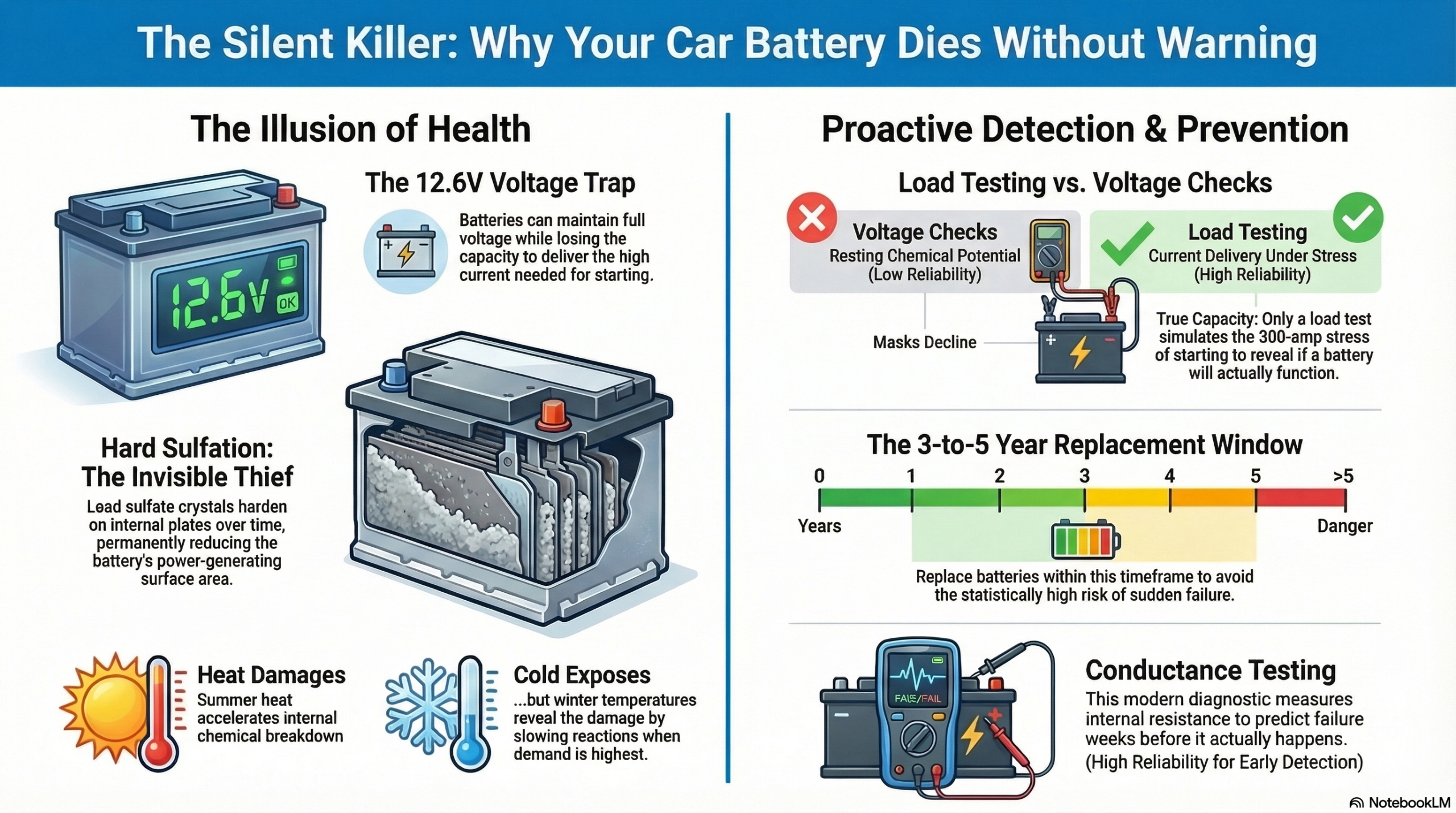
A battery’s voltage is an independent property from its capacity. Voltage reflects the chemical potential of the lead-acid cells, and the battery will read 12.6 volts when rested as long as the basic chemistry is intact and the cell is not shorted. This voltage reading says nothing about whether the battery can provide a hundred amps of current for five seconds, which is what starting an engine requires.
Capacity is the total electrical charge the battery can deliver, measured in amp-hours. A new battery might deliver 600 to 800 amp-hours over a one-hour discharge at moderate current. As the battery degrades, capacity drops to 500, then 400, then 300 amp-hours. The voltage stays at 12.6 volts throughout this entire capacity decline, in the sense that the number of functioning cells and their chemical potential remain unchanged. The battery is dying, yet the voltage meter does not reveal this.
A battery that rests overnight can recover a surface charge from the few electrons remaining at the plate surfaces and junctions. The next morning, the battery reads nearly full voltage in spite of significant capacity loss. As soon as the starter motor demands full current, the battery collapses and cannot supply the current needed for starting. This is why a battery can test as charged one afternoon and fail to start the car the next morning after a cold night. The cold overnight temperature lowered the battery capacity further, yet the voltage appeared normal before the engine-start demand was placed on it.
Why Warning Signs Are So Rare
The voltage illusion and why a dying battery reads normal
Standard 12-volt meters are nearly useless for battery health diagnosis. A dying battery with only 30 percent capacity remaining will read 12.4 to 12.6 volts on a standard meter. The battery will still turn on the interior lights, still power the radio, and still activate the power windows. These continuous, moderate-current loads do not reveal the battery’s lack of capacity in the sense that they do not approach the amp-hour or cold-crank-amp demands that the battery cannot meet.
An analogy: imagine a water tank that is 70 percent blocked internally with sediment. The pressure gauge on the tank reads normal in the sense that pressure depends on the water that is there, not on the missing water. Yet if you try to fill a large swimming pool quickly, the flow rate is far below what it should be. The gauge says the tank is fine, yet the tank cannot deliver the required flow. The same principle applies to batteries. The voltage gauge says the battery is fine, yet if the battery cannot deliver a 300-amp starting current, it is not fine, regardless of what the meter shows.
Modern vehicles with energy-management systems actually mask battery decline further. The alternator adjusts charging voltage based on electrical load and battery state. If the battery capacity has dropped significantly, the alternator senses this and adjusts charging to compensate. The vehicle remains capable of starting for weeks longer than the battery’s actual capacity would suggest, right up to the moment it cannot start at all. The system works to keep the engine running, yet this means the battery fails without any gradual degradation of starting performance.
How cold weather suddenly exposes hidden weakness
Cold weather reduces battery capacity in two simultaneous ways. The chemical reaction in the battery slows at low temperature, reducing the current the battery can produce. At the same time, cold weather thickens the engine oil, increasing the current demand needed to crank the engine to speed. A battery that barely meets starting current requirements at 70 degrees Fahrenheit will fall 30 to 40 percent short of the needed current at 20 degrees Fahrenheit. If the battery was already degraded to 70 percent capacity before the cold night, the overnight temperature drop reduces it below the threshold needed for starting.
Winter mornings expose battery decline that summer driving conceals. A battery declining in September and October still starts the vehicle reliably at 60 to 70 degrees. By December, the same battery fails to start in the morning cold, not in the sense that the battery aged three months more, yet in the sense that the temperature demand revealed the capacity loss that already existed. The battery seemed fine on a warm November afternoon, yet cold revealed its true state.
The timing of cold weather relative to battery age compounds this effect. A three-year-old battery in a hot climate might still have adequate capacity through the warm months. The first winter brings cold nights that expose the capacity decline, and the battery dies in January or February before the owner expected any problems. A battery in a cold climate is tested regularly by winter starts, so decline becomes noticeable gradually. A battery in a warm climate can hide its decline for months, right up to the first hard freeze or cold snap.
Why modern vehicle electronics make early detection harder
Older vehicles had mechanical fuel pumps and simple electrical systems. If the battery was weak, the engine would crank slowly, the lights would dim during starting, and the operator could hear the deterioration in the starter motor’s sound. Modern vehicles have electronic fuel pumps, complex engine management systems, and computers that verify operation within specifications or the system powers down gracefully. The result is that a weak battery either starts the engine or it does not; there is little middle ground.
The engine control computer monitors input signals and fuel pressure to a tight tolerance. If the battery voltage sags below a certain threshold during starting, the computer might momentarily shut down injector operation and then resume it, or it might disable the fuel pump temporarily and restart it. These corrective actions happen in milliseconds and are invisible to the driver. The engine either turns over and starts or it does not. Modern vehicles provide fewer clues that the battery is declining until the moment it fails completely.
Modern vehicles also use the battery for many electronics that run when the engine is off. Keyless entry, security systems, and engine computers draw current from the battery even when the vehicle is parked. This parasitic drain can amount to 50 to 100 milliamps on some vehicles, which is negligible over a day yet becomes significant if the vehicle sits parked for a week. A battery that has sufficient capacity for all this parasitic drain still seems fine, right up to the morning when the owner intends to drive and reveals the battery cannot provide the 300-amp starting current from the parasitic drain having partly discharged it overnight.
The Risk Factors That Accelerate Silent Failure
Age and heat exposure as the primary drivers
The primary factor determining battery life is age combined with heat exposure. A typical lead-acid battery lasts 3 to 5 years under normal conditions, yet this statistic hides the role of temperature. A battery in a cool climate can last 5 to 7 years, while the same model battery in a hot climate rarely lasts more than 2 to 3 years. Heat accelerates the chemical reactions that degrade the battery, increases water evaporation from the electrolyte, and causes the plates to corrode faster.
A battery mounted in the engine bay, as most vehicle batteries are, sits directly above the engine where temperatures regularly exceed 120 degrees Fahrenheit when the vehicle is driven on a hot day. The battery sits in an oven for 20 to 30 minutes every time the vehicle is driven in summer. After a month of summer driving, the battery has experienced the equivalent of years of chemical degradation. The manufacturer’s three-to-five-year life expectancy assumes moderate temperature; a battery in hot climates is on a far shorter timeline.
A battery installed in a vehicle that is driven aggressively or that pulls heavy loads generates more heat in the alternator and charging system. This extra charging heat transfers to the battery, further accelerating electrolyte degradation. Towing vehicles that are regularly towed or that regularly run the air conditioning at maximum load put additional stress on the battery and charging system, shortening battery life by months compared to casual driving. Understanding how long a car battery lasts under various conditions helps drivers plan for replacement.
Repeated partial discharge and short-trip driving
Every discharge-recharge cycle stresses the battery. A vehicle driven 5 miles and then parked creates a deep discharge cycle in the sense that the alternator does not run long enough to fully recharge, followed by parasitic drain from the security system and engine computer. After weeks of these short trips, the battery accumulates sulfation and never gets the long full-recharge cycle that would help it recover.
A vehicle that is driven daily for an hour on the highway at 60 miles per hour gets full recharge cycles regularly, and the battery might last six or seven years in spite of identical age. The same battery in a vehicle driven five days a week for 10-mile commutes with mostly idling never gets fully recharged and develops sulfation faster. After three years, the commute battery is at 60 percent capacity while the highway battery is at 90 percent, and this difference grows every year.
Vehicles used for delivery routes, taxis, or services involving constant stop-and-start driving are hard on batteries. The alternator runs constantly yet at idle speeds where output is low. The battery is drawn on repeatedly yet never fully recharged on the highway. These vehicles often need battery replacement every two to three years in spite of careful maintenance. The problem is not neglect yet the duty cycle, which prevents the battery from ever achieving a full charge state.
Parasitic drain from accessories and electronics
Modern vehicles draw current even when the engine is off. The security system, keyless entry receiver, engine computer in sleep mode, radio memory, and dash camera all draw power continuously. Most of this drain is by design and minimal, yet in aggregate it amounts to 20 to 100 milliamps depending on vehicle and equipment package. A battery that sits unused for a week loses 0.1 to 0.7 amp-hours to parasitic drain, which is not enough to kill the battery yet is enough to leave it slightly discharged when the owner goes to start the vehicle.
Additional accessories like aftermarket security systems, custom amplifiers, and dash cameras increase parasitic drain significantly. A vehicle with a 50-milliamp factory parasitic drain might rise to 200 or 300 milliamps with aftermarket equipment. A battery parked in a garage for two weeks accumulates a partial discharge, and the battery’s capacity is further strained. A battery that started at 70 percent capacity from age is left at 60 percent capacity after a two-week rest period.
A vehicle that is driven regularly has time for the alternator to recharge the battery before parasitic drain becomes significant. A vehicle that sits for days between uses accumulates parasitic discharge that the battery cannot recover from before the next starting demand. This is why commuter vehicles often develop battery problems; the vehicle sits all day while the owner is at work, parasitic drain draws the battery down, and the evening drive tries to start a partially discharged, age-degraded battery in cold weather.
How to Detect a Battery That Is About to Fail
Load testing vs. voltage testing and why one is far more reliable
Voltage testing with a standard 12-volt meter is nearly worthless for battery diagnosis. It measures only the resting voltage and reveals nothing about the battery’s capacity under load. A dying battery with 30 percent capacity remaining will read 12.4 to 12.6 volts and will pass a voltage test every time. This false assurance sends owners driving with a battery that might fail at any moment.
Load testing is the proper method for battery diagnosis. A load tester applies a 300-amp load to the battery for 15 seconds while measuring the voltage during the load. A healthy battery will maintain 9.6 volts or higher under this load. A battery that drops below 9.6 volts under load has insufficient capacity for reliable starting. A battery that cannot maintain 9.0 volts is near failure. Load testing reveals the actual capacity under the electrical stress that real engine starting creates.
Most professional service facilities have load testing equipment available at little or no charge. If the service department only runs a voltage test and declares the battery “fine,” ask for a load test instead. The few minutes of load testing provide the only reliable assessment of battery health and predict which batteries are about to fail. A battery that reads 12.6 volts yet cannot maintain 9.6 volts under load is a battery to replace before it fails.
What a conductance test measures that voltage cannot
Conductance testing is a newer diagnostic method that measures the internal resistance of the battery without applying a load. The battery’s internal resistance increases as plate corrosion and sulfation develop, even though the voltage remains normal. A conductance tester detects this internal resistance increase and can predict battery failure with reasonable accuracy. Modern technicians often use conductance testing in addition to load testing for comprehensive battery evaluation. The battery’s internal chemistry is what conductance testing actually measures in a way that traditional voltage testing cannot.
Conductance testing is faster than load testing and is less stressful on the battery, which is valuable for testing a vehicle that is difficult to start. A conductance test can be performed with the battery connections in place without running a 300-amp load through the electrical system. Some service facilities have switched entirely to conductance testing for routine battery checks. If the service department uses conductance testing and reports that the battery is failing, the assessment is likely accurate and the battery should be replaced.
The advantage of conductance testing is that it detects internal degradation before the battery’s capacity drops to the point of starting failure. A conductance test can identify a battery that will fail in another month before it strands the owner. The combination of load testing and conductance testing provides the most reliable battery health assessment. A battery that fails both tests is definitely near the end of its life.
The 3-to-5-year replacement window and why it exists
The standard guidance to replace a car battery every three to five years is not arbitrary. After three years, most batteries have lost enough capacity and have accumulated enough corrosion that failures become statistically likely. A battery at three years is still functional under normal conditions yet is borderline for starting in cold weather. A battery at four years has a significant probability of failure in winter. A battery at five years should be replaced unless load testing confirms it still has adequate capacity.
This guidance is conservative and intentionally so. It prevents stranded vehicles and starting failures. In warm climates or with careful driving patterns, a battery might reliably reach five or six years. In hot climates or with difficult duty cycles, three years might be optimistic. The three-to-five-year recommendation is a statistical average across all climates and duty cycles.
Once a battery reaches four years old, the risk of sudden failure begins to accelerate. A four-year-old battery might start reliably on a warm day yet fail on a cold morning. Rather than gamble on a battery’s reliability and risk being stranded, planned replacement at three to five years based on your specific climate and driving patterns is the sound approach. Waiting for the battery to fail guarantees inconvenience; replacing it within the established window gives you control over the timing.
Acting Before the Battery Leaves You Stranded
Building a testing routine into regular service visits
The most practical approach to avoiding battery failure is to add battery testing to the vehicle’s regular maintenance routine. At every oil change or service visit, ask the service department to perform a load test or conductance test on the battery at no charge. Most dealers and independent shops offer this service freely as a matter of routine maintenance. This adds five minutes to a service visit and catches battery decline early.
Keep records of battery test results year over year. A battery that tested at 650 cold-crank amps last year yet tests at 550 this year is declining predictably. You can schedule replacement for early autumn or well before winter, verifying the battery change happens on your timeline rather than on a dark morning when you need to start the vehicle. Periodic testing removes the element of surprise and lets you plan the replacement to fit your schedule and budget.
For vehicles that sit idle for extended periods, a battery maintainer can keep the battery charged without overcharging. A smart maintainer charger can be plugged in when the vehicle is parked for more than a week, keeping the battery at full charge and preventing sulfation from parasitic drain. This is highly valuable for vehicles in storage or for owners who drive irregularly. The maintainer costs less than a replacement battery and extends the life significantly.
The warning signs that do exist and what they look like
A few observable signs indicate a battery in decline. The starter motor cranks the engine slowly, taking noticeably longer to turn the engine over than it did months ago. The car cranks, yet the starter motor sounds strained or labored. The interior lights dim noticeably when the engine is cranking. These signs indicate that the battery is providing lower voltage or current than designed, which is the only pre-failure warning that most vehicles produce.
Clicking when you turn the key, where the starter relay clicks yet the starter does not engage, is a classic battery failure warning. The battery voltage is so low that the starter solenoid cannot stay engaged, yet still slightly above the threshold needed to click the relay. This is an imminent-failure warning; the battery will likely not start the vehicle the next time you try. Replace it immediately.
In winter, a vehicle that struggles to start in cold mornings yet starts easily in the afternoon indicates a battery near the limit of its capacity. The cold reduces capacity further, pushing it below the threshold needed for starting. This pattern repeats and worsens. Do not wait for true failure; arrange battery replacement when you see this pattern emerge. A battery showing any of these signs needs testing and replacement planning within days or weeks, not months.
If you enjoyed this article, be sure to follow us on Microsoft Start.

Leave a Comment
More in News

Alex Palou Back on Peak Form, Dominates Barber Qualifying

Avoidable Driving Mistakes That Double Your Risk After Dark

The W16 Mistral ‘Caroline’: an ode to a beloved daughter, by Bugatti Sur Mesure

All-new 2027 INFINITI QX65 blends sporty fastback design, luxurious interior and spirited, rewarding performance

Acura Celebrates 40 Years of Precision Crafted Performance
Trending on Motoring Chronicle

Fogged windows: why it happens and fixes

Subaru focuses on consumer affordability and excellent value with updated pricing on 2026 Subaru Forester

The All-New BMW iX3

The Nissan Leaf has been chosen by the WWCOTY as the Supreme Winner of 2026