What Your Engine Oil Color Is Actually Telling You


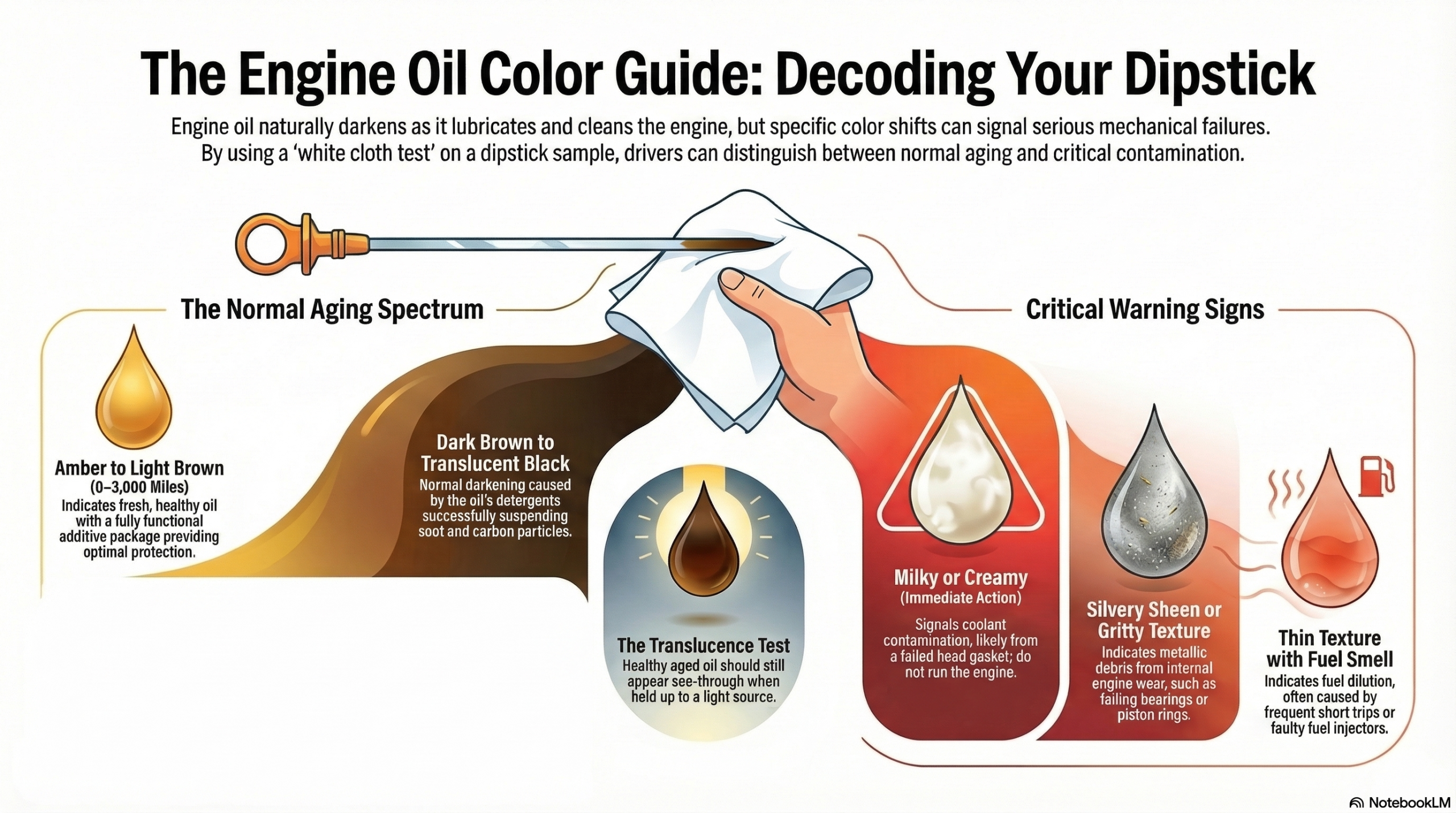
Engine oil color reveals its age, contamination level, and operating condition. Fresh oil is amber or light brown. Oil darkened to black but still translucent after a few thousand miles is normal. Milky or creamy oil indicates coolant contamination and requires immediate attention. Gritty oil with visible metallic particles signals internal engine wear. Thin, dark oil with a fuel smell indicates fuel dilution.
The Oil Color Spectrum and What Each Shade Means
Amber and light brown , fresh to lightly used oil
The baseline for engine oil condition starts with amber or light brown fluid. This color indicates oil that has not undergone significant oxidation or contamination. When you extract an oil sample from a dipstick on a newly serviced engine, the fluid should appear translucent with a golden or honey-like tint. This baseline exists as virgin mineral oil contains only minimal degradation products. At this stage, the additive package is functioning at full capacity, providing optimal protection against wear, corrosion, and sludge formation.
Amber oil typically indicates the engine has run for only a few hundred miles from the last change. The color can vary slightly depending on the oil’s base stock; synthetic oils often appear slightly lighter, while mineral oils can show a warmer tone. At this point, the engine is not yet seeing significant heat stress or contamination accumulation. The dipstick reading at this stage should match the “full” line on the stick, assuming no topping up has occurred.
Light brown oil signals more mileage than fresh amber oil but still indicates good condition. This shade usually appears between 1,000 and 3,000 miles into a service interval on a well-maintained engine. The oil has begun to expose itself to combustion byproducts and minor thermal stress, yet oxidation remains minimal. At this point, the oil’s color change is a normal part of the aging process and does not indicate a problem requiring action.
Dark brown to black , normal aging and what it indicates
As oil accumulates mileage, it naturally darkens. Dark brown to nearly black oil is the expected condition for an engine that has been running hard or for several thousand miles from the last oil change. This darkening occurs as combustion gases and incomplete combustion products dissolve into the oil. Carbon, soot, and other oxidation byproducts give the oil its dark coloration. This process is normal and does not automatically signal that the oil needs replacement.
The key distinction lies in the oil’s translucence. Oil that is dark brown or black yet remains translucent when held up to light is performing as designed. The darker color indicates the oil’s additive package is working, binding suspended contaminants and preventing them from forming deposits on the engine’s internal surfaces. Modern detergent oils are formulated to carry these contaminants in suspension, which is why they darken more quickly than older, non-detergent oils.
An oil that turns opaque black, appearing thick and muddy when examined on a cloth, indicates either an unusually short service interval for the driving conditions or a potential issue in the engine. Heavy idling, short-trip driving without reaching full operating temperature, or excessive blow-by from worn piston rings can accelerate darkening beyond normal expectations. The transition from dark brown to jet black often happens around the 5,000 to 8,000 mile mark on a typical passenger car, depending on driving patterns and engine condition.
Milky, grey, or creamy , coolant contamination
Milky or creamy oil is never normal and always indicates a serious problem requiring immediate diagnosis. This discoloration occurs when coolant enters the oil, creating an emulsion of water and oil that resembles yogurt or milky coffee when examined on a white cloth. Coolant contains glycol-based compounds and water that are immiscible with oil; when they mix, the result is this characteristic opaque, foamy appearance.
The sources of coolant contamination into the crankcase are limited, and all require repair. A failed cylinder head gasket is the most common cause, allowing coolant from the jacket to seep past the gasket into the cylinder. Once in the cylinder, the coolant mixes with the combustion process and drains into the sump with the oil. A cracked cylinder head or engine block can create a direct path for coolant to enter the oil. A failed intake manifold gasket on certain engine designs can also introduce coolant into the crankcase. Warped cylinder heads from overheating will fail to seal properly and allow seepage.
Milky oil must be addressed prior to driving the vehicle further. The presence of water in the oil compromises lubrication, reduces film strength, and can cause bearing corrosion. The oil’s viscosity changes unpredictably when coolant is mixed in, and the additive package loses effectiveness. If you discover milky oil, the engine should not be run. A mechanic should perform a pressure test on the cooling system and a compression test on the engine to identify the leak source. The oil must be drained immediately, and the contamination source must be repaired prior to the engine being safely operated again.
Silvery sheen or visible particles , metal debris in the fluid
Oil with a silvery sheen or visible particles suspended in it indicates metal contamination from internal engine wear. When examined on a white cloth, this oil appears to contain fine metallic dust or small visible flakes. The particles originate from bearing wear, piston ring wear, or cylinder wall degradation. Each of these sources generates different types of particles that a trained technician can identify, but the presence of particles signals advancing wear.
A light silvery sheen is sometimes present in oil from engines with slightly elevated wear but not yet in critical condition. This appearance occurs as fine metallic particles are suspended throughout the oil in such small quantities that they create a subtle reflective effect. If an engine has recently experienced
hard driving or sustained high RPM operation, minor metallic content is expected. A single occurrence of silvery particles does not mandate an immediate engine rebuild.
Visible particles or flakes, most notably larger pieces that can be seen with the naked eye, indicate more advanced wear. Particles this large suggest bearing material loss or piston ring damage. An engine producing visible metal particles should be brought to a mechanic for diagnosis, as continued operation can cause catastrophic failure. Magnetic drain plugs are designed to collect these particles, and examining the drain plug at every oil change provides an early warning system. A sudden increase in metallic content on the drain plug, even without visible particles in the oil itself, warrants investigation.
How to Read the Oil Correctly
Using the dipstick and the cloth test
The oil dipstick is the primary tool for assessing oil condition, yet it must be used correctly to provide accurate information. Regular oil changes depend on understanding what the dipstick is showing you. After locating the dipstick under the hood, pull it straight out without twisting or angling it. Some oil will cling to the stick; this is the sample you will examine. The most reliable assessment method is to wipe the oil onto a white paper towel or white cloth, which provides contrast for observing color, translucence, and particles.
When using a cloth test, drag the oily dipstick across the white surface to create a streak of oil. This method reveals the oil’s true color far more accurately than examining the stick itself, where metallic surfaces create reflections that distort the apparent color. The cloth also makes it easier to spot particles; hold the cloth up to light and examine the streak closely. Any sparkle or glitter indicates metallic content. A gritty feeling on the cloth suggests abrasive particles or sludge contamination.
The dipstick also displays level markings, typically showing “minimum” and “maximum” lines. The oil should be at or above the minimum mark and ideally near the maximum mark. A reading between minimum and maximum is acceptable, though most drivers prefer to maintain levels closer to maximum. If the oil is below the minimum mark, the engine should be topped up prior to driving to prevent bearing starvation.
When to check and what conditions affect the reading
Oil level and color readings are most accurate when the engine is cold, meaning at least five minutes have elapsed from engine shutdown. Hot oil gives misleading readings as thermal expansion increases the apparent level on the dipstick. Cold checks are more reliable and represent the true amount of oil in the sump. If you must check oil immediately after driving, wait at least ten minutes for the temperature to stabilize.
The surface on which the car is parked also affects readings. Always park on level ground when checking oil; parking on a slope will cause the oil to collect unevenly in the sump, resulting in inaccurate level readings. If the car is parked on an incline, wait at least one minute after stopping to allow the oil to settle prior to checking the level. For the most consistent results, check oil at the same time each week and on level ground.
Ambient temperature affects the oil’s viscosity and appearance. In cold climates, even fully warmed oil appears thicker and slightly darker immediately after shutdown, as it cools quickly. This is normal and does not indicate a problem. In hot climates, oil could appear slightly thinner and lighter, as thermal energy keeps it more fluid. These temperature-related appearance shifts are expected and separate from genuine degradation or contamination.
How to distinguish normal darkening from accelerated degradation
Normal darkening follows a predictable pattern based on mileage and driving conditions. Oil from an engine that has run 3,000 miles from the last change should appear dark brown yet translucent. Oil from 7,000 miles should be black yet still translucent. If your oil darkens much faster than this baseline, the engine will be experiencing abnormal conditions that accelerate degradation.
Short-trip driving is the most common cause of accelerated darkening. When an engine is never allowed to reach full operating temperature, water and fuel accumulate in the oil faster than they can evaporate or burn off. An engine running 50 short trips of five miles each will have much darker oil than an engine running two trips of 125 miles each, even if the total mileage is identical. The first engine accumulates more water, fuel contamination, and incomplete combustion products, as it never warms sufficiently to purge these contaminants.
Comparing your oil condition to the manufacturer’s specifications for your vehicle is the most reliable method. Consult your owner’s manual for the recommended oil change interval and note what condition the oil should display at the midpoint of that interval. If your oil is significantly darker than this baseline, the driving conditions can be shortening the effective interval. Turbocharged engines naturally produce darker oil from elevated exhaust gas recirculation temperatures, and this is normal for these engines. Diesel engines also darken more quickly from the combustion characteristics of diesel fuel, and this acceleration is expected and does not indicate a problem.
Conditions That Cause Abnormal Color Changes
Short-trip driving and incomplete combustion cycles
An engine requires several minutes of operation to reach full operating temperature, typically around 195 to 210 degrees Fahrenheit for a gasoline engine. During the warm-up phase, the mixture is rich to aid cold starting, and the catalytic converter is less efficient at removing unburned hydrocarbons. This means unburned fuel and combustion byproducts enter the oil in higher concentrations during cold running. If a vehicle is driven exclusively in short trips without reaching full operating temperature, this contamination accumulates in the oil faster than it can be purged.
Fuel dilution from incomplete combustion is the primary driver of accelerated oil darkening in short-trip scenarios. Gasoline that enters the cylinder without combusting fully drains into the crankcase during the exhaust stroke, mixing with the oil. At full operating temperature, most fuel that does not combust on the first cycle is forced out through the exhaust valve on the next cycle. In a cold engine, much of this unburned fuel enters the oil. Water accumulates for the same reason; when the engine is cold, the catalytic converter and exhaust system do not get hot enough to vaporize water from combustion, so it condenses on the cylinder walls and drains past the rings into the sump.
Oil used primarily for short-trip driving deteriorates faster as the additive package must cope with higher levels of contamination than expected. The detergents are overwhelmed by soot and unburned fuel, the anti-wear additives are diluted by fuel contamination, and the corrosion inhibitors face attacks from water accumulation. For this reason, vehicles used primarily for short trips of under five miles each should follow the severe service oil change interval specified in the manual, which is typically 3,000 miles instead of the normal 5,000 to 7,500 mile interval.
Turbocharged engines and elevated heat exposure
Turbocharged engines produce significantly darker oil than naturally aspirated engines of the same displacement. The turbocharger compresses incoming air prior to entry into the cylinders, raising combustion temperatures substantially above those found in naturally aspirated engines. These elevated combustion temperatures accelerate oil oxidation and produce more soot as a byproduct of combustion.
The oil circulating through the turbocharger itself experiences extreme heat stress. Turbochargers can reach surface temperatures exceeding 800 degrees Fahrenheit during sustained boost operation. The oil flowing through the turbo’s bearings is exposed to this heat and degrades faster than oil remaining in the main gallery. For turbocharged engines, the oil change interval is often shortened to account for this accelerated degradation. Many manufacturers recommend 5,000 mile intervals for turbocharged engines rather than 7,500 or 10,000 mile intervals for equivalent naturally aspirated engines.
The exhaust gas recirculation system on turbocharged engines also contributes to faster oil darkening. Exhaust gases are routed back into the intake to reduce emissions, and these hot gases introduce additional combustion byproducts into the engine. The oil must carry more soot and carbon particles in suspension. Checking your turbocharged engine’s oil color against the manufacturer’s baseline for that specific engine is essential, as the appearance will be darker than oil from a similarly-aged naturally aspirated engine. Darkened oil that matches the expected baseline for a turbocharged engine is not a cause for concern.
Diesel vs. petrol engines , why diesel oil always looks darker
Diesel engines produce darker oil much more rapidly than petrol engines, sometimes appearing black after only 1,000 to 1,500 miles. This is a normal characteristic of diesel combustion and does not indicate a problem. Diesel fuel combusts at higher temperatures than petrol, and the combustion process naturally generates more soot particles. Additionally, diesel engines operate on a different combustion cycle with higher compression ratios, which increases the production of carbon particles and other combustion byproducts.
The soot content in diesel oil is higher as diesel fuel contains naturally occurring sulfur compounds that create additional particulate matter when combusted. Modern low-sulfur diesel fuels have reduced sulfur content, yet even these fuels produce more soot than petrol. Diesel oil specifications such as CEC L-38-A include soot tolerance levels that are much higher than those for petrol engine oils. A diesel oil that appears jet black is meeting specifications and does not need replacement if the mileage interval has not been exceeded.
Diesel engines also use different additive packages specifically formulated to handle the higher soot levels. Diesel-specific oils contain detergents and dispersants optimized to keep soot particles suspended without allowing them to accumulate as sludge. Never assess a diesel engine’s oil condition using the standards for petrol engines. Check the manufacturer’s maintenance schedule for your specific diesel engine, which will provide guidance on what darkening is normal at each mileage interval. Comparing a diesel engine’s oil to a petrol engine’s oil is not meaningful; diesel oil will always appear significantly darker.
When Color Change Signals a Serious Problem
Milky oil and what it means for the engine’s condition
Milky oil demands immediate action and represents one of the few oil color issues that should halt engine operation. The milky appearance occurs when water or coolant emulsifies into the oil, typically creating a light brown or creamy color under the dipstick light. Coolant entering the oil through a failed head gasket is the most likely cause in a gasoline engine. The glycol-based antifreeze mixes with the oil, preventing proper separation, and the resulting emulsion cannot lubricate effectively.
The consequences of running an engine with milky oil are severe. Water in the oil reduces the viscosity unpredictably, causing rapid breakdown of the oil film between moving parts. Bearing corrosion accelerates as water promotes rust formation on steel surfaces. The oil’s additive package becomes depleted quickly as corrosion inhibitors are consumed by the water attack. Sludge forms as the oil’s detergent system fails to keep contamination suspended.
If milky oil is discovered, the engine should not be run beyond what is necessary to drive the vehicle directly to a repair facility. Continued operation will cause bearing wear and potentially catastrophic engine failure. A mechanic will perform a pressure test on the cooling system to locate the leak source. If a cylinder head gasket is failed, it must be replaced. A warped cylinder head could require removal and resurfacing or replacement. Once repairs are complete, the oil system must be thoroughly flushed prior to fresh oil installation.
Fuel dilution , how to detect it and what causes it
Fuel-diluted oil appears thin and will have a strong fuel smell when examined on a cloth. The oil can appear slightly darker than normal yet more transparent than it should be, with a runny texture. When you rub fuel-diluted oil between your fingers, it evaporates more quickly than normal oil from the volatile components of the fuel. This condition is distinct from normal darkening and requires investigation.
Fuel enters the oil when combustion does not occur in the cylinder and the unburned fuel passes the piston rings into the crankcase. In a cold engine, this is unavoidable to some degree. Extended cold running that never reaches full operating temperature allows significant fuel accumulation. A faulty fuel injector that leaks fuel even with the engine off can introduce fuel into the cylinder, where it drains into the sump. A stuck open fuel injector will pour fuel constantly, rapidly diluting the oil. A leaking fuel pressure regulator can also flood the engine with excess fuel.
Mild fuel dilution from a few cold starts is normal and not a cause for concern. If the oil remains fuel-diluted for weeks or consistently appears thin with a fuel smell regardless of operating conditions, the vehicle should be serviced. The fuel dilution could indicate a faulty injector or stuck injector valve that needs cleaning or replacement. A fuel pressure regulator leak will require replacement. If a mechanic can find no electrical or mechanical cause for the fuel dilution, the issue will be driver behavior; excessive cold starting without allowing the engine to warm up adequately can accumulate fuel dilution even with the engine systems functioning correctly.
When to act immediately vs. when to monitor
Milky or creamy oil requires immediate action and should be treated as an emergency. Stop driving the vehicle except to reach a repair facility. Do not attempt to top up the oil or continue operating the engine. The cooling system failure that caused the coolant contamination will continue to leak, and operating the engine further will cause additional damage.
Gritty or sandy-textured oil with visible metallic particles should be addressed within 100 to 200 miles of discovery. This is a warning sign that internal engine wear is progressing faster than normal. Have the engine inspected by a mechanic and determine whether it can safely continue operation or requires repair. Do not ignore visible particles or gritty texture; they do not resolve on their own and indicate advancing damage.
Oil that has darkened to black yet remains translucent and has no odor beyond normal oil smell can be monitored on a normal schedule. These color assessments form part of a comprehensive routine for checking your car’s fluids monthly. Check the oil color at each fill-up to verify it is not darkening excessively fast. If the oil darkens to black in 2,000 miles when you expect it to darken gradually over 5,000 miles, this is a warning to have the engine checked for internal leaks or other issues. Oil that is slightly darker than expected for the mileage yet meets all other criteria does not require immediate action; simply maintain your regular service interval.
Fuel-diluted oil with a strong fuel smell should be assessed within 500 miles. If the smell persists and the oil continues to appear thin after a few days of normal driving, the fuel dilution is not resolving and indicates an injector or fuel system problem. Most fuel dilution resolves within 200 to 300 miles of normal driving as the engine reaches full operating temperature and burns off the excess fuel. If it does not resolve, seek a diagnosis to determine the cause.
If you enjoyed this article, be sure to follow us on Microsoft Start.

Leave a Comment
More in News

Chase Elliott Steals Martinsville Win From Dominant Denny Hamlin

What Does O/D Off Mean?
Why Is My Fuel Economy Getting Worse?

Nobody Can Stop Alex Palou at Barber Motorsports Park

Alex Palou Back on Peak Form, Dominates Barber Qualifying
Trending on Motoring Chronicle
Think twice before modifying a vehicle, say valuation experts
Understanding ‘Balance of Performance’ in WEC: A Crucial Aspect Ahead of Le Mans

How long does oil last in a car not driven?
A Place in time – the unique 70-year bond between Aston Martin and the small Buckinghamshire town of Newport Pagnell [Photo Gallery]