Mercedes Is Removing the Mechanical Link From Your Steering. Should You Be Worried?


The new Mercedes-Benz EQS will be the first German production car available with steer-by-wire, a system that completely removes the physical connection between the steering wheel and the front wheels. Instead of a mechanical column linking your hands to the road, electrical signals from sensors in the steering wheel are sent to motors mounted at the front axle, which then turn the wheels.
If your first reaction to that is discomfort, you are not alone. The idea of nothing but software and wiring standing between your steering input and the car’s response is enough to make most drivers uneasy. For 140 years, every car on the road has had some form of mechanical linkage between the wheel in your hands and the wheels on the tarmac. Mercedes is now offering a version of the EQS where that linkage simply does not exist.
So the obvious question: what happens if the system fails?
Mercedes says the steer-by-wire setup uses a fully redundant architecture, meaning there are two completely independent signal paths running at all times. If one fails, the other takes over with no interruption to the driver. Beyond that, the car retains the ability to steer through its rear-axle steering system and through targeted braking of individual wheels via ESP. In the worst possible scenario, the car still has two backup methods of directional control.
The system has completed over one million test kilometers across test benches, closed circuits, and public roads. That is a significant validation program, but it is worth noting that real-world reliability over hundreds of thousands of customer vehicles and several years of use is a different test entirely. The technology is proven in concept. Long-term durability is something that only time and volume production will confirm.
Mercedes is not the first to put steer-by-wire into a production car. Lexus offered it in the RZ 450e, and Toyota made it available on the bZ4X in certain markets. Early feedback from owners of those vehicles has been mixed. Some praised the lightness and precision. Others reported a disconnected, video-game-like sensation that took significant adjustment. The calibration of how the steering feels, how much resistance it provides, and how it weights up at speed is everything with this technology. Getting it wrong means the car feels dead in your hands. Getting it right means it could feel better than a mechanical system.
What Mercedes is promising falls into the “better” camp. Without a mechanical column transmitting every bump and rut from the road surface through the steering wheel, the company says it can filter out the vibrations that cause fatigue on long drives while preserving the feel of grip and road texture that drivers need to place the car with confidence. That is a difficult balance to get right. A steering system that filters too much feedback leaves the driver blind to what the tires are doing. One that filters too little offers no benefit over a conventional setup.
The practical benefits beyond feel are real and measurable. Without a fixed steering ratio determined by mechanical gearing, the system can adjust how much the front wheels turn relative to steering wheel rotation depending on the situation. At parking speeds, a small input at the wheel produces a large turn at the front axle, meaning drivers no longer need to wind the wheel hand-over-hand to maneuver into tight spaces. At motorway speeds, the ratio tightens for stability, so the car does not feel nervous or twitchy with small corrections.
Combined with the EQS’s existing rear-axle steering, which turns the rear wheels in the same direction as the fronts at higher speeds for stability and in the opposite direction at low speeds for a tighter turning circle, the steer-by-wire system gives Mercedes the ability to change the car’s handling character depending on what the driver needs at any given moment.
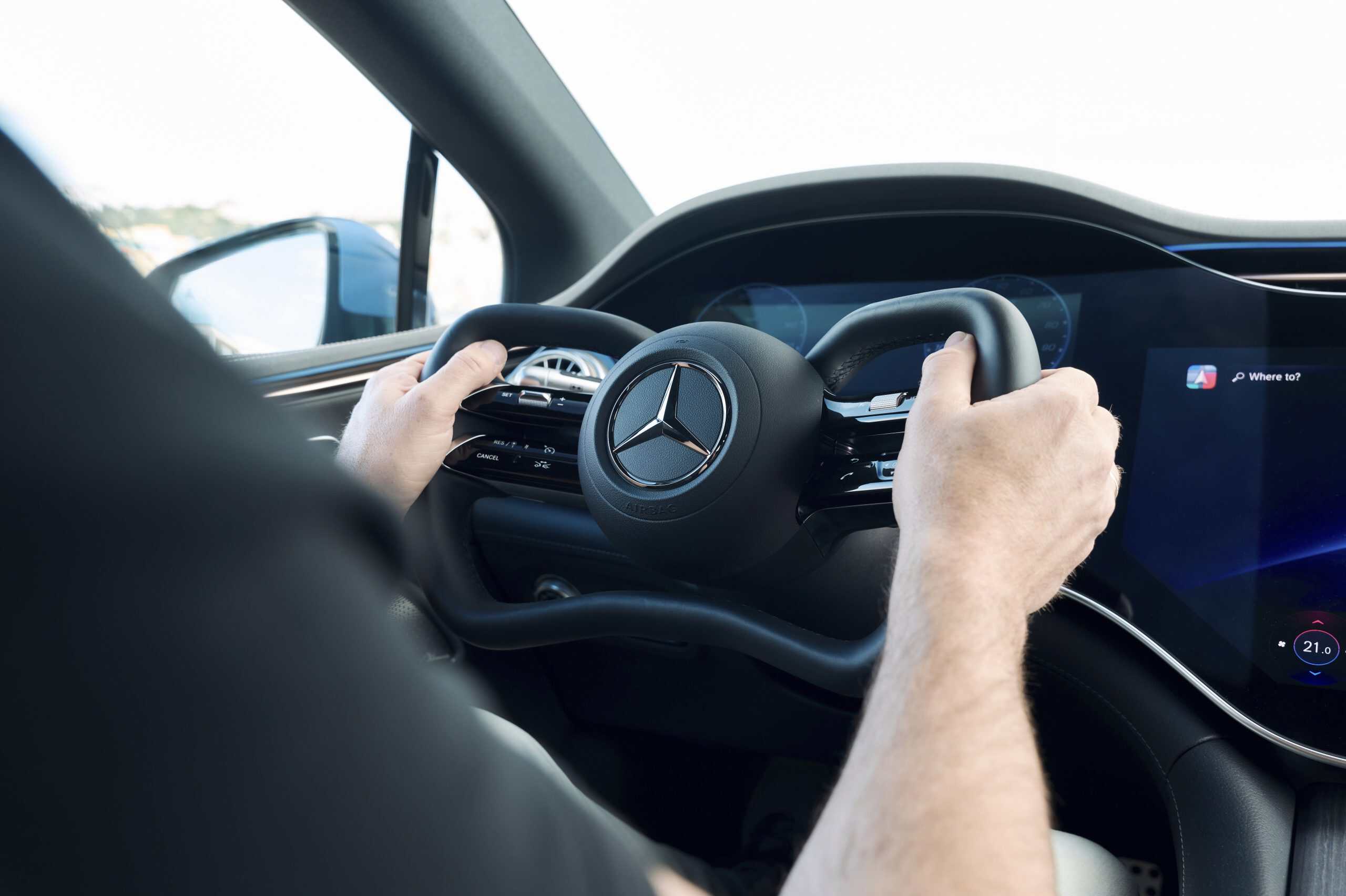
There is a visual change too. Without a mechanical column passing through the dashboard, Mercedes has flattened the steering wheel design, opening up more space in front of the driver and improving the sightline to the instrument display. It also makes getting in and out of the car easier, which sounds minor until you consider that the EQS is a large, low-slung sedan that has drawn complaints about ingress since launch.
The airbag system had to be completely redesigned to work with the new steering wheel shape. With the top of the rim removed, the airbag can no longer brace against a closed wheel during deployment. Mercedes developed an internal support and folding structure that shapes the airbag as it inflates, maintaining the same level of occupant protection as a conventional setup. It is a small detail, but it signals how much re-engineering steer-by-wire requires beyond just removing the steering column.
Steer-by-wire remains optional on the new EQS. The standard car continues with a conventional electromechanical steering system, so buyers who are not ready to trust the new technology can avoid it entirely. Mercedes has not confirmed UK pricing for the steer-by-wire option.
The bigger picture is that steer-by-wire is likely the direction all cars are heading. It gives manufacturers complete freedom to adjust steering behavior through software rather than hardware, it eliminates a heavy mechanical component from the car, and it is a prerequisite for higher levels of autonomous driving where the car needs to steer itself without a physical column in the way. The EQS is the test case. If Mercedes gets the calibration right and owners report that it feels as good as or better than a conventional system, expect to see steer-by-wire spread across the lineup within a few years.
For now, the answer to whether you should be worried is: probably not, but reserve judgment until independent reviewers have driven it. The engineering and safety case is strong on paper. The question that only real-world driving can answer is whether it feels right.
If you enjoyed this article, be sure to follow us on Microsoft Start.

Leave a Comment
More in News

Can an Electric AMG Actually Replace the V8? Here’s What We Know About the New GT 4-Door

2026 Mitsubishi Outlander Plug-In Hybrid Mid-Cycle Refresh Pricing To Start At $43,245

World premieres of new GLE and GLS marked by five-millionth model assembled at MBUSI in Tuscaloosa

Fans asked. Nissan answered: The manual Z NISMO and more for 2027

Laufey x Lexus Present: Blue in Green Edition RZ
Trending on Motoring Chronicle

Subaru of Indiana Automotive Begins Hybrid Production

Hyundai IONIQ 9 Secures Top Honors for Safety, Quality and Reliability

Breaking point: unexpected bill of £772 enough to make Brits want to replace car

Production milestone for BMW Group Plant Hams Hall: British engine plant celebrates 25 years