Mastering a new era of aerodynamics with the Bugatti Tourbillon [Photo Gallery]

06 BUGATTI BTS Episode 6
Image courtesy Bugatti
06 BUGATTI BTS Episode 6
Image courtesy Bugatti

In June 2024, the Bugatti Tourbillon made its first appearance on the global stage, with the highly acclaimed World Premiere at the marque’s home in Molsheim. It is an automobile conceived in every way to push the boundaries of possibility – a philosophy most spectacularly manifested in its advanced aerodynamic design. In the latest episode of A New Era, Bugatti’s world-class engineers and aerodynamicists uncover the art of creating a new hyper sports car that masters the forces of air.

The first step in crafting one of the world’s most aerodynamically sophisticated road-cars started with a simple idea: to create a step-change from the masterpieces that have come before. “The Tourbillon’s predecessor, the Chiron², was already a low-drag car. But with the Tourbillon, we need to do better than that,” emphasized Paul Burnham, Bugatti’s Chief Vehicle Engineer for the Tourbillon.

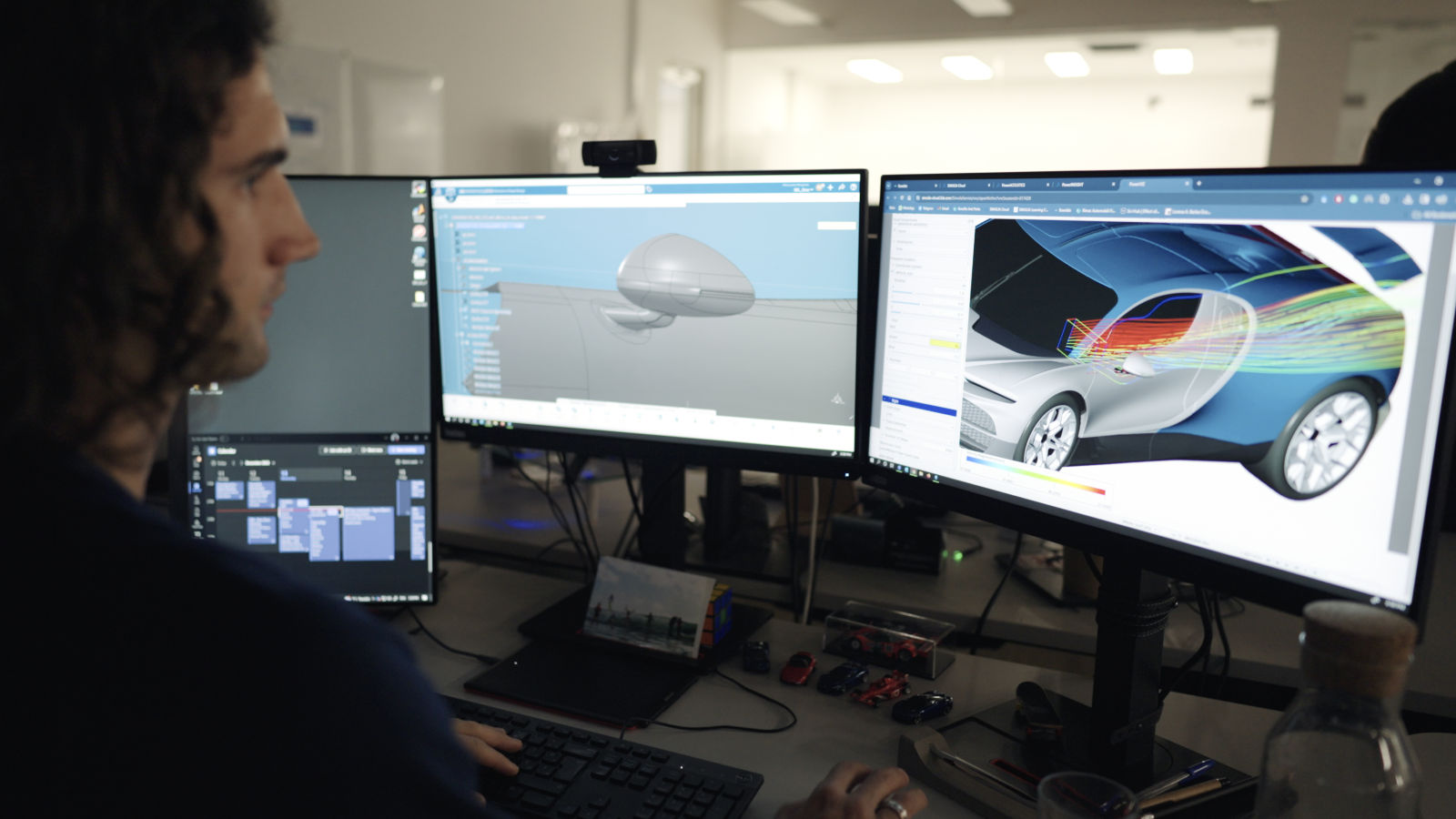
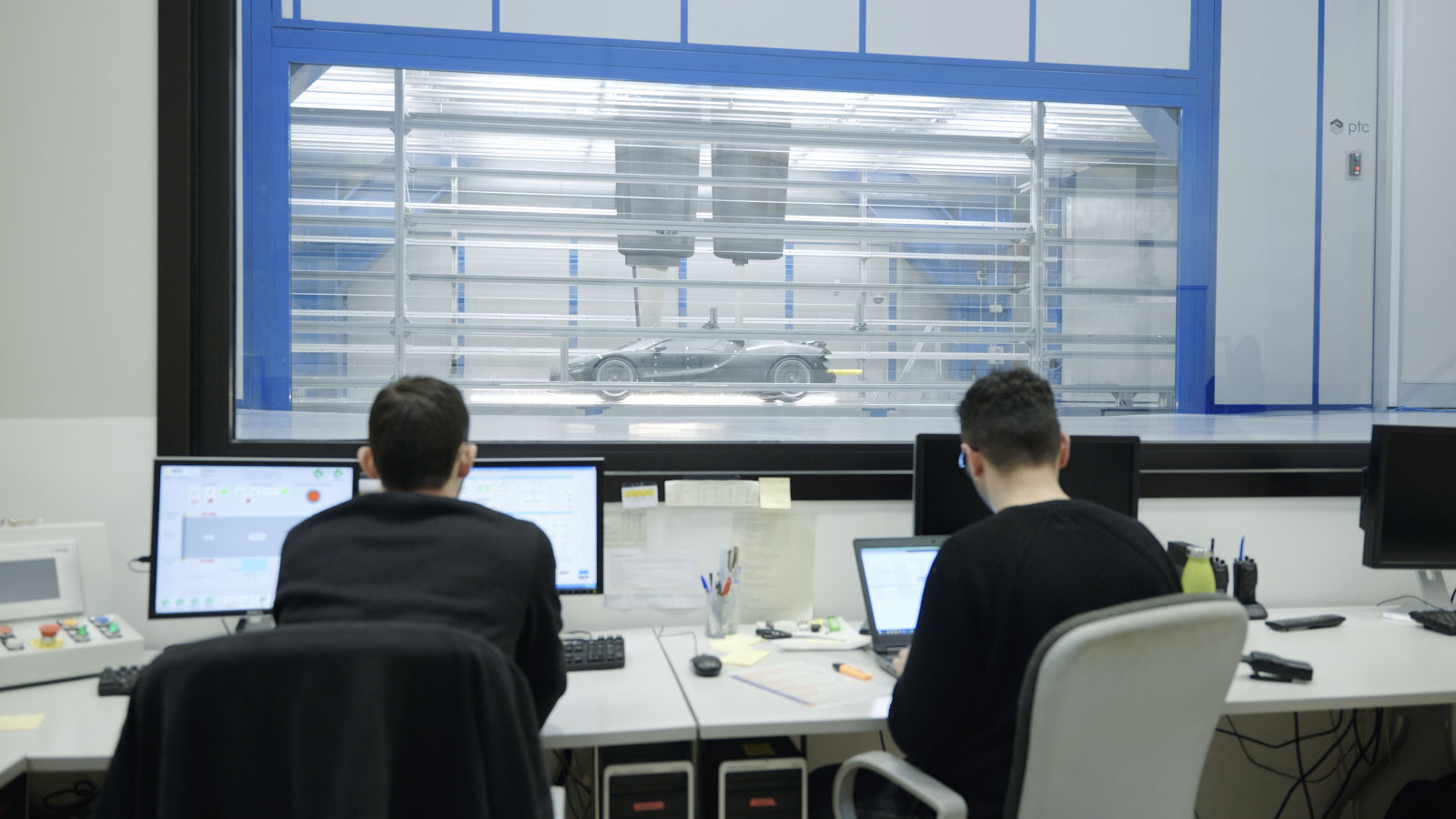
Taking the concept of aerodynamic performance further than the top-speed world record-breaking Chiron, started at a conversely small point in the development process. With the foundation laid for Bugatti’s next hyper sports car by the marque’s design and engineering teams, months of CFD (Computational Fluid Dynamics) simulations gave them a first idea of the performance to come. For the next step, fifteen months prior to the Tourbillon’s reveal to the world, a collective of some of Bugatti’s finest engineers and aerodynamicists congregated at a state-of-the-art wind-tunnel facility in Italy – their focus a beautifully constructed half-scale model of the Tourbillon.

“This test represents the first validation of the scale-model. This is the first test in which we assess different design-volumes, and different changes to the car. By exchanging parts, we steer the car towards the pursuit of high-speed performance, shifting later on in the process to handling efficiency and dynamic ability.”

DAVID ŠOŠTARIĆ – HEAD OF AERODYNAMICS AT BUGATTI RIMAC

The model at the center of the fastidious testing program is itself a work of art. Perfectly mirroring the shape of what would evolve to become the Tourbillon, the test-subject was meticulously crafted from 250 individual, 3D-printed components, fitted with over 100 pressure taps around the model’s body-panels.

Such extensive measures, precisely placed across its exterior form, served a critical purpose in the Tourbillon’s aerodynamic development. Correlating every single point relating to mass-flow measurements, static pressure points, and air velocities, the instruments were carefully analyzed by the Tourbillon’s aerodynamic engineers to validate their expected performance profile for the car, scrupulously developed in the virtual world with cutting-edge simulation tools.

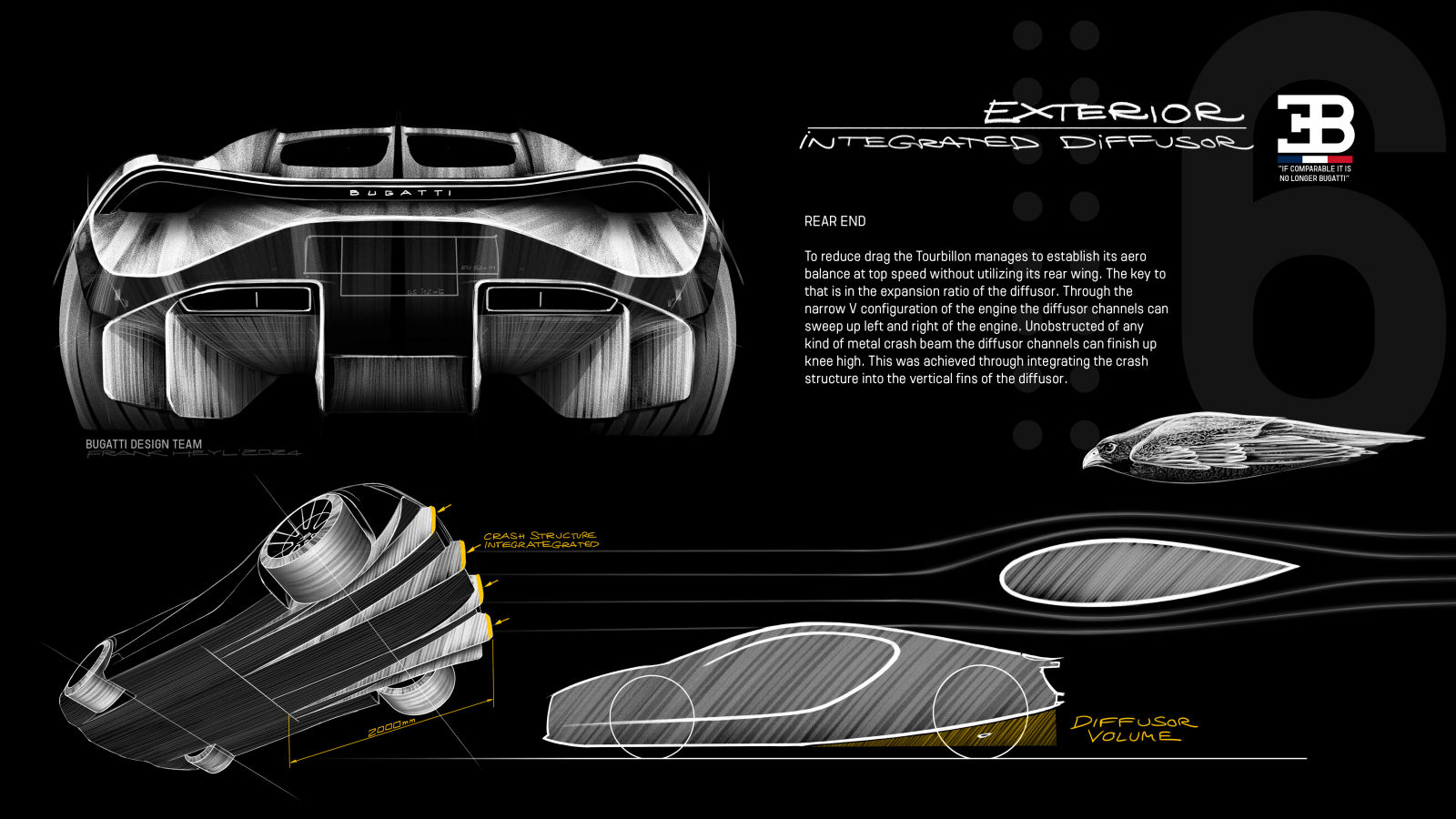
Lowering the intricate frontal area of the car; integrating a highly advanced rear diffuser; shrinking the glass house of the cockpit’s exterior profile and its aerodynamic impact – throughout the Tourbillon, Bugatti’s aerodynamicists and engineers fused data-led insight with their industry-leading expertise to enhance the vehicle’s design, creating a powerful evolution from the Chiron.

The ultimate objective for the teams’ masterful work was therefore clear throughout the Tourbillon’s development: optimizing drag-coefficient and airflow over the entire car. The scores of hours, days and months in achieving this mission, thus come together to realize the dynamic ability set as the benchmark for performance. The dedication and skill poured in takes the concept of Bugatti hyper sports car capabilities to unprecedented heights – so much so that the Tourbillon can reach its top speed without its rear wing deployed, yet remaining highly stable.

As the intricate process of correlating the simulation models to real test results and part-development gained pace, the size of the Tourbillon itself grew over the next year from model, to full-sized prototype – an evolution that saw the scale of the wind tunnel facilities grow commensurately.

“We’ve moved on from a scale-model wind tunnel to a full-sized facility, continuing our program of validating the Tourbillon’s aerodynamic performance. Only now, we are using a full-scale prototype, which represents a natural step in enhancing calibration of our simulation tools, getting that next degree of accuracy in results.”

PAUL BURNHAM – BUGATTI’S CHIEF VEHICLE ENGINEER FOR THE TOURBILLON

The culmination of an intensive project over years of passion-fueled craft, the first, experimental-prototype phase thus reaffirmed the aerodynamics teams’ carefully curated simulation projections – setting the stage for creating yet more sophisticated prototypes and, ultimately, the final manifestation of Bugatti’s new era.

“The Tourbillon is a completely new program; we started really from scratch. We are merging over a century of expertise in combustion-engine power, with state-of-the-art electric performance. The new hybrid system is a significant change from Bugatti models of the past and makes the cooling system much more complex. But that’s why we have taken the detail to the next level; looking intensively at the airflows through the radiator channels at the front, through to the intakes behind the door within the iconic Bugatti C-line, to ensure that our digital simulations align with the physical model and deliver enough cooling to manage the car’s performance. The Tourbillon has been created by teams dedicated to the pursuit of perfection. Everyone has been fully committed to making the Tourbillon a new benchmark for the automotive industry, and it is a true testament to the skill and passion that has fueled its development.”

PAUL BURNHAM – BUGATTI’S CHIEF VEHICLE ENGINEER FOR THE TOURBILLON

Watch the full episode ‘A New Era: Master of Air’ on the official Bugatti YouTube channel.

Jarrod

Jarrod Partridge is the founder of Motoring Chronicle and an FIA accredited journalist with over 30 years of experience following motorsport and the global automotive industry. A member of the AIPS International Sports Press Association, Jarrod has covered Formula 1 races and automotive events at venues around the world, bringing first-hand insight to every race report, car review, and industry analysis he writes. His work spans the full breadth of motoring — from the latest EV launches and road car reviews to the cutting edge of motorsport competition.

Leave a Comment

More in News

LONDON - Red double decker buses and other traffic.

Why Northern Ireland Could Soon Ban Drivers From Overtaking Stationary Buses Near Schools

A consultation on whether Northern Ireland should introduce new rules ...
The pumps and sign of the Texaco Petrol Station on Bath Road

What HMRC Advisory Fuel Rate Changes From June 1 Mean for Company Car Drivers

HMRC is increasing its advisory fuel rates for company car ...
Freedom or safety for young drivers? UK can and must deliver both, says GEM 11/05/2026 SHARE: Images are for editorial use only. Experts gathering at Young Driver Focus in London on 13 May to press for action, not further delay Young drivers remain disproportionately at risk, with preventable deaths continuing on UK roads International evidence shows graduated driver licensing can cut crashes by up to 40% GEM Motoring Assist will return to the RAC Club, London, on 13 May as headline sponsor of Young Driver Focus 2026, renewing calls for decisive action to improve protection for newly-qualified drivers. Despite years of evidence and advocacy, the UK has yet to introduce a comprehensive system of graduated driver licensing (GDL) - a move GEM and other road safety groups say is costing young lives. GEM head of road safety James Luckhurst said: “We are long past the point of asking whether we should act. The evidence is overwhelming, and the consequences of delay are measured in lives lost and families devastated.” GDL is a phased approach that allows new drivers to gain experience under lower-risk conditions before progressing to full driving privileges. Common measures include limits on late-night driving and restrictions on carrying same-age passengers during the months after passing the test. International research consistently shows crash reductions of between 20% and 40% where GDL systems are in place. In some regions of Canada, reductions in young driver deaths have exceeded 80%. In the UK, drivers aged 17 to 24 account for around 20% of road deaths, despite making up just 7% of licence holders. Inexperience, distraction and overconfidence remain key risk factors - precisely the issues GDL is designed to address. GEM stresses that a well-designed system supports rather than penalises young people, and a recent TRL review1 found no significant negative impact on access to education, employment or social activity. GEM supports a system that extends structured learning, reduces known high-risk conditions and allows young drivers to build skills progressively and safely. GEM head of road safety James Luckhurst said: “We do many things well in the UK, particularly in driver training, but the current system offers too little structured support once someone passes the test. That’s where the real risk begins. “The choice is simple: continue with a system we know is failing too many young people, or take proven steps that will save lives. Doing nothing is not a neutral position - it is a decision with consequences… and Young Driver Focus offers a chance to translate the latest insight into real-world action.”

What the Mileage Allowance Jump From 45p to 55p Means for Every UK Driver

The tax-free mileage allowance for UK workers using their own ...
Young caucasian man stressed driving car at street

How the Cost of Owning a Car in the UK Has Hit £11,500 a Year

A decade ago, running a car in Britain cost around ...
GEM Motoring Assist warning about red light runners at UK junctions

Running a Red Light Is a Gamble With Other People’s Lives

Road safety body GEM Motoring Assist has issued a fresh ...

Trending on Motoring Chronicle

Freedom or safety for young drivers? UK can and must deliver both, says GEM 11/05/2026 SHARE: Images are for editorial use only. Experts gathering at Young Driver Focus in London on 13 May to press for action, not further delay Young drivers remain disproportionately at risk, with preventable deaths continuing on UK roads International evidence shows graduated driver licensing can cut crashes by up to 40% GEM Motoring Assist will return to the RAC Club, London, on 13 May as headline sponsor of Young Driver Focus 2026, renewing calls for decisive action to improve protection for newly-qualified drivers. Despite years of evidence and advocacy, the UK has yet to introduce a comprehensive system of graduated driver licensing (GDL) - a move GEM and other road safety groups say is costing young lives. GEM head of road safety James Luckhurst said: “We are long past the point of asking whether we should act. The evidence is overwhelming, and the consequences of delay are measured in lives lost and families devastated.” GDL is a phased approach that allows new drivers to gain experience under lower-risk conditions before progressing to full driving privileges. Common measures include limits on late-night driving and restrictions on carrying same-age passengers during the months after passing the test. International research consistently shows crash reductions of between 20% and 40% where GDL systems are in place. In some regions of Canada, reductions in young driver deaths have exceeded 80%. In the UK, drivers aged 17 to 24 account for around 20% of road deaths, despite making up just 7% of licence holders. Inexperience, distraction and overconfidence remain key risk factors - precisely the issues GDL is designed to address. GEM stresses that a well-designed system supports rather than penalises young people, and a recent TRL review1 found no significant negative impact on access to education, employment or social activity. GEM supports a system that extends structured learning, reduces known high-risk conditions and allows young drivers to build skills progressively and safely. GEM head of road safety James Luckhurst said: “We do many things well in the UK, particularly in driver training, but the current system offers too little structured support once someone passes the test. That’s where the real risk begins. “The choice is simple: continue with a system we know is failing too many young people, or take proven steps that will save lives. Doing nothing is not a neutral position - it is a decision with consequences… and Young Driver Focus offers a chance to translate the latest insight into real-world action.”

What the Mileage Allowance Jump From 45p to 55p Means for Every UK Driver

The tax-free mileage allowance for UK workers using their own ...
Mulliner Dreams – 2

Realising the dream: a very special Speed Six [Photo Gallery]

Many a Bentley owner’s love of the marque begins in ...
flat-tire-6660469_1280

Flat Tyre Fix: No Spare? No Problem!

A flat tire (tyre) without a spare feels like the ...

The EU Wants To Shut UK Cars Out Of Its Market. Here Is What That Could Mean for Prices

The European Commission's proposed Industrial Accelerator Act includes a "Made ...