
Four Superbrains for the Neue Klasse: More intelligent, more efficient, more powerful.
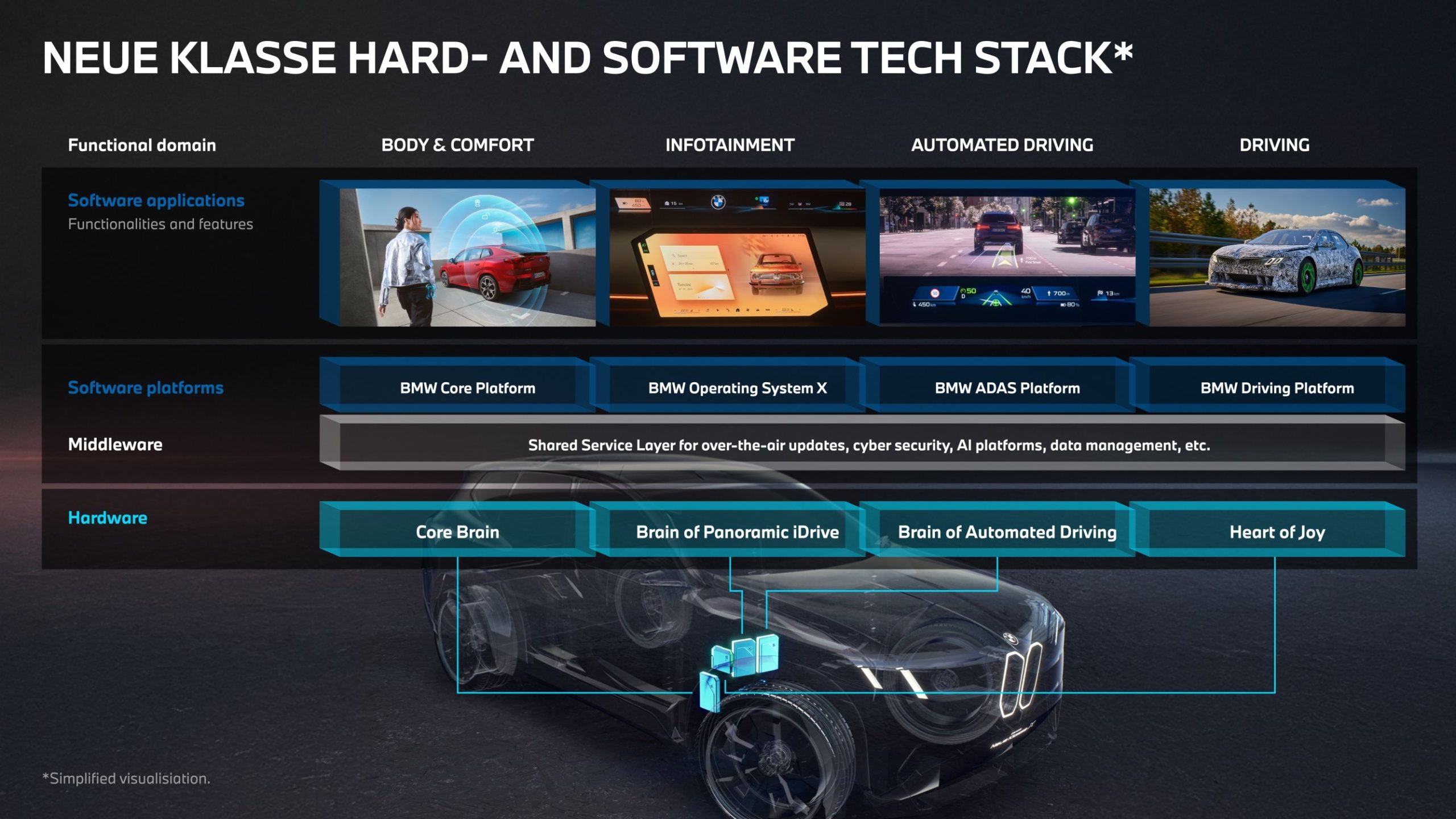
The BMW Group is the first automotive manufacturer to launch a completely newly developed digital nervous system for all drivetrain variants and vehicle segments. It is more intelligent, more powerful and more efficient and will be rolled out for the first time in the models of the Neue Klasse. Four high-performance computers, also called “Superbrains“, consolidate the computing power for the most important customer functions: infotainment, automated driving, driving dynamics, and basic functions such as vehicle access, climate control, and comfort. The four Superbrains provide more than 20 times the computing power compared to the current vehicle generation and are already designed for upcoming software and function updates, including AI-powered customer experiences.
“Technology openness is the key to BMW’s success. Starting with the first model of the Neue Klasse, we will roll out the technologies of the Neue Klasse across the entire future model portfolio – across all segments and all drivetrains. This also applies to our completely newly developed electronic architecture made up of powerful ‘Superbrains’ and highly interconnected software platforms. This architecture allows us to decouple the development of the vehicle and software from each other. The advantage: More than ever before, all future BMW models will remain digitally up to date via over-the-air upgrades and will receive updates even from the next and subsequent vehicle generations,” says Frank Weber, Board Member for Development at BMW AG.
A fundamental component of the digital nervous system is the radically simplified wiring harness. It is based on a so-called zonal wiring harness architecture, which uses 600 meters less wiring and brings 30% weight savings compared to the previous generation. The wiring harness is divided into four zones: front end, center, rear and roof. The Superbrains are connected via high-speed data connections to smaller control units, the zonal controllers, which manage and consolidate the data flow of the electronics in and out of the zones. The wiring in the vehicle is therefore zone-related and can thus be shorter, thinner, and lighter.
A crucial prerequisite for thinner and lighter wiring are the so-called “Smart eFuses”. These are digital fuses that replace up to 150 traditional fuses. Smart eFuses can be intelligently programmed for digitally controlled energy distribution to components. The selective activation of components allows for the design of intelligent power modes for various vehicle states such as driving, parking, charging, and upgrading, in which unnecessary consumers can be identified and switched off. Thus, the eFuses make a significant contribution to the 20% improved energy efficiency.
The completely newly developed electronic architecture forms the basis for the next generation SDV. From the launch of the Neue Klasse, the upcoming BMW model generation will benefit from it. The first fully electric derivative of the Neue Klasse will go into series production later this year at the Debrecen plant (Hungary).
The advanced software architecture of the BMW Group builds on this new electronic architecture. With the multitude of digital functions in SDVs, it is crucial that functions can be continuously developed on stable software platforms rather than being newly developed for every new generation. This is precisely what is achieved with the Neue Klasse. In the vehicle the software platforms run on the respective Superbrains, and the vehicle functions run on top of them. The “Shared Service Layer” acts as a connecting element (middleware) and provides, among other things, state-of-the-art cybersecurity and flexible over-the-air updates. It also enables customer-relevant AI functions thanks to intelligent networking of cross-domain data sources.
“With the introduction of the Neue Klasse, we are entering a mode of software development where we achieve software continuity. This means we continuously develop software rather than starting from scratch each time,” says Christoph Grote, Senior Vice President BMW Group Electronics and Software. “Based on our advanced software architecture and the fact that today our global development teams generate 130 times more software than ten years ago, we see ourselves in an excellent competitive position. More than ever, our software developers can focus on product innovations.”
For the Neue Klasse, the development teams are working on well over 1,000 software modules, over 20 GB of software, and over 500 million lines of code, which will ultimately be integrated into the Superbrains and the rest of the electronic architecture in the vehicle. To achieve this, the BMW Group has established a solid foundation for future-proof and highly effective vehicle software development in recent years. Innovative methods and tools have been anchored in the continuously growing global developer network. At the heart of vehicle software development is the integrated developer environment: a tailored tool-chain called “CodeCraft.” The speed and quality of development have been enhanced with the use of a variety of tools that support the software developer with generative AI. CodeCraft runs in the cloud on up to 75,000 virtual CPUs, supports the simultaneous work of well over 10,000 software developers, and records up to 200,000 software builds per day at peak times. This corresponds to a productivity increase of more than 130 times compared to ten years ago.
Leave a Comment
More in News

7 Steps To Successfully Change Your Oil

How long does oil last in a car not driven?

How to Check Tyre Tread Properly
Bentayga ‘X’ Concept revealed at FAT Ice Race as part of new Bentley Partnership

Second Annual Honda National Technician Contest a Success
Trending on Motoring Chronicle
Q by Aston Martin unveils Palm Beach Edition DB12 Volante
750S Le Mans special edition celebrates 30th anniversary of McLaren’s iconic debut victory

Gaming on the go: Audi integrates AirConsole
Timeless Elegance: A Journey Through the Decades at Salon Privé Blenheim Palace 2024 [Photo Gallery]