
Can an Electric AMG Actually Replace the V8? Here’s What We Know About the New GT 4-Door


Mercedes-AMG has confirmed that the next-generation GT 4-Door Coupe will be fully electric, and it is currently completing its final validation testing in northern Sweden ahead of a world premiere later this spring. For anyone who has associated AMG with the hand-built V8s that defined the brand for decades, this is the moment the transition becomes real.
The question most AMG buyers will be asking is simple: can three electric motors deliver the kind of driving experience that made the 63 and 73-series cars worth the price premium over a standard Mercedes? Based on what AMG has revealed about the car’s hardware, the answer might be more encouraging than skeptics expect.
The centerpiece of the new GT 4-Door is a system AMG calls RACE ENGINEER, and it is genuinely different from the drive mode selectors found in every other performance EV on sale today. Where a Porsche Taycan or BMW i4 M50 gives you a choice between preset driving modes, the AMG system hands the driver three independent rotary controllers that each adjust a separate element of the car’s behavior.
The first dial controls throttle response, adjusting how aggressively the electric motors react to pedal input. The second adjusts the car’s cornering balance by varying the torque split between front and rear axles, effectively changing the car’s handling character from stable understeer through neutral to controlled oversteer. The third controls traction slip across nine stages, determining how much wheelspin the car will allow before intervening.
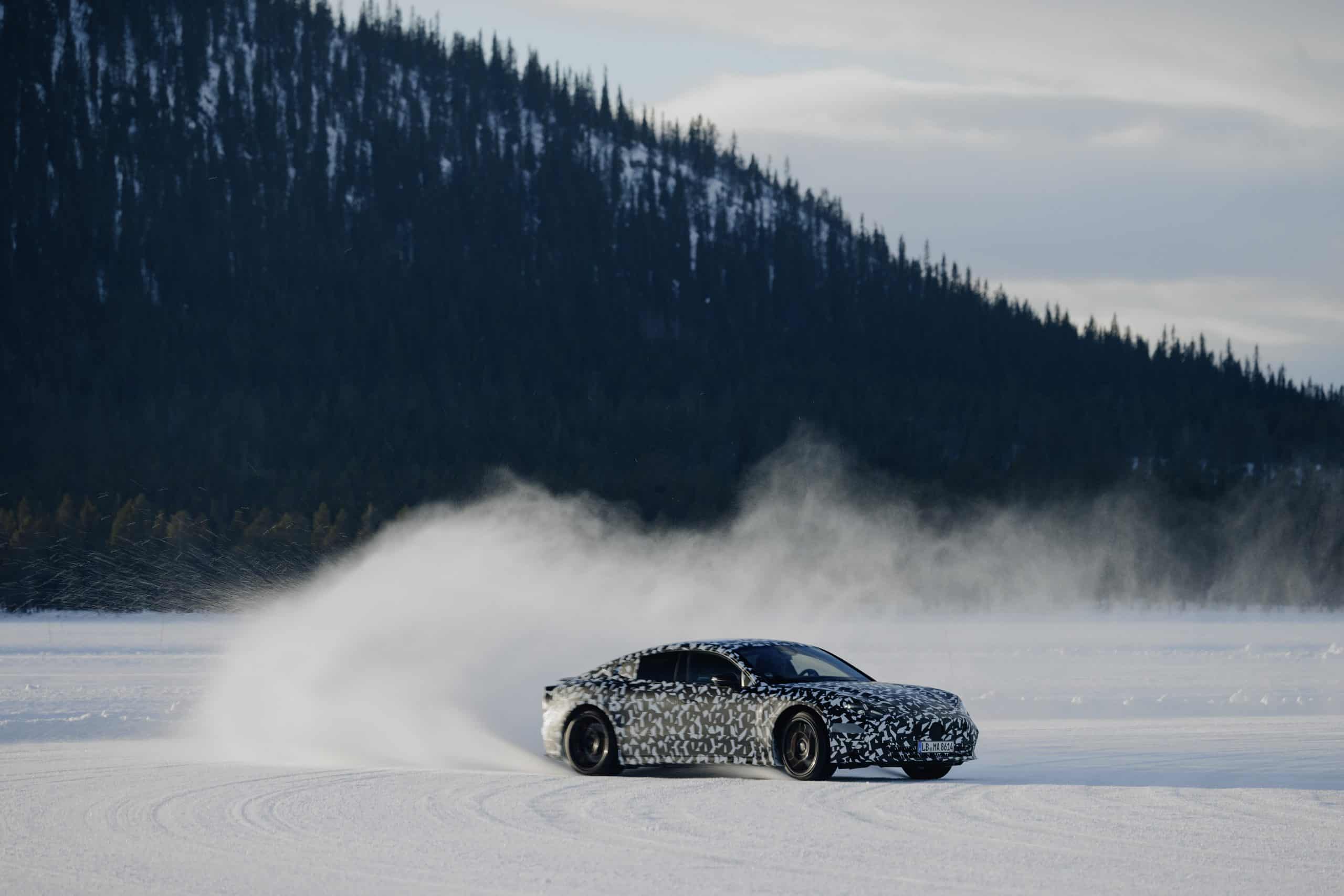
In practice, this means two drivers could set the same car up in completely different ways for the same stretch of road. One might want sharp throttle response with a stable rear end. Another might want a lazy pedal map with loose traction control for drifting. That level of granularity does not exist in any current production EV, and it borrows directly from the approach AMG used in the GT R and GT Black Series on track.
There is a catch. The full range of adjustment for the cornering and traction dials is only available with the stability control switched off, which limits the system’s usefulness to track days and closed courses. With ESP on, only the throttle response dial remains active. That is a sensible safety decision, but it does mean the most interesting part of the system is locked away from everyday road driving.
The drivetrain itself uses three axial flux motors, a type of electric motor that is smaller and lighter than the conventional radial flux units found in most EVs. One motor drives the front axle, two drive the rear, and each rear motor can send different amounts of torque to each wheel independently. AMG claims this is the first time a fully electric performance car has combined axial flux motors with a fully variable all-wheel drive system that can also decouple the front axle entirely for rear-wheel drive running.
That last point matters. One of the persistent criticisms of all-wheel drive performance EVs is that they always feel like all-wheel drive cars, with the front axle pulling the nose into corners rather than letting the rear push it through. If AMG’s system can genuinely switch between RWD and AWD in real time based on what the driver is asking for, it would address one of the biggest dynamic compromises in the segment.
Braking uses a hybrid setup with carbon ceramic discs on the front axle and conventional steel discs on the rear. AMG says this combination delivers a consistent pedal feel whether the car is slowing through regenerative braking, friction braking, or a blend of both. That is worth noting because brake feel has been a weak point in several high-performance EVs, where the transition between regen and mechanical braking can feel vague or unpredictable.
The suspension is an air system with active roll stabilization, replacing traditional anti-roll bars with a hydraulic setup that can vary its stiffness depending on the driving situation. According to AMG, it can run fully soft when cruising in a straight line, then firm up significantly during hard cornering. The system uses an 8.2-liter pressure accumulator for rapid height adjustment, and AMG claims the setup also improves electric range by lowering the car at higher speeds.
On the battery, AMG has revealed that the cells are directly cooled by an electrically non-conductive oil that flows around each individual cell. The focus, according to the engineering team, was on repeatable performance: the ability to do multiple fast laps without significant power reduction from heat buildup. That has been a weak point for several performance EVs, including early versions of the Taycan Turbo, so if AMG has genuinely solved thermal management for sustained track use, it would be a meaningful selling point.
What AMG has not revealed is equally telling. There are no power or torque figures yet. No 0-62 time. No range estimate. No pricing. The company is clearly holding back the headline numbers for the spring reveal, which suggests confidence that those figures will make an impact when they land.
For buyers currently considering a Porsche Taycan, BMW i4 M50, or even the upcoming electric Audi RS e-tron GT, the new AMG GT 4-Door is going to be the car to wait for before making a decision. The RACE ENGINEER system alone sets it apart from anything else in the segment on a hardware level. Whether that translates to a genuinely better driving experience will depend on calibration and software, which is something that can only be judged when the car reaches production spec.
The world premiere is expected before summer 2026. Pricing will almost certainly place it above the current Taycan Turbo, which starts at around £131,000 in the UK. For that kind of money, AMG needs to prove that an electric GT can deliver an emotional experience, not just a fast one. The V8 was never just about speed. It was about sound, drama, and a mechanical connection between car and driver that no electric motor has yet replicated. That is the real benchmark the new GT 4-Door will be measured against.
If you enjoyed this article, be sure to follow us on Microsoft Start.

Leave a Comment
More in News

Mercedes Is Removing the Mechanical Link From Your Steering. Should You Be Worried?

2026 Mitsubishi Outlander Plug-In Hybrid Mid-Cycle Refresh Pricing To Start At $43,245

World premieres of new GLE and GLS marked by five-millionth model assembled at MBUSI in Tuscaloosa

Fans asked. Nissan answered: The manual Z NISMO and more for 2027

Laufey x Lexus Present: Blue in Green Edition RZ
Trending on Motoring Chronicle
Aston Martin Valhalla: the ultimate driver’s supercar [Photo Gallery]
Feeling The Track: Bugatti Bolide Owners Take on Circuit Paul Ricard [Photo Gallery]
One-of-a-kind MC20 Maserati per Maserati [Photo Gallery]

A Lamborghini gateway to Courchevel [Photo Gallery]
