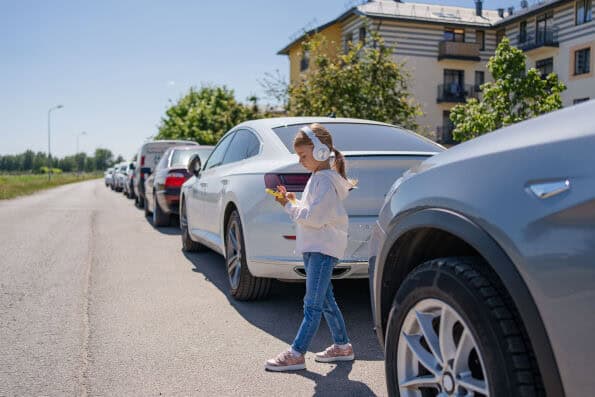
VW Emergency Assist Plus Can Now Steer an Unresponsive Driver to the Shoulder


- Volkswagen’s Emergency Assist Plus can now steer an unresponsive driver’s car to the road’s shoulder, activate hazards, and call for help on its own.
- A new rearview camera on the 2027 Atlas, ID. Buzz, and Tiguan can detect pedestrians behind the vehicle and apply the brakes automatically at low speed.
- The updates land on 2027 Atlas, Golf, ID. Buzz, and Tiguan models, building on driver assistance already standard across the VW lineup.
A Car That Can Pull Itself Over When the Driver Can’t
Volkswagen is adding a fail-safe to its driver assistance lineup that can take over if the person behind the wheel becomes unresponsive. The updated Emergency Assist Plus feature, part of a wider round of 2027 model year changes to the brand’s IQ.DRIVE system, can guide a car to the shoulder, put it in park, and call for help without any input from the driver.
How Emergency Assist Plus Works
The feature builds on VW’s existing Emergency Assist, which already ships standard on every Volkswagen in the US lineup alongside Front Assist, Active Blind Spot Monitor, Rear Traffic Alert, Adaptive Cruise Control, and Lane Assist. Emergency Assist Plus activates two ways. With Lane Assist engaged, it triggers if the car detects several lane departures in a row without driver correction. With Travel Assist engaged, it triggers if the system senses no steering input for 25 seconds.
Once triggered, the car first tries to get the driver’s attention. Under Lane Assist, it gives visual and audible warnings. Under Travel Assist, the horn honks, the brakes pulse three times, and the seatbelt tightens. If nothing works, the front camera checks for space on the shoulder and steers the car there, or to the rightmost lane if the shoulder is not clear. Brake lights and turn signals warn nearby traffic as the car pulls over, and hazards start flashing once it stops. Volkswagen says the system also shifts the car into park, unlocks the doors, turns on the interior lights, and places an emergency call.
“The protection and peace of mind of our customers is fundamental to all of us at Volkswagen,” said Thomas Zorn, Vice President, Vehicle Safety, Volkswagen of America. “We already offer one of the most comprehensive packages of ADAS features on the mass market. These improvements to the existing features reflect our ongoing commitment to helping drivers navigate the road with greater confidence through continuous innovation.”
A Rearview Camera That Watches for People
Certain trims of the 2027 Atlas, ID. Buzz, and Tiguan add a new Rearview Camera System that can spot pedestrians behind the car while reversing. If someone walks behind the vehicle at speeds between 1 and 6 mph, the system applies the brakes on its own to help avoid a collision, on top of the standard rear traffic alert already fitted across the lineup.
Smarter Lane Changes and Cruise Control
Travel Assist, VW’s semi-automated highway driving system, now allows driver-initiated lane changes on more models. Above 45 mph, a driver flicks the turn signal partway and the car checks its rear radar sensors before completing the move. A wait-to-clear function holds the lane change for up to 12 seconds if traffic is in the way, shown through arrow graphics in the digital instrument cluster.
Predictive Adaptive Cruise Control also gets smoother for 2027. The system now lets drivers accept a higher speed limit sooner after the car reads a new sign, cutting the delay between seeing the sign and the cruise control catching up. It also works on highway ramps, slowing the car and guiding it through an exit using GPS map data or a driver’s turn signal.
The 2027 ID. Buzz adds one more layer: Road Experience Management data, delivered through the In-Vehicle Premium subscription. The system pulls in real-world data from other connected vehicles on lane markings, signage, and street lighting, which helps the ID. Buzz stay centered in a lane even where the paint on the road has faded. A one-year trial of In-Vehicle Premium comes with the 2027 ID. Buzz, alongside a turn-by-turn route guidance feature, AirConsole in-vehicle gaming, What3Words location search, and a Wi-Fi hotspot.
Which Models Get the Upgrade
The new features land across VW’s 2027 lineup built on the MQB Evo and MEB platforms: the Atlas family, Golf family, ID. Buzz, and Tiguan. Not every update reaches every model. The Rearview Camera System with pedestrian detection is limited to certain trims of the Atlas, ID. Buzz, and Tiguan, while the Road Experience Management data is specific to the ID. Buzz’s subscription package.
Volkswagen has not released pricing for the 2027 model year updates. The changes add to a driver assistance package the brand already markets as one of the most complete standard packages on any mass-market brand sold in the US, competing with similar systems offered by Honda, Toyota, and Hyundai.
Much of this round of updates comes free to owners who already have a 2027 Atlas, Golf, ID. Buzz, or Tiguan on order. Aside from the Road Experience Management data tied to the ID. Buzz’s In-Vehicle Premium subscription, the Emergency Assist Plus and pedestrian-detecting rearview camera features are built into the vehicle’s standard driver assistance suite rather than sold as extras. Volkswagen says specific trim availability for the new Rearview Camera System will vary by model, so shoppers cross-checking a build sheet should confirm which trims include it before assuming every 2027 Atlas, ID. Buzz, or Tiguan gets the upgrade.

Leave a Comment
More in News
Which Side Is the Accelerator and Brake?

How to Tell if a Car Was Written Off Before You Buy It

2027 Jeep Wrangler JL-2A Special Edition Adds Retro Style for Just $115 More
What Actually Happens If You Ignore an MOT Advisory

What California’s New Mirrored License Plate Format Means for Your Car
Trending on Motoring Chronicle
Hyundai IONIQ 6 N makes its Canadian Debut at the 2026 Canadian International Auto Show

Porsche celebrates fifty years since the original audacious adventure [Photo Gallery]

Bentley breaks the ice with FAT International

UK Drivers Face £200 in French Tolls and €140 Fines for Missing Stickers