
What Does S Mean on a Gear Shift?


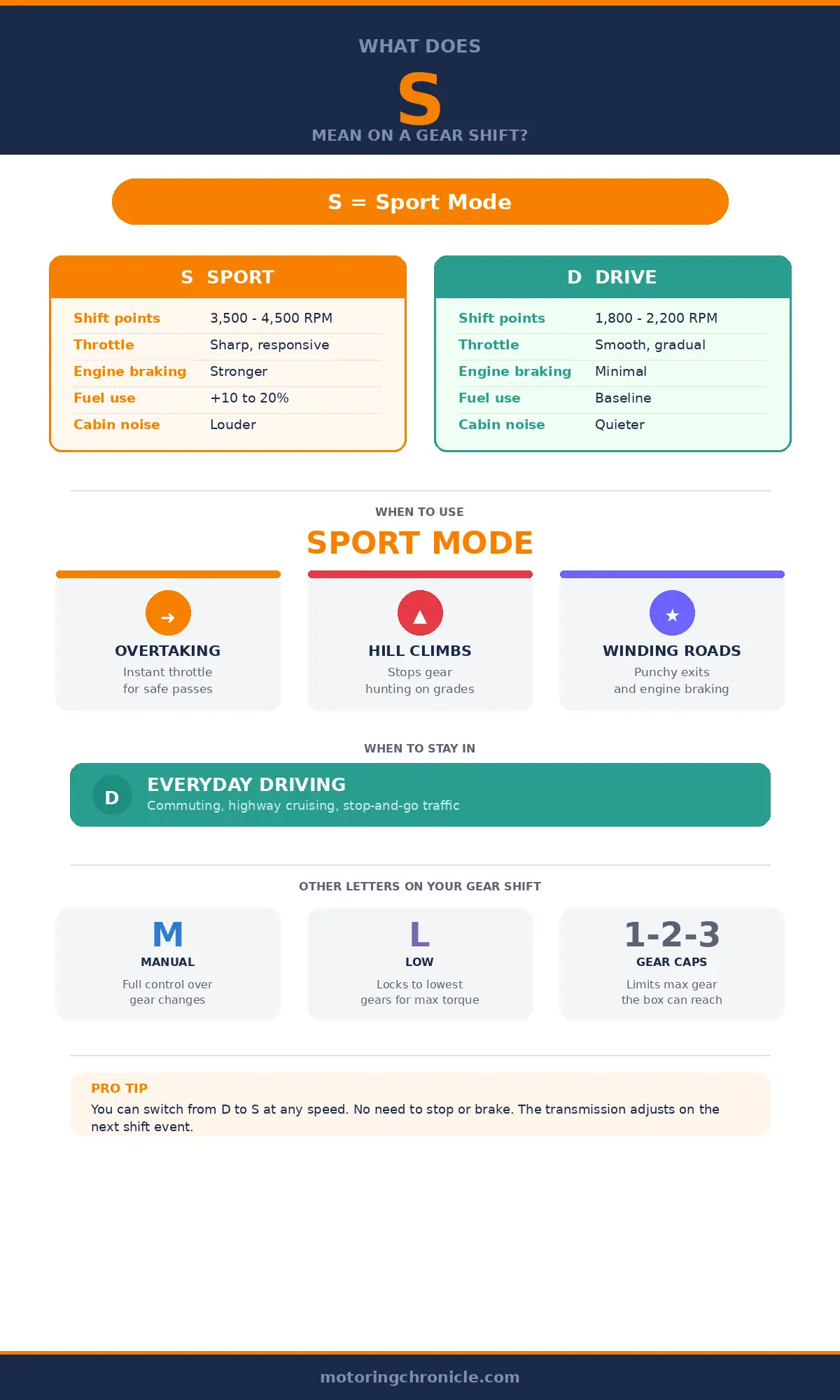
- The S on your gear shift activates Sport mode, which holds each gear longer at higher RPM for faster acceleration and stronger throttle response.
- Use S mode for overtaking, hill climbing, and spirited driving on open roads. Switch back to D for everyday commuting and highway cruising to save fuel.
- Sport mode will not damage your transmission, but running it full-time can increase fuel consumption by 10 to 20 percent over standard Drive mode.
How Sport Mode Changes the Way Your Transmission Shifts
Every automatic gear shift has a D for Drive. Most also have an S sitting right below it, and a large number of drivers have never moved the selector past D to find out what happens next. The S stands for Sport mode. Selecting it tells the transmission control module to change its shift strategy, holding each gear longer and allowing the engine to rev higher before the next upshift. The result is a noticeably different driving experience from the same vehicle, using the same engine, on the same stretch of road.
What S Mode Does Inside the Transmission
Shift Points and RPM Changes
In standard Drive mode, the transmission control module shifts up as early as it can to keep the engine at low RPM. This reduces noise, vibration, and fuel consumption. The shift points are calibrated for comfort and economy. On a typical sedan, the gearbox might shift from second to third at around 2,200 RPM under light throttle.
In Sport mode, the module raises those shift points. The same second-to-third upshift might not occur until 3,500 to 4,500 RPM, depending on the manufacturer. The engine stays in the meat of its power band for longer, which means more torque is available at the wheels during each gear. The downshift thresholds also change. A light tap on the accelerator in D mode might not trigger a downshift; the same tap in S mode drops the transmission a gear immediately for faster response.
This altered shift map is the core of what Sport mode does. The engine, drivetrain, and brakes remain mechanically identical. The software simply allows the engine to work harder within each gear before moving on.
Throttle Response and Pedal Mapping
On many vehicles, S mode also recalibrates the electronic throttle. The accelerator pedal becomes more sensitive in the first half of its travel. A quarter-press of the pedal in D mode might open the throttle body to 20 percent. The same quarter-press in S mode might open it to 35 or 40 percent, delivering a sharper initial burst of acceleration.
This change in pedal mapping makes the vehicle feel quicker even before the transmission has shifted differently. The combination of a more aggressive throttle map and higher shift points creates a driving experience that feels significantly more responsive. For drivers who have noticed their car hesitating when pressing the accelerator, switching to S mode removes much of that sluggish feeling by eliminating the conservative throttle calibration built into D mode.
S Mode Compared to D Mode
The Practical Differences on the Road
D mode prioritizes fuel economy and smooth ride quality. The transmission shifts up early, the throttle map is gentle, and the vehicle settles into the highest available gear as quickly as conditions allow. For daily commuting, school runs, and long highway trips, D mode is the correct setting. It keeps the engine quiet, reduces fuel costs, and places the least amount of stress on drivetrain components over time.
S mode reverses those priorities. It favors acceleration, engine braking, and responsiveness over economy and silence. The trade-off is a measurable increase in fuel consumption. Running in Sport mode full-time can increase fuel use by 10 to 20 percent compared to D mode on the same route. That increase adds up quickly for drivers covering significant weekly mileage. Understanding how throttle behavior and gear selection affect your consumption is the same principle covered in maximizing fuel economy when accelerating.
Cabin noise also rises noticeably. Higher RPM means a louder engine, and the vehicle spends less time in its quietest cruising gears. On a highway run in D mode at 70 mph, a four-cylinder engine might sit at 1,800 RPM. In S mode at the same speed, the tachometer could read 2,800 to 3,200 RPM. The difference is audible from inside the cabin.
When Each Mode Makes Sense
D mode is the right choice for flat highways, city commuting, and any situation where smooth, efficient progress is the goal. S mode earns its place on twisting back roads, highway on-ramps where quick merging speed is needed, steep uphill climbs where extra torque prevents the gearbox from hunting between gears, and open stretches of road where the driver wants a more engaging experience behind the wheel.
Switching between the two is seamless on every automatic transmission that offers the option. Moving the selector from D to S while driving at any speed will not cause a jolt or damage the gearbox. The transmission simply adjusts its shift strategy on the next available shift event.
The Other Letters on Your Gear Shift
What M, L, and the Numbers Mean
The S is not the only letter below D that confuses drivers. Many automatics also feature M, L, or numbered positions. Each one gives the driver a different level of manual control over the gearbox.
M stands for Manual mode. Selecting M allows the driver to shift gears up and down using either the gear lever (pushing it forward for up and backward for down, or vice versa depending on the manufacturer) or paddle shifters mounted behind the steering wheel. The transmission will hold whatever gear the driver selects until the driver changes it or the engine reaches its rev limiter, at which point most systems will force an upshift to protect the engine. Manufacturers use different brand names for this feature. Porsche calls it Tiptronic. BMW calls it Steptronic. The function is the same across all of them.
L stands for Low. Selecting L locks the transmission into its lowest one or two gears. This is useful for steep descents where maximum engine braking is needed, for crawling through deep snow or mud, or for any situation where the driver needs strong, low-speed torque without any upshifting. The transmission stays in a low ratio regardless of engine speed until conditions become unsafe, at which point the control module will intervene.
Some older automatics display numbers (1, 2, 3) instead of letters. These represent gear caps. Selecting 2 prevents the transmission from shifting above second gear. Selecting 3 caps it at third. These are functionally similar to L and S, giving the driver control over how high the gearbox is allowed to shift. Modern vehicles have largely replaced these numbered positions with S and M modes, which accomplish the same goal with more refined electronic calibration.
When to Use Sport Mode
Overtaking and Highway Merging
Merging onto a busy highway from a short on-ramp requires fast acceleration over a brief distance. In D mode, pressing the accelerator hard triggers a kickdown, but there is a brief pause as the transmission selects a lower gear and the engine climbs to its power peak. In S mode, the transmission is already sitting in a lower gear at higher RPM, so the response to throttle input is almost immediate. The vehicle reaches merging speed faster and with less drama.
The same logic applies to overtaking on two-lane roads. When a safe gap appears in oncoming traffic, the window for passing is limited. S mode removes the delay between pedal input and forward thrust, making the maneuver quicker and more predictable.
Hilly and Mountainous Terrain
On uphill grades, D mode often causes the transmission to hunt between two gears as it tries to balance economy with the increased load. The gearbox shifts up, realizes it does not have enough torque, shifts back down, regains speed, and shifts up again. This constant cycling generates heat in the transmission fluid and wears internal clutch packs faster than steady operation in a single gear.
S mode raises the shift points high enough that the transmission holds a lower gear through the climb without hunting. The engine works harder, but the gearbox operates in a stable, predictable pattern. On the descent, the higher RPM provides useful engine braking that reduces the load on the brake system.
Spirited Driving on Open Roads
On a winding country road with minimal traffic, Sport mode turns a standard automatic sedan into a more engaging machine. The sharper throttle response and delayed upshifts make cornering exits feel punchy, and the stronger engine braking on corner entry reduces the need for constant brake pedal use. This is the scenario the engineers designed S mode for, and it is where the feature feels most natural.
When Not to Use Sport Mode
Daily Commuting and Stop-and-Go Traffic
In heavy traffic, the aggressive throttle mapping of S mode makes smooth, low-speed driving harder. The pedal becomes twitchy at crawling speeds, and the transmission holds lower gears that keep the engine revving higher than needed for the pace of traffic. Fuel consumption climbs, cabin noise increases, and the ride quality suffers. D mode is calibrated for exactly this kind of driving, and it handles it with less effort from the driver and less fuel from the tank.
Long Highway Cruising
At steady highway speeds on flat terrain, the engine needs very little power to maintain velocity. D mode selects the highest gear available, drops the RPM to its lowest point, and lets the engine loaf. S mode prevents that top gear from engaging and holds the engine at elevated RPM for no practical benefit. Over a 300-mile highway trip, the fuel penalty from running in Sport mode adds up to a tangible cost. For drivers looking to improve their gas mileage, leaving S mode off during long highway stretches is one of the simplest adjustments available.
Will Sport Mode Damage My Transmission?
No. The transmission is engineered to operate across the full range of parameters that S mode uses. The higher RPM, delayed shifts, and increased engine braking are all within the designed operating envelope of the gearbox and engine. Manufacturers would not include the mode if it risked component damage under normal use.
The practical concern is not damage but wear rate. Running at higher RPM for extended periods generates more heat, consumes more fuel, and places greater demand on engine oil and transmission fluid compared to D mode. None of these factors cause immediate harm, but over tens of thousands of miles of exclusive Sport mode use, fluid degradation and component wear will accumulate faster than they would under the gentler D mode calibration. Using S mode when conditions call for it and switching back to D for routine driving is the approach that balances performance with long-term reliability.
Sport Mode FAQs
Can I switch from D to S while driving?
Yes. Moving the gear selector from D to S at any speed is safe and will not damage the transmission. The gearbox adjusts its shift strategy on the next available shift event. There is no need to slow down, stop, or press the brake pedal before making the change.
Does every automatic car have an S mode?
Not every one. Sport mode is common on mid-range and higher-trim vehicles, but some economy-focused automatics offer only D and L. Some manufacturers integrate sport mode through a separate button on the dashboard or center console rather than a position on the gear lever itself. Check your owner’s manual for the specific layout of your vehicle.
Is S mode the same as manual mode?
No. S mode still shifts automatically. It simply uses a more aggressive shift map with higher RPM thresholds. Manual mode (M) gives the driver full control over individual gear changes and will hold a selected gear until the driver commands a shift or the engine hits its rev limit.
Does Sport mode make my car faster?
It makes the car accelerate more quickly from low and mid-range speeds by keeping the engine in its strongest power band. It does not increase the engine’s peak power output or raise the vehicle’s top speed. The mechanical hardware remains unchanged. The difference is in how the existing power is delivered.
Sources

Leave a Comment
More in News

Why Brake Fluid Needs Changing Every Two Years (and What It Costs)
Why Your Car Pulls to One Side (and What a Wheel Alignment Costs)

How to Tell if a Slow Puncture Is Repairable (and What It Costs)

How to Check and Top Up Your Car Coolant Without Damaging the Engine
What a New DVLA Eyesight Test Could Mean for 6 Million Older Drivers
Trending on Motoring Chronicle

The new 911 Cup – stronger performance for the successful one-make model [Photo Gallery]

The control center of performance: The interior of the new Mercedes-AMG GT 4-Door Coupe
High Performance in New York City: With the MINI John Cooper Works through the Big Apple [Photo Gallery]
Dashcam Reports to Police Pass 230,000 With Two in Three Leading to Action
